Developing a Nursing Perspective
NURS-FPX4005Nursing Leadership: People, Processes and Organizations
NURS-FPX4015Pathophysiology, Pharmacology, and Physical Assessment
NURS-FPX4025Research and Evidence-Based Decision Making
NURS-FPX4035Enhancing Patient Safety and Quality of Care
NURS-FPX4045Nursing Informatics
NURS-FPX4055Optimizing Population Health through Community Practice
NURS-FPX4065Patient-Centered Care Coordination
NURS-FPX4905Capstone Project for Nursing
NHS-FPX5004Communication, Collaboration, and Case Analysis for Master's Learners
NHS-FPX6004Healthcare Law and Policy
NHS-FPX6008Economics and Decision Making in Health Care
NURS-FPX6011Evidence-Based Practice for Patient-Centered Care and Population Health
NURS-FPX6016Quality Improvement of Interprofessional Care
NURS-FPX6020Advanced Nursing Practice 1: Biopsychosocial Concepts
NURS-FPX6026Biopsychosocial Concepts for Advanced Nursing Practice 2
NURS-FPX6080MSN Practicum: Professionalism in Person-Centered Care and the Workplace Environment
NURS-FPX6085MSN Practicum and Capstone
NURS-FPX6100The Role of Nurse Educators
NURS-FPX6108Curriculum Overview: Design, Develop and Evaluate
NURS-FPX6112Technology Integration for Nursing Education
NURS-FPX6116Nursing Education Assessment and Evaluation
NURS-FPX6200Management and Leadership for Nurse Executives
NURS-FPX6222Healthcare Safety and Quality Management
NURS-FPX6224Healthcare Technology and Informatics
NURS-FPX6226Advanced Operations and Finance Management
NURS-FPX6400Nursing Informatics Fundamentals
NURS-FPX6422Clinical Information Systems and Application to Nursing Practice Analysis
NURS-FPX6424Data Mining to Advance Healthcare
NURS-FPX6426Nursing Informatics Life Cycle Management
NURS-FPX6620Care Coordination Healthcare Models
NURS-FPX6622Care Coordination Structure and Process
NURS-FPX6624Care Coordination Ethical and Legal Considerations
NURS-FPX6626Care Coordination Leadership
NHS-FPX8002Written by Evelyn Prather, DNP
NURS-FPX8004Written by Evelyn Prather, DNP
NURS-FPX8006Written by Evelyn Prather, DNP
NURS-FPX8008Person-Centered Care in Doctoral Practice
NURS-FPX8020Doctoral Executive Leadership in Contemporary Nursing
NURS-FPX8022Nursing Technology and Advanced Healthcare Information Systems
NURS-FPX8024Advanced Global Population Health
NURS-FPX9000Reviewed by Evelyn Prather, DNP
NURS-FPX9010Reviewed by Evelyn Prather, DNP
NURS-FPX9020Doctor of Nursing Practice 3
NURS-FPX9030Reviewed by Evelyn Prather, DNP
NURS-FPX9040Doctor of Nursing Practice 5
RSCH-FPX7864Quantitative Design and Analysis
MHA-FPX5001Foundations of Master's Studies in Healthcare Administration
MHA-FPX5006Healthcare Finance and Reimbursement
MHA-FPX5010Strategic Healthcare Planning
MHA-FPX5012Organizational Leadership and Governance
MHA-FPX5014Healthcare Quality, Risk, and Regulatory Compliance
MHA-FPX5016Introduction to Health Information Systems
MHA-FPX5017Data Analysis for Healthcare Decisions
MHA-FPX5020Health Administration Capstone
MHA-FPX5028Comparative Models of Global Health Systems
MHA-FPX5040Healthcare Administration Change Leadership
MHA-FPX5042Team Development and Personal Leadership in Health Care Settings
MHA-FPX5064Health Information Systems Analysis and Design for Administrators
MHA-FPX5068Leadership, Management, and Meaningful Use of Healthcare Technology
PM-FPX5018Project Management Foundations
MBA-FPX5002Core MBA Leadership
MBA-FPX5006Core Business Strategy
MBA-FPX5008Core Applied Business Analytics
MBA-FPX5010Core Accounting Methods for Leaders
MBA-FPX5012Core Marketing Management
MBA-FPX5014Core Applied Managerial Finance
MBA-FPX5016Core Operations Management for Leaders
MBA-FPX5910MBA Capstone Experience
No course matches that search. Ask in chat; if Capella runs it, we can usually support it within a week.
Finding your Capella FlexPath course when the code is printed differently
The Capella FlexPath courses above are stored with the hyphenated form the university uses in its own listings, NURS-FPX4025, but the search box reads the digits on their own. Typing 4025 finds it from any spelling: NURS FPX 4025 with spaces, NURS4025 with the FPX segment dropped, or FPX4025 the way some screens abbreviate it. If the code has gone missing entirely, search the title instead; population health and care coordination both resolve. The FPX in the middle marks the FlexPath section of a course, which is why it shows up on one screen and vanishes from the next.
Two things trip people up. The prefix is one: three courses in the MSN core carry NHS rather than NURS, so a search for NURS-FPX5004 or NURS-FPX6004 returns nothing while NHS-FPX5004 and NHS-FPX6004 sit in the list. Type the digits, not the letters. The specialization filter is the other. The MSN tab holds four specializations plus a shared core, and the nine core courses are identical whichever specialization you enrolled in, so a Nursing Informatics student and a Nursing Education student both land on the same NURS-FPX6011 page and both belong there.
What is on a course page, and what is in an assessment manual
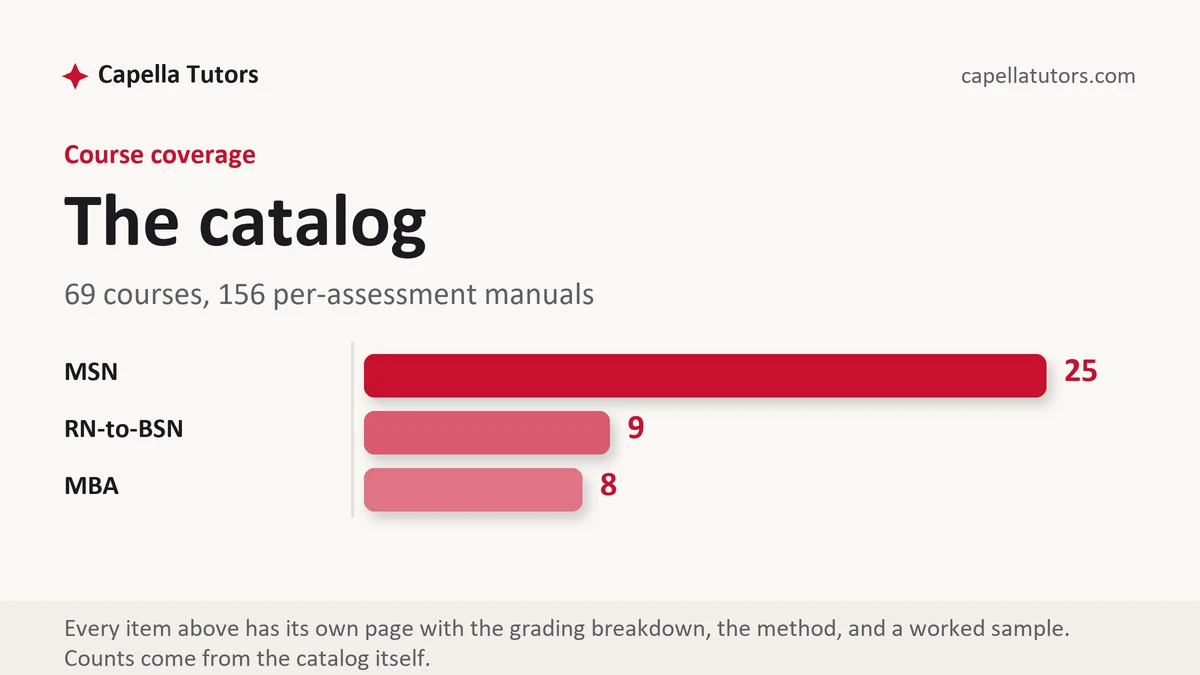
The catalog is two layers deep: forty-two course pages behind the cards above, and 156 per-assessment manuals behind those. A course page answers the questions you have before writing starts. What the course actually grades, where it sits in your billing session, its full assessment list with a line on each, how to begin, and the questions students ask about that specific code. Open it when you are deciding what goes in your two slots, or when the code is new to you and you want to know what you have walked into.
An assessment manual answers the questions you have with the scoring guide already open: how that one deliverable is scored across the four levels, the method our tutors run, a section-by-section structure with planning word targets, an annotated original excerpt with the moves marked, the mistakes that cap a strong draft at Basic, and a checklist for the hour before you submit. Where a manual and the guide attached to your assessment disagree, your courseroom wins. The manual is the method; the scoring guide is the contract.
How the RN-to-BSN, MSN and MBA sequences differ in what they grade
Three programs share this catalog and none of them grades the same way, which matters when you budget hours per assessment rather than per course.
| Sequence | What the deliverables mostly ask for | Where your hours go |
|---|---|---|
| RN-to-BSN | Practice-based writing: a problem from your own unit, current evidence appraised against it, a change argued with its barriers named. Closes with a capstone built on the earlier work. | Finding and appraising sources. The writing is short; the evidence table behind it is not. |
| MSN | The same analytical writing at wider scope, plus documented practice. Nine core courses are shared by all four specializations, with four more specific to yours. | Practicum logging. The FlexPath MSN totals 27 program points and 500 documented practicum hours, 100 carried by NURS-FPX6080 and 200 by NURS-FPX6085. |
| MBA | Computed work with an argument on top. The analytics, accounting and finance courses ask you to produce numbers, then defend a decision to a business reader. | Getting the inputs right before drafting. One wrong figure contaminates every paragraph resting on it. |
So a BSN assessment is front-loaded, most of the work happening before the first paragraph exists. An MSN practicum course is back-loaded, because hours accumulate on a calendar you do not control. An MBA assessment fails on a number rather than on an argument. Plan the slot around whichever failure mode your course carries.
When your course is not in the list yet
This catalog is deliberately smaller than everything Capella runs, because a page built on a guessed assessment list is worse than no page. If yours is missing, send three things in chat: the code exactly as your courseroom prints it, the assessment titles from the courseroom sidebar, and the scoring guide for whichever one is next.
Two absences are on purpose. The nurse practitioner tracks, FNP and PMHNP, are not here: they run on GuidedPath rather than the FlexPath MSN, and their clinical requirements are a different problem from a written assessment. Doctoral work goes through the DNP help page instead of a course page, because those deliverables are project-scale and get scoped in conversation.
Three questions students ask before clicking into a course
My courseroom lists a different number of assessments than the course page. Which is right?
Yours. Capella retires and rebuilds courses, so two learners in the same code can be on different versions of it. Use the course page for the method and the shape of the work, then map its list onto the one in your courseroom and tell us where they diverge. If your assessment is new enough to have no manual, the scoring guide is all we need to write to it.
I already have the FlexPath writing manual. Do I need the course page too?
They do different jobs. The FlexPath writing manual teaches the machinery every Capella assessment runs on: four criterion levels, the scoring guide used as an outline, the extra move that lifts Proficient to Distinguished. The course page tells you what that machinery is aimed at this time. Knowing the method and misreading the criterion still costs you the criterion.
Do you cover the GuidedPath section of the same course?
Yes. A code identifies the same content in both formats, so what a criterion asks for does not change; what changes is the clock. FlexPath moves when you submit, GuidedPath moves when the week ends, so Capella class help on GuidedPath is mostly about landing drafts ahead of fixed weekly deadlines rather than beating an evaluation queue. Name your format when you write to us and the plan comes back built for that calendar.
Course not in the list?
Send the course code. If its assessments check out against the catalog, we take it on and your first sample is free.