Help for every MBA-FPX5010 deliverable lives on this page — a premium original sample with a walkthrough, back in 24 to 48 hours. The course itself: Core Accounting Methods for Leaders, listed at 2 pts / 4 quarter credits in Capella’s MBA catalog, offered in FlexPath. Both spellings reach it, MBA5010 and MBA-FPX5010.
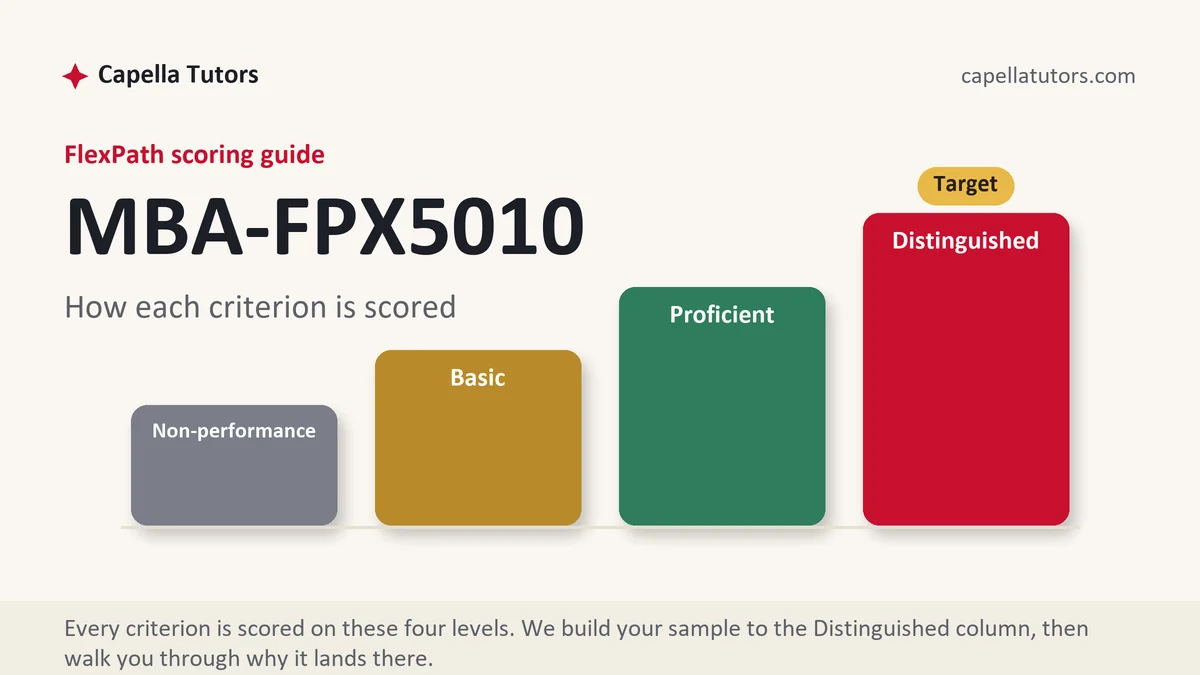
What MBA-FPX5010 actually grades
Managerial accounting written for decisions: statement analysis, costing, and budget reasoning presented to a leadership audience. The criteria want the numbers interpreted, what the ratio movement means for the decision at hand, and reliably reward students who write like a controller briefing a CEO rather than an accountant showing work.
How we help in this course
Our drafts do the accounting correctly and then do the part the rubric weighs: interpretation, implication, recommendation. If the statements themselves are the struggle, the walkthrough traces every figure to its source so the sample is also the tutorial.
Every deliverable in the course follows our standard promise: a premium original draft in 24 to 48 hours, written to the Distinguished column on FlexPath or the A rubric row on GuidedPath, through the eight-person pipeline with both QA passes, revised free until it meets target.
Assessment manuals for this course
Every assessment in MBA-FPX5010 has its own manual now: the walkthrough, the structure that maps to the criteria, an annotated sample excerpt, and the done-for-you door. Open Assessment 1, Assessment 2, Assessment 3, or start from the list in the sidebar.
In MBA-FPX5010 right now?
Send the assessment number and the scoring guide from your courseroom. First premium sample free, back in 24 to 48 hours.
Writing like a controller briefing a chief executive
The 5010 criteria reward interpretation over computation: what the ratio movement means for the decision at hand, argued to a leadership audience. Accountants showing work score Basic; managers reading statements score Distinguished, which inverts what most students expect from an accounting course. Our drafts do the accounting correctly and then spend their length where the columns spend theirs, meaning, implication, recommendation, in the register of a briefing rather than a worksheet. Ratio movements get read against the decision the case poses, because interpretation with no decision attached is still summary, and summary is what the Basic column exists to catch.
When the statements themselves are the obstacle
Some clients arrive fluent in management but lost in the debits, and the walkthrough is built for exactly that arrival: every figure in the draft traced to its source statement, so the sample doubles as the tutorial the course assumes you had. Study one walkthrough and the next assessment's numbers stop being hostile territory. That transfer is deliberate; the fewer tutorials you need, the better the engagement is working.
What does a complete scope request look like here?
Assessment number, scoring guide, and the case's financial exhibits. The same-day reply names which criteria carry weight and when the draft lands inside the 24 to 48 hour window.
How does this course fit the session plan?
It is a 2-point FlexPath course on the submit-next-on-grade loop, so fast, Distinguished-targeted turnarounds are what keep it from quietly consuming session weeks the flat rate already bought.
The assessments, one by one
Assessment 1
Statement analysis with the ratios interpreted, not recited. Read the full Assessment 1 manual.
Assessment 2
Costing and budget reasoning applied to a decision. Read the full Assessment 2 manual.
Assessment 3
The accounting synthesis that closes the course. Read the full Assessment 3 manual.
How to actually write MBA-FPX5010: where to begin
Open the scoring guide before the case. Copy each criterion into a blank document as a heading, paste its Distinguished description underneath, and only then open the financial exhibits. This order matters more here than anywhere else in the core, because the exhibits invite you to start computing, and computation with no criterion attached is the most common way strong students produce ungraded work here. A typical 5010 assessment supplies financial statements or a case with exhibits and asks you to analyze them for a management audience: statement review, ratio work, sometimes costing or budget reasoning, always ending in a recommendation someone could act on.
Then build the numbers file. Pull at least two periods of the case's income statement and balance sheet into a spreadsheet, compute the ratios your criteria call for, liquidity, profitability, leverage, efficiency as asked, for every period, and note the direction of each movement. Two more items complete the file: an industry benchmark for each ratio where one exists, and the decision the case is really posing, expand or hold, approve the budget or cut it, extend credit or refuse. Every ratio you compute should eventually face that decision.
The audience shapes the register. 5010 is accounting for leaders, so the paper is a controller's briefing, not a worksheet: findings first, method visible but subordinate, every figure traceable, every interpretation ending at the decision.
| Section | What goes in it | What Distinguished looks like |
|---|---|---|
| Introduction | The organization, the decision at hand, and a preview of your verdict. | The recommendation previewed in one sentence before any numbers appear. |
| Statement review | What the income statement and balance sheet show across periods. | Movements explained, not restated: why revenue rose, what drove the margin. |
| Ratio analysis | The assigned ratios computed across at least two periods. | Every ratio trended and benchmarked; no single-period numbers anywhere. |
| Interpretation for management | What the movements mean for the decision the case poses. | Competing signals weighed openly, profitability against liquidity, instead of picked. |
| Recommendation | The committed call, its risks, and what to monitor next. | Limits of the data named, a monitoring measure attached to the call. |
Developing the analysis
Ratios only mean something in motion and in company. A current ratio of 1.8 is a fact; a current ratio that fell from 2.4 to 1.8 across three periods while inventory swelled is an argument about deteriorating liquidity, and that argument is what the criteria price. Work every ratio the same way: state the value, state the trend across periods, set it against the benchmark, and say what it means for the decision. Where the signals conflict, and in good cases they do, weigh them openly instead of picking the convenient one, because weighing competing evidence is usually the exact move the Distinguished column names. Then close at the decision: reporting that margins compressed is Basic, arguing that compressing margins plus rising leverage make the proposed expansion unaffordable this cycle is Distinguished. Show enough method that a reader can trace any figure to its statement, and keep the arithmetic clean, because one bad ratio poisons every section built on it.
Citations that survive faculty review
A numbers paper still carries an evidence criterion, and 5010 evaluators enforce it. Cite the case exhibits or company filings for every figure; cite an industry data source for each benchmark, since the library's databases in the IBISWorld style carry ratio benchmarks by sector; and cite current peer-reviewed or authoritative accounting sources for interpretation claims. If you analyze a real public company, its 10-K is the primary source and gets a full APA reference. Keep interpretation sources within roughly five years, reach everything through the Capella library and ABI/INFORM, and put author and date inside the sentence making the claim. The textbook can anchor definitions, but a paper citing only the textbook reads as a floor performance, and the guide has a column for that.
The mistakes that land Basic instead of Distinguished
- Computation without interpretation. A page of correct ratios with no argument attached is the accountant showing work, and the criteria grade the manager reading them.
- Single-period ratios. A number with no trend and no benchmark cannot support a conclusion, and evaluators notice immediately.
- No decision at the end. Analysis that never answers the case's question leaves the heaviest criteria unscored.
- Arithmetic errors. One wrong ratio propagates through every section that uses it, and the revision cycle it triggers costs you session time.
- Worksheet register. Dense tables with thin prose invert the grading weight; the prose is the product, the tables are its exhibits.
MBA-FPX5010 questions students actually ask
How much accounting do I need to already know?
Managerial literacy, not a CPA's toolkit. The course assumes you can read an income statement and a balance sheet and compute standard ratios from given formulas; it grades what you conclude from them for a management decision. Students who arrive weak on the mechanics close the gap fastest by rebuilding one exhibit in a spreadsheet by hand, because tracing each figure once teaches more than rereading the chapter.
What if I am not sure my ratio math is right?
Verify before you interpret, because everything downstream depends on it. Recompute each ratio in a spreadsheet with cell formulas rather than a calculator, check that the inputs come from the right statement lines, and sanity-check against the prior period, since a ratio that doubles in one period usually means a wrong input, not a corporate transformation. Keep the spreadsheet; if an evaluator questions a figure, the trail answers in minutes.
Do I really need outside sources in an accounting paper?
Yes, for two named jobs: benchmarks and interpretation. Saying a ratio worsened requires only the exhibits; saying it is now weak for the industry requires an industry source, and saying what the trend implies for the decision is stronger with an authoritative voice behind it. Two or three well-used sources beyond the case usually satisfy the evidence criterion; a reference list padded with uncited textbooks does not.