FlexPath bills a flat rate per 12-week session no matter how many courses you complete, so pace is tuition. Our expedite plan runs your two course slots at full speed: every assessment written to Distinguished in 24 to 48 hours, submitted the moment the previous one is graded, a course pair closing in about a week. On that cadence a bachelor's typically finishes in one billing session, a master's in two, and a doctorate in three, and every session you skip is a session Capella never bills.
Why FlexPath rewards speed like no other format
Three verified format rules combine into the opportunity. Billing is flat per 12-week session, with unlimited course completions inside it. Enrollment allows two courses at a time, and finishing one auto-registers you into the next, so there is never idle time between courses. And deadlines are yours: target dates you set and adjust, an engagement touch at least every 28 days, up to 12 weeks per course.
Put plainly: the format was built so a fast writer pays less. The catch is that most students are not fast writers on top of a job and a family, and evaluation queues punish drift. That gap between the format's promise and a working adult's week is exactly what the plan closes.
The plan, mechanically
Both slots full, always
Two courses active from day one of the session. Your tutorship manager builds the target-date calendar in the first 12 days and adjusts it as gradings return.
Every assessment in 24 to 48 hours
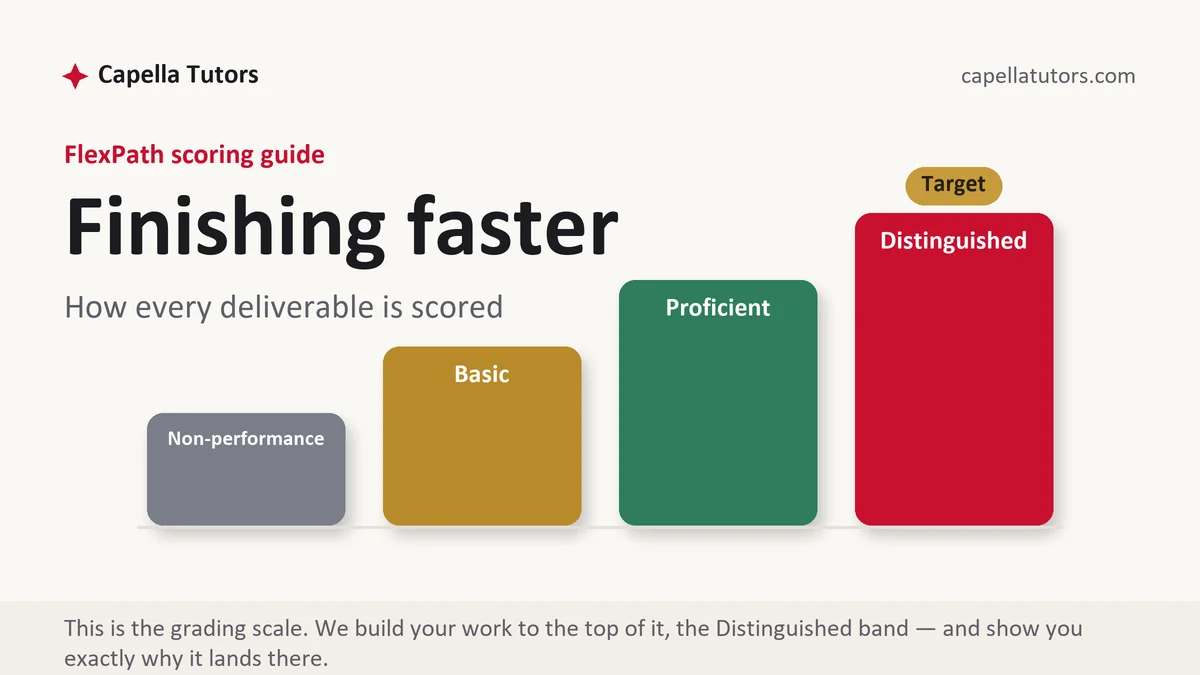
Each deliverable runs the eight-person pipeline and comes back written to the Distinguished column of its scoring guide, with a walkthrough so you own the material.
Submit on grade, never on a schedule
The moment an assessment is graded, the next one goes in. FlexPath queues are the real bottleneck, so we keep yours permanently loaded.
A course pair closes about weekly
Auto-registration rolls you forward, the calendar re-plans, and the cycle repeats until the catalog is empty.
Doctoral programs run the same loop with one honest difference: doctoral evaluations take longer per assessment, which is why doctoral plans budget three sessions rather than one.
The numbers, at Capella's published rates
| Program | Typical pace, going alone | On the Expedite Plan | You keep |
|---|---|---|---|
| RN-to-BSN | 24+ months, 8 sessions, $20,600-$28,240 | ~12 weeks, 1 session, $2,575-$3,530 | $18,000-$24,700 |
| MSN | 24+ months, 8 sessions, $21,120-$24,600 | ~24 weeks, 2 sessions, $5,280-$6,150 | $15,800-$18,450 |
| DNP | 36+ months, capped at $32,000 | ~36 weeks, 3 sessions, $10,200-$10,440 | up to $21,800 |
Session rates used: bachelor's $2,575-$3,530, master's $2,640-$3,075, doctoral $3,400-$3,480 per 12-week session, as published on Capella's tuition page in July 2026. Capella markets its fastest quartile finishing the RN-to-BSN in under 9 months for under $11,000; most students are not in that quartile, and the typical-pace figures above are what the same catalog costs at one course at a time. Resource kits and your program's exact rate vary. Planning math, not a quote. Run your own numbers in the calculator.
The fine print that actually matters
- Federal aid has a pacing rule. Aid-funded students must engage a unique course each session and maintain minimum program points. The plan's calendar is built around this, but if you use federal aid, tell your manager on day one.
- Practicum hours do not compress the same way. Clinical courses carry hour requirements alongside the writing. Our virtual practicum support keeps those moving in parallel so they never stall a session.
- The 12-day window sets your rhythm. Target dates are chosen in each course's first 12 days. Plans that start mid-session still work; they just plan the remaining weeks honestly.
- You still learn the material. Every sample arrives with its walkthrough, and you revise and submit your own version. The speed comes from never facing a blank page, not from skipping the learning.
Start with this session
Tell us your program, how many courses remain, and where you are in the current session. Your manager returns the expedite calendar and the first premium sample free.
Sources and verification
Facts on this page come from official and independent sources, and anything that matters is worth checking against the originals:
- www.capella.edu: Capella University's official site, the primary source for program, FlexPath, and tuition facts
- www.capella.edu/online-degrees: the official online degree directory
- www.hlcommission.org: Higher Learning Commission, the institutional accreditor
- www.ccneaccreditation.org: Commission on Collegiate Nursing Education, the nursing accreditor
- apastyle.apa.org: APA Style, the official style authority behind the formatting rules
How sessions, points, and hours combine when you expedite your Capella degree
Three numbers govern any plan to expedite your Capella degree, and only one of them answers to writing speed. Sessions are billed flat every 12 weeks. Program points are fixed by your catalog and do not shrink. Practicum hours, where your program carries them, are worked in real time on real shifts. The FlexPath MSN shows the interaction cleanly: 27 program points across thirteen courses, nine core and four in your specialization, alongside 500 documented practicum hours. Coursework support empties the catalog faster and cuts how many sessions you are exposed to. It does nothing at all to the hours.
Run the arithmetic. Thirteen courses across two slots is six pairs and one single, seven cycles, and at a pair closing in about a week the writing side occupies roughly seven to eight active weeks. That fits inside one 12-week session with room to spare. Now add the hours. 500 documented hours across two sessions, about 24 weeks, is close to 21 hours a week without a break; compressed into a single session it would be over 40 a week, a second job stacked on the one you already have. That calculation, not the drafting, is why the table above budgets two sessions for a master's. NURS-FPX6080 carries 100 of those hours and NURS-FPX6085 carries 200, so 300 of the 500 sit inside two named courses; where the remaining 200 are logged is what your program handout specifies, and that is the first thing to confirm with your advisor.
Moving fast and moving early in the week are different skills
Speed gets the attention; timing does the quiet work. Faculty have two business days to evaluate an attempt, and business days skip Saturday and Sunday. Run one revision loop from two starting points. Submit Monday: the result is back Wednesday, the fix goes in Wednesday, the second result lands Friday, and the loop closes inside one working week. Submit Thursday: the result waits until Monday, the fix goes in Monday, the second result lands Wednesday, and the loop has eaten a weekend and spilled into a second week. Two days of calendar and one weekend, for identical work. Do that once per course and a program's worth of small timing choices becomes the session you did or did not have to buy.
Where students actually lose weeks
- Paperwork started after the coursework. Placements, site agreements, and preceptor confirmations run on other people's calendars. Your program handout sets what is required, and the students who lose a session are the ones who read it in month two.
- The queue entered on a Thursday. Priced in the section above: two days and a weekend, every time.
- Topic churn. Where later assessments build on an earlier choice, changing the clinical problem afterwards means redoing graded work. Pick the well-studied problem first and keep it.
- Waiting on a grade before writing. The next assessment should already be outlined when the current one returns. Idle waiting is the one expense a flat rate does not cover.
A realistic plan for a working nurse
Three twelve-hour shifts leaves four days, and they are not four equal days. The shape that holds up: two off days protected as writing days the way you protect a shift; every submission on a Monday or a Tuesday, which usually means finishing the file on your last off day of the week before; practicum hours banked in blocks on a fixed weekday rather than an hour at a time, because scattered hours are the ones that go undocumented; the calendar re-planned the day a grade returns, not on Sunday night. Then be honest on day one. If your rotation cannot produce roughly twenty documented hours a week, budget three sessions instead of two, and read how aid and FlexPath billing interact before you compress anything.
Questions about expediting, answered straight
Can I really finish an MSN in two billing sessions?
The writing side fits comfortably. The hours decide it. Two sessions works when you can document roughly twenty practicum hours a week alongside the coursework and your placement paperwork cleared before session one. If either is shaky, three sessions is the honest plan.
Do the practicum hours have to wait for the practicum courses?
Sequencing is your program's call and your handout is the authority. Mechanically: NURS-FPX6080 and NURS-FPX6085 are the practicum-designated MSN courses, carrying 100 and 200 hours, so a plan that leaves either for the final session has put its riskiest component last. Ask your advisor how early hour logging can begin.
What if I lose two weeks to a bad month?
The plan absorbs it if the slots stay open. FlexPath asks you to touch each course at least once every 28 days, so two quiet weeks sit inside the rails rather than breaking them. What you lose is queue position, which is recoverable. Tell your manager the week it happens and the calendar gets rebuilt around it.