You are a working nurse; the BSN is a writing degree. Capella's RN-to-BSN runs in both formats, and in FlexPath every course is passed by writing assessments against scoring guides, no proctored exams in the standard model. We cover all nine core courses from NURS-FPX4000 through the NURS-FPX4905 capstone, each assessment drafted to Distinguished in 24 to 48 hours, and on the expedite plan the entire program typically closes in one flat-rate billing session.
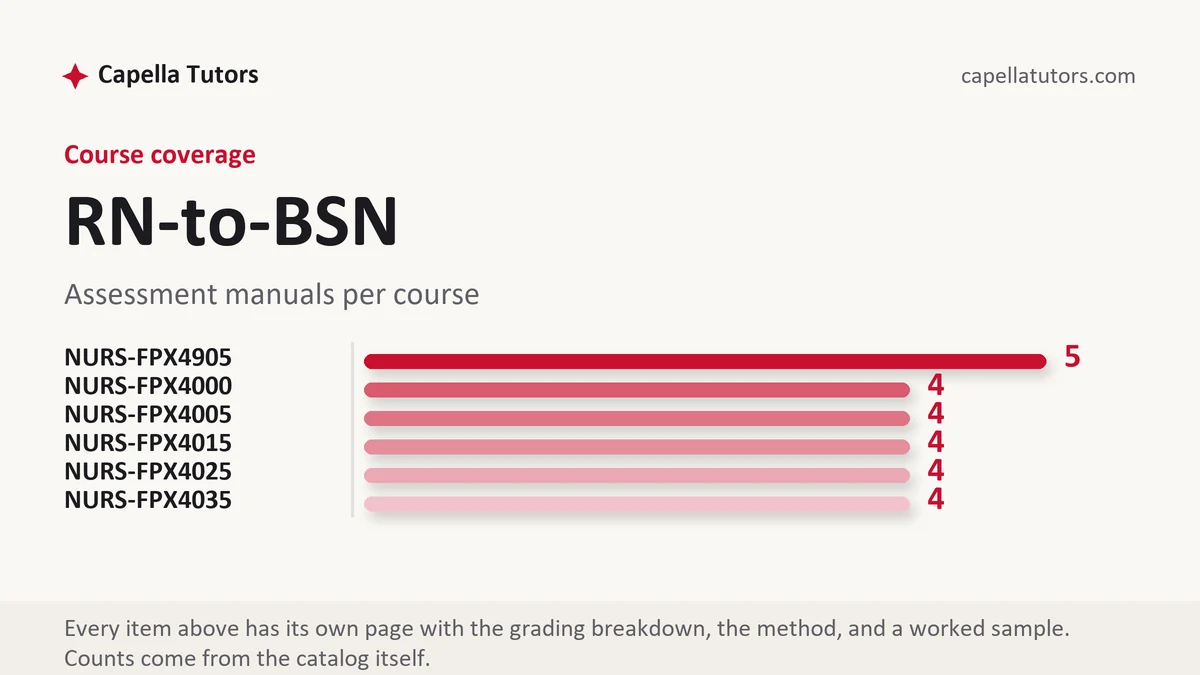
The program, mapped honestly
The RN-to-BSN is a completion program: you arrive with your RN and your prior credits, and Capella fills the baccalaureate gap with a nursing core plus whatever general education you still owe. It runs in FlexPath, self-paced with competency scoring, and GuidedPath, weekly deadlines with letter grades, and the entry math favors people like you: the program admits with a high school credential plus transferable credit, and Capella markets its fastest quartile finishing in under 9 months for under $11,000. The work itself is papers, plans, presentations, and one practicum-bearing capstone, which means the whole degree plays to exactly what we do.
The nine core courses, all covered
| Course | What it really asks for |
|---|---|
| NURS-FPX4000 | Developing a Nursing Perspective, the orientation to scoring-guide writing itself |
| NURS-FPX4005 | Leadership: people, processes, and organizations, applied to your own unit |
| NURS-FPX4015 | Patho, pharm, and assessment, the three Ps folded into written cases |
| NURS-FPX4025 | Research and evidence-based decision making, the EBP writing course |
| NURS-FPX4035 | Patient safety and quality of care |
| NURS-FPX4045 | Nursing informatics |
| NURS-FPX4055 | Population health through community practice |
| NURS-FPX4065 | Patient-centered care coordination |
| NURS-FPX4905 | The capstone project, writing plus practicum hours |
Both spellings reach the same course, NURS4025 and NURS-FPX4025 alike, and the gen-ed FPX courses that round out a completion plan, composition, statistics, psychology, are covered by the same team.
The capstone, where writing meets hours
NURS-FPX4905 closes the program with a capstone project and a practicum requirement, roughly 40 hours completed in the final stretch with paperwork approved before you enroll in it. We support both halves: the capstone writing runs through the standard pipeline to Distinguished, and our virtual practicum support keeps the hours and the logs moving so the last course never becomes the slow one. Plan the capstone's paperwork one course early; that single habit protects your finish date more than anything else in the program.
The one-session math
At the published bachelor's FlexPath rate of $2,575 to $3,530 per 12-week session, pace is the whole game. A one-course-at-a-time pace across two years touches eight or more sessions, $20,600 to $28,240. The expedite plan, two courses at once, each assessment back in 24 to 48 hours, submit on grade, typically clears the RN-to-BSN catalog in a single session. Same courses, same school, published rates; the difference is that you never wait on a blank page. Details and the calculator live on the expedite page.
Start with your current course
Tell us which NURS-FPX course and assessment you are on. First premium sample free, back in 24 to 48 hours.
Where the 90 program points come from
Almost everyone who writes in for Capella RN-to-BSN class help opens with the same question: how much of this degree do I actually have to take? The FlexPath BSN catalog listing asks for at least 90 program points, a minimum of 27 of them at the 3000 level or above, with 180 quarter credits as the GuidedPath equivalent. The buckets are what matter.
| Bucket | Points | What it means for you |
|---|---|---|
| Nursing core, the nine NURS-FPX courses | 27 | Nine courses at 3 points each, and nothing transfers in against them |
| General education | 22.5 | Spread across categories with a minimum in each, the likeliest landing spot for old credit |
| Foundational nursing skills coursework | 15 minimum | Usually satisfied already by the RN preparation you completed |
| Electives | The remainder | Roughly 25 points, filled by transfer, testing, or coursework you pay for |
Those three named buckets add to 64.5, which is why a completion program is mostly an argument about transfer credit rather than a course load. The nursing core is also exactly 27 points, the size of the 3000-level minimum, so the nine courses satisfy that rule by themselves. Confirm every figure against your own catalog year and your enrollment audit, since Capella revises requirements; the transfer credit guide is this paragraph with tactics attached.
What each of the nine NURS-FPX courses tests
NURS-FPX4000 teaches you to write to criteria before it asks you to write about nursing. NURS-FPX4005 wants a leadership problem from your own unit run through a named model, not a definition of leadership. NURS-FPX4015 turns patho, pharm, and assessment into written cases, the one course where clinical knowledge you already own carries most of the grade. NURS-FPX4025 is the register shift, since appraising studies against each other is a different act from reporting them, and the Assessment 2 manual performs that move in public. NURS-FPX4035 and NURS-FPX4045 each hand you a systems problem, safety in one and health information technology in the other, and want an intervention with stakeholders and a measure attached. NURS-FPX4055 moves you off the unit into a population, where the data is aggregate and the plan must survive a budget question, and NURS-FPX4065 coordinates care across settings while arguing ethics and policy. Each course page carries its per-assessment manuals underneath it, and the course catalog lists the full set.
The jump from clinical practice to scholarly writing
A nurse with fifteen competent years stalls in NURS-FPX4000 for a reason that has nothing to do with intelligence. Charting rewards the shortest defensible sentence: patient tolerated procedure, no distress noted. Scholarly writing rewards a claim that names its own source and its own limits. Both are professional writing; only one of them is what the scoring guide reads for.
Three habits from the floor have to be unlearned. Charting hides the actor, while a criterion that says analyze wants you visible and arguing. Charting compresses, and compression reads as thin rather than efficient when a criterion expects a claim plus its evidence. Charting states what happened, and that is the expensive one, because academic writing states what the evidence supports. A sentence saying the evidence suggests a reduction, in these patients, over this timeframe outscores one saying the intervention works. Hedging is accuracy here, not weakness, and the Distinguished column pays for it.
- Description where the criterion says analyze. Reporting what a source found and stopping satisfies nothing; the comparison you skipped was the criterion.
- Drafting before opening the scoring guide. The prompt is only the topic. The guide is the assignment.
- Using your workplace as evidence without labeling it. Practice observation is welcome and has to be named as observation, not slipped in as established fact.
- Leaving the Distinguished sentence out. It is usually one added move, a limitation, an implication, or a comparison, and it runs a sentence or two.
How the capstone differs from everything before it
NURS-FPX4905 carries the same 3 points as the eight courses ahead of it and considerably more risk, because it is the only one gated by something outside your control. The catalog attaches 40 practicum hours, and hours need a site, a preceptor, and approved paperwork before any of them count. Every other course you finish at your own kitchen table; this one needs a second person to sign.
The other difference is continuity. In NURS-FPX4035 you argue one safety problem, submit, and move on. In the capstone a single problem runs the whole course, identified, grounded in evidence, designed into an intervention, then evaluated, so a weak choice in the first assessment cannot be quietly dropped in the fourth; our manuals run from Assessment 1 through Assessment 5 for that reason. Start the paperwork while you are still inside NURS-FPX4065 and the approval chain runs alongside your writing; start it when the capstone opens and it runs in series, which is how a finish date slips by a month. Confirm the current hour count and approval window in your own program handout, then read the FlexPath writing manual before you draft.
RN-to-BSN questions students actually ask
Can I take two NURS-FPX courses at once?
Yes, and on FlexPath two is the ceiling. Billing is flat per 12-week session, so running one course instead of two costs the same money for half the progress, which makes the second slot the cheapest thing in the program. The real constraint is your own writing throughput; pair a heavy course with a lighter one, submit each assessment on grade, and the pair closes together.
How much of the 90 points can I transfer in?
The nine nursing core courses are yours to complete. General education and electives are where credit lands, and on paper that is most of the remaining 63 points. What actually transfers depends on your transcripts, course equivalency, and current policy, so the only honest answer comes from your official evaluation. Get it in writing before you promise yourself a finish date, because two courses either way is a difference of weeks.
What happens if an assessment comes back Basic?
You revise and resubmit. Basic is not a failing grade, it is a note that a criterion was answered shallowly. Read the evaluator's comment against the criterion it belongs to instead of rewriting the whole paper, since the fix is usually one section that summarized where it should have compared. Faculty have two business days to evaluate an attempt, so a targeted revision costs days rather than weeks.