Enhancing Patient Safety and Quality of Care runs as NURS-FPX4035 at Capella, 3 pts / 6 qcr, available in both FlexPath and GuidedPath in the RN-to-BSN path. Whether your courseroom shows NURS4035 or NURS-FPX4035, it is the same course and the same support applies.
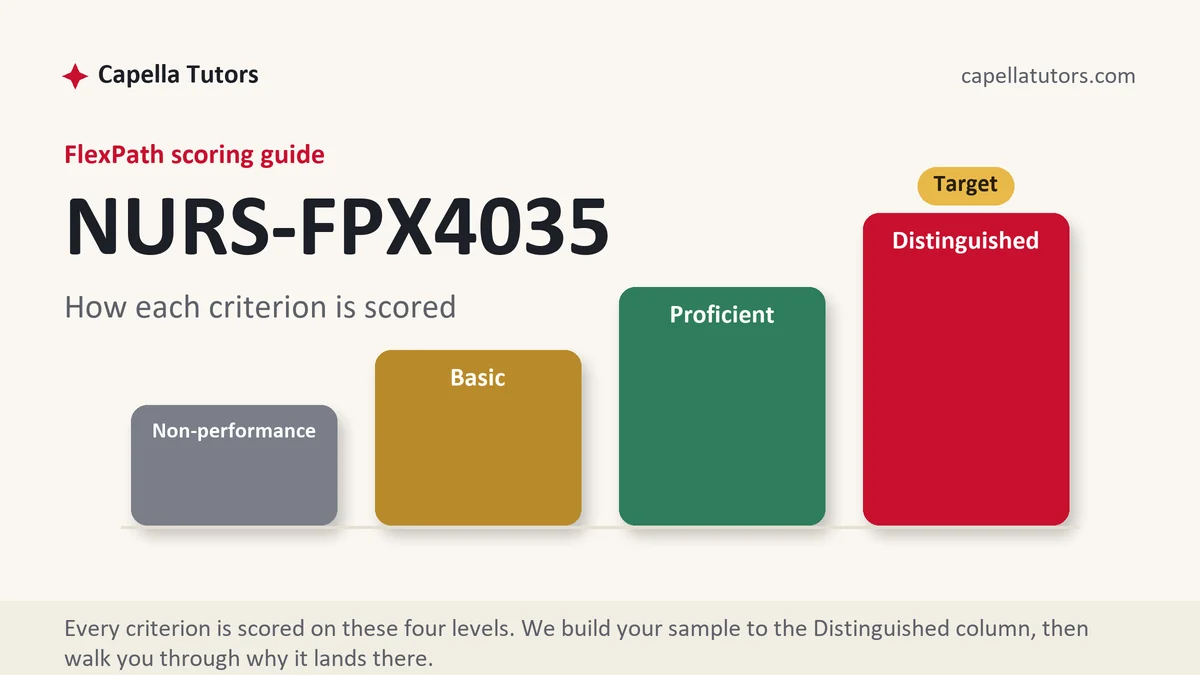
What NURS-FPX4035 actually grades
Safety and quality work arrives as improvement writing: root-cause thinking, safety-culture analysis, and QI proposals with measures attached. The scoring guides want the discipline of quality science, a defined problem, a measurable aim, an intervention tied to evidence, not passionate generalities about safety mattering. Nurses with incident-report experience have the raw material; the course grades whether you can structure it.
How we help in this course
We draft 4035 deliverables in genuine QI grammar, aim statements that are actually measurable, interventions matched to the failure mode, measures that would satisfy a quality department, using your unit's context wherever you share it. It converts what you already witness at work into what the criteria pay for.
The service terms are the same ones the whole site runs on: 24 to 48 hour delivery per deliverable, Distinguished or A targets matched to your format, two independent QA passes before anything reaches you, and free revisions until the target is met.
Assessment manuals for this course
Every assessment in NURS-FPX4035 has its own manual now: the walkthrough, the structure that maps to the criteria, an annotated sample excerpt, and the done-for-you door. Open Assessment 1, Assessment 2, Assessment 3, Assessment 4, or start from the list in the sidebar.
In NURS-FPX4035 right now?
Send the assessment number and the scoring guide from your courseroom. First premium sample free, back in 24 to 48 hours.
QI grammar, translated into scoring-guide terms
Safety writing at Capella is graded structurally: the criteria ask for a defined problem, a measurable aim, an intervention tied to evidence, and measures a quality department would accept. Passionate generality about safety mattering scores Basic no matter how sincere it is, because the columns are written to reward quality-science discipline over conviction. Our 4035 drafts are built in that grammar from the outline stage, each criterion a section, each section closing the loop between failure mode, intervention, and measure, with the Distinguished extras placed where the columns name them.
What your incident-report experience is worth here
Nurses arrive at this course with the raw material already witnessed; the course grades whether it gets structured. Share a safety event pattern from your unit, stripped of identifying detail, and the draft anchors its analysis in it, which is reliably the difference between a generic root-cause essay and one that reads Distinguished. The exchange takes you five minutes and improves every criterion the guide weighs. Anonymizing runs to professional standard as a matter of course.
Do you draft the improvement plan's measures too?
Yes, and they are written to be genuinely measurable, numerator, denominator, and timeframe, since vague measures are the most common Basic-column trigger in this course.
How fast does a 4035 assessment come back?
Inside 24 to 48 hours through the full pod, both QA passes included, revised free until the target column, Distinguished on FlexPath or the A row on GuidedPath, is met. Evaluator comments fold straight into that cycle.
The assessments, one by one
Assessment 1
The safety-problem analysis: a failure examined at system level. Read the full Assessment 1 manual.
Assessment 2
Root-cause analysis and an improvement plan with measures attached. Read the full Assessment 2 manual.
Assessment 3
Presenting the improvement work to the people who must run it. Read the full Assessment 3 manual.
Assessment 4
The safety-and-quality synthesis that closes the course. Read the full Assessment 4 manual.
How to actually write NURS-FPX4035: where to begin
Open the scoring guide first and copy its criteria into a blank document as headings, Distinguished descriptions pasted underneath. In 4035 those criteria typically ask you to analyze a safety event or quality gap, trace it to root causes, propose evidence-based improvement strategies, and build an improvement plan with resources and measures attached. The assessments in this course usually chain together, a root-cause analysis feeding an improvement plan feeding a presentation or toolkit, so the safety problem you pick first travels the whole course. Pick it once, pick it well.
Pick it from your own unit. The strong 4035 problems are the ones incident reports already track: a fall with injury, a wrong-dose event, a handoff failure, a CAUTI cluster. Write down the pattern with identifiers stripped: what happened, what the process was supposed to be, where it bent. You are not documenting the incident, you are extracting its anatomy, which is what the root-cause criterion grades.
Then hold the systems line for the whole paper. Quality science attributes failure to processes, not people, and the criteria are written in that doctrine: a root-cause analysis that lands on "the nurse should have been more careful" has not reached a root cause, it has stopped at the sharp end. Keep asking why until the answer is a system property, staffing, interruptions, lookalike packaging, a workaround the unit normalized, because interventions can only attach to system properties.
| Section | What goes in it | What Distinguished looks like |
|---|---|---|
| The event and its context | The safety event or quality gap, de-identified, with the data that sizes it. | A named, measurable gap on a real unit, not "errors happen in hospitals". |
| Root-cause analysis | The causal chain from the event back to the system conditions that produced it. | Multiple contributing causes ranked, human factors included, blame absent. |
| Evidence-based strategies | Interventions the literature supports, each matched to a root cause you identified. | Strategy-to-cause mapping explicit, with the strength of each study weighed. |
| The improvement plan | Who does what, by when, with what resources, and the aim stated as a measure. | An aim with a numerator, a denominator, and a timeframe, plus one anticipated barrier answered. |
| Organizational resources | The existing people, committees, data systems, and budget realities the plan will use. | Resources named specifically enough that a quality department could convene them. |
| Conclusion and references | The argument closed, current APA, citations matched both ways. | The plan restated as achievable with what the organization already has. |
Developing the synthesis
The synthesis 4035 wants is the closed loop: this root cause, this evidenced intervention, this measure that would show it worked. The safety literature hands you real disagreements: hourly rounding trials show mixed effects on falls; bundle studies show CAUTI reductions but rarely isolate which element carries the effect. Pair them, weigh design strength and setting fit, and let the verdict shape the plan: adopt the intervention with the strongest fit, and say why the runner-up lost. Reciting that a bundle reduced infections somewhere is Basic; arguing which of its elements your unit's failure mode actually needs is Distinguished. Then name what the evidence cannot settle, usually the isolated effect of a single component.
Citations that survive faculty review
Safety writing runs on two evidence layers, and the criteria expect both. Peer-reviewed studies from roughly the last five years, found through the Capella library, CINAHL, and PubMed, carry the intervention claims; the quality-infrastructure sources, AHRQ, the Institute for Healthcare Improvement, Joint Commission sentinel event material, carry definitions, tools, and the scale of the problem. An AHRQ toolkit can define your RCA method, but a claim that an intervention reduces falls needs a study behind it. Give every source a named job for a criterion and write the citation into the working sentence, "Nguyen et al. (2024) found rounding cut falls by a quarter in a matched-unit trial" argues; the same claim with a trailing parenthetical asserts. Close with the two-way check between citations and references, current APA.
The mistakes that land Basic instead of Distinguished
- Blaming the person. A root-cause analysis that ends at an individual has not found a root cause.
- Passion without structure. Paragraphs about safety mattering, however sincere, contain nothing a criterion can award.
- The unmeasurable aim. "Improve handoff communication" cannot be scored, achieved, or audited; the guide wants a number, a denominator, and a date.
- Interventions unmatched to causes. Proposing education for a problem your own analysis traced to interruptions breaks the paper's internal logic.
- No measurement plan. An improvement plan with no way to know it worked reads as intention, and intention scores Basic.
NURS-FPX4035 questions students actually ask
Can I write about a real incident from my unit?
Yes, and you should, with the identifiers gone. Strip names, dates, room numbers, and any detail that could trace to a specific patient or colleague, then describe the pattern rather than the occurrence: "a wrong-dose event involving lookalike vials during a night-shift interruption" gives the analysis everything it needs. Real events produce real root causes; hypotheticals produce the generic essays the Basic column describes.
What makes an aim statement measurable?
Three parts: a numerator, a denominator, and a timeframe. "Reduce falls with injury from 4.1 to under 3 per 1,000 patient days on the unit within six months" can be scored, audited, and declared achieved or not. If your aim has no number, ask what your quality department already counts, falls, catheter days, medication events per doses dispensed, and borrow that measure; the criteria reward aims a real dashboard could track.
Do I have to use a specific root-cause tool?
Only if your scoring guide names one; otherwise choose the tool that fits the event and use it visibly. A fishbone diagram suits an event with several contributing categories, five-whys suits a single causal chain. What the criterion actually grades is the analysis, causes ranked, human factors included, systems held responsible, so the tool is scaffolding. Name it, apply it in the text, and let the ranked causes drive the improvement plan.