You send the deliverable in front of you, by chat, WhatsApp, or the form. A tutorship manager confirms scope and price in minutes, your eight-person team drafts it through two QA passes, and a premium original sample lands in your email in 24 to 48 hours with a walkthrough of why it scores. You revise it into your own voice, submit it yourself, and send it back for free revisions if anything falls short. Nothing touches your courseroom login, and your first sample is free.
Your first order, minute by minute
Open the chat and send three things
Course code, the assessment or assignment name, and the scoring guide or prompt attached in your courseroom. Screenshots work. If you are mid-panic at 2 a.m., the 24/7 desk is the same chat.
Get scope and price up front
Your tutorship manager replies with the timeline and the exact price before anything starts. Standard deliverables run 24 to 48 hours; capstones get a scoped plan instead of a guess.
Approve and hand it off
Pay through the secure processor and the pipeline starts. From this moment you never face the blank page; your only job is the final read and submit.
What happens inside the 24 to 48 hours
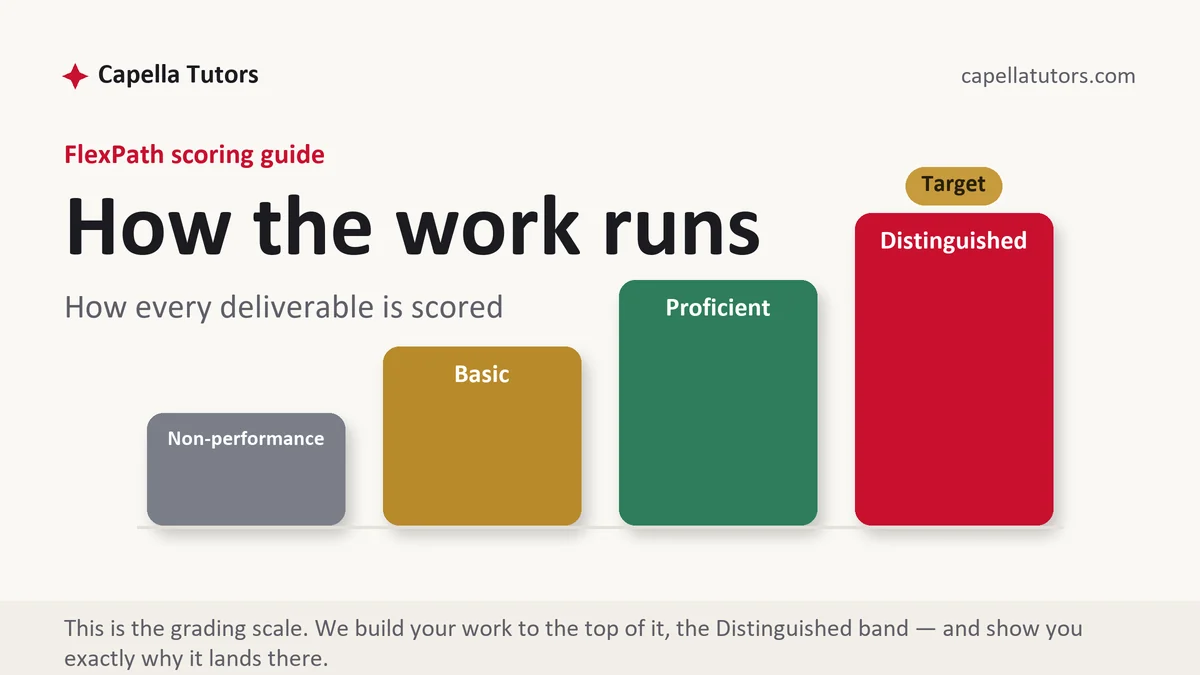
Every deliverable runs the same eight-person pipeline, in order. The research analyst pulls your scoring guide apart and gathers current peer-reviewed sources. The subject writer, matched to your program, drafts to the Distinguished column on FlexPath or the A rubric row on GuidedPath. The scoring-guide QA grades the draft criterion by criterion the way a Capella evaluator would; the second QA pass checks originality and current APA separately, because those fail independently. The editor polishes structure and flow, your lead tutor signs off, and your manager ships it. Meet each of them on the team page.
Delivery, walkthrough, and revisions
Delivery goes to your personal email: the sample, the walkthrough notes tied to each criterion, and the reference list. Read the walkthrough first; it is the fastest way to own the material before you revise. Then make the work yours, submit in your own courseroom, and watch the grade. If a supported deliverable comes back below target, Distinguished on FlexPath or an A on GuidedPath, revisions are free until it gets there. Most revision requests we see are APA touch-ups and they turn around same day.
Privacy, payment, and the lines we hold
- We never log into Capella. No courseroom access, no submissions on your behalf, ever. You stay the only person who touches your account.
- Your details stay yours. No sharing, no resale, no contact with your school, delivery to your personal email only.
- Payment is boring on purpose. A secure card processor, a clear price agreed before work starts, no subscriptions hiding in the fine print.
- Original, every time. Samples are written fresh for you and never reused; the originality QA pass exists so that stays true.
Quick answers
How fast can you really go?
What does it cost?
Do you handle whole courses or just single pieces?
Try it on the assessment in front of you
Three things in chat: course code, assessment, scoring guide. First premium sample free.
What to send when you ask for Capella class help
Capella class help moves at the speed of your first message. Six things make the difference, plus anything you have already written, and every one of them changes the draft.
- The course code exactly as your courseroom prints it. NURS4025 and NURS-FPX4025 reach the same course, and the code decides which writer on the bench is the match.
- The assessment or assignment name and its number. Courses reuse a topic across several pieces, and the number is what pins the deliverable.
- The scoring guide or rubric file itself, not a description of it. Capella revises guides, and the criterion wording is the writing brief. A summarized guide produces a draft written to the wrong contract.
- The prompt or the scenario. Simulation and case courses grade fidelity to their own facts, so that world matters as much as the criteria do.
- Your due date and your time zone, both. Half the rush requests we receive stop being rushes once the time zone is stated.
- Your topic or practice setting, if the course builds on one. Where later assessments depend on an earlier choice, that choice has to be locked before the first draft or you pay for it twice.
A half-finished draft is useful rather than embarrassing; it shows us your register.
When the 24 to 48 hours starts, and what stops it
The clock starts when scope is approved and the files are in hand, not when you first say hello. That is the most common misunderstanding in our inbox: a Tuesday night conversation that finishes Wednesday morning is a Wednesday order. Two things pause a clock that is already running. A scoring guide that turns out to belong to a different assessment, which we query rather than guess around, and a topic change after drafting has begun, which sends the piece back through the research pass. Neither is a penalty and both cost hours. Rush handling exists for genuine tonight deadlines and is arranged before the order starts, never after.
What each pass in the pipeline is looking for
Eight people is not eight readings of the same kind. Each pass hunts a specific failure.
- Research pass. A topic the literature has not studied, and sources outside the currency window your course expects.
- Subject writer. A criterion with no home in the outline, which is the mechanical cause of most Non-performance marks.
- Scoring-guide QA. The section that answers its criterion completely and then stops, which is Proficient sitting where Distinguished was available.
- APA and originality QA. Citation drift, a reference no in-text mention uses, and any passage that should be quoted rather than paraphrased.
- Editor. The one-sentence paragraph, the buried topic sentence, and the heading that does not match the criterion beneath it.
- Lead tutor and manager. Scope against the prompt, and whether the walkthrough explains the grade to you rather than describing the paper back to you.
The revision loop, in calendar terms
Send back the evaluator's own words. A marked scoring guide, the faculty comments, or the graded rubric row tells us what to change; a message saying it came back low does not, and asking twice costs you a day. APA and formatting corrections turn around the same day. A revision that touches an argument or adds an unaddressed criterion is a next-day job, because it re-enters the writing and QA passes instead of skipping them. There is a harder cost on FlexPath: a second attempt starts a fresh two-business-day evaluation window, so the revision promise protects your grade while the self-score protects your calendar.
What we will not do, and why each line sits there
The privacy list above draws the account boundary. These are the work boundaries, and they hold in every course.
- Anything timed, proctored, or sat. Quizzes and exams get preparation and practice questions from us. You sit them, every time.
- Clinical and practicum hours. Those are worked by you and verified by your preceptor. Our lane is the writing that surrounds them.
- Your Turnitin draft slots. We will read a report with you and show you which highlights are harmless. Submitting the draft, and the graded attempt, stays yours.
- Promise a number. Distinguished on FlexPath and an A on GuidedPath are what we target and revise toward for free. An outcome only your evaluator controls is not ours to guarantee.
- Start on a guess. If the guide you send belongs to a different assessment, we ask again rather than write to the wrong criteria, even when that delays the order.
- Take a deadline we cannot hit. If tonight is impossible at that scope, you hear it in the first reply instead of receiving a late file.
Questions about the process
Can you work from a screenshot of the scoring guide?
Yes, and most orders arrive that way. What matters is that every criterion is legible edge to edge, including the Distinguished column, which is the one screenshots crop. A cut-off row gets queried, not inferred.
Can I talk to the writer directly?
Your tutorship manager is the channel, deliberately. One thread means one record of what was agreed, and it keeps the writer writing instead of answering messages.
What if I disagree with the direction of the draft?
Say so on the first read. Direction changes are cheap in the first hours and expensive after both QA passes have run, because the piece has to go back through them.