We are a coursework support team built specifically for Capella's FlexPath format. Send the assessment in front of you and a US-based graduate tutor returns a premium original sample written to the Distinguished column of its scoring guide in 24 to 48 hours, with a walkthrough of why it lands there. You revise, learn, and submit. On the full expedite plan we run two courses at once and close a course pair about every week, which is how a bachelor's finishes in one flat-rate session, a master's in two, and a doctorate in three.
Every FlexPath deliverable, handled
| Deliverable | What you get | Turnaround |
|---|---|---|
| Written assessments | An original model mapped to every criterion of the scoring guide, plus margin notes on why each section scores Distinguished. | 24-48 hours |
| Presentations | Slides plus full speaker notes, because FlexPath evaluators grade the notes, not the bullet points. | 24-48 hours |
| Plans, analyses, and projects | Structured to the criterion headings so nothing hides from the evaluator. | 24-48 hours |
| Capstones | The long-haul deliverables, including NURS-FPX4905 and MBA-FPX5910, scoped up front with a real timeline. | scoped per project |
| Revisions and proofreading | Your own draft tightened against the guide until it reads at the top of the scale. | usually same day |
Every piece runs the same eight-person pipeline: research analyst, subject writer, a scoring-guide QA pass, a separate APA and originality QA pass, an editor, and your tutorship manager, with the 24/7 desk behind all of it. Meet them on the team page.
How FlexPath actually works, in four facts
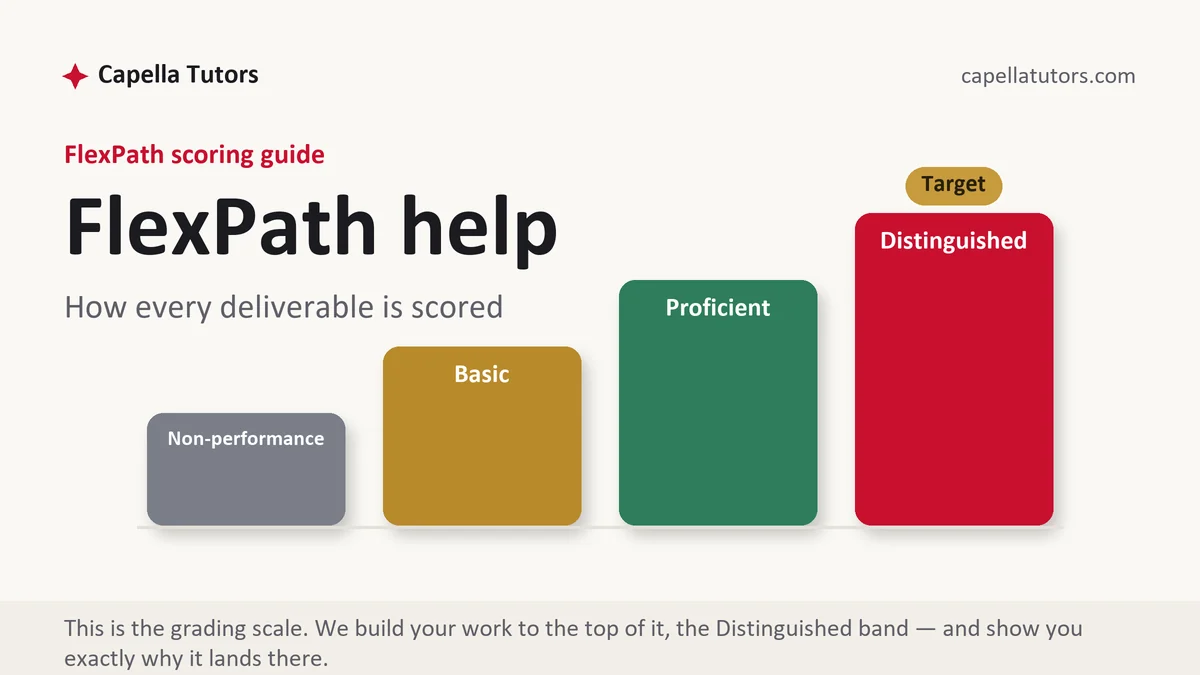
Everything about supporting FlexPath students follows from four verified format facts. There are no letter grades: every criterion is scored Distinguished, Proficient, Basic, or Non-performance against a published scoring guide. Deadlines are yours: you set target dates in the first 12 days, adjust anytime, must engage at least every 28 days, and each course allows up to 12 weeks. Load is capped at two courses at a time, with auto-registration into the next course when one completes. And billing is a flat rate per 12-week session, however much you finish.
That last fact changes what coursework help is worth. In a per-credit school, help saves stress. In FlexPath, pace is literally money: every session you do not need is a session you do not pay for.
The expedite plan, applied to FlexPath
The plan is simple and the format makes it work. We keep both course slots full. Each assessment comes back to you in 24 to 48 hours, written to Distinguished on every competency, and the moment one is graded we guide you to submit the next. A course pair closes in about a week, you auto-register forward, and the cycle repeats. Doctoral evaluations take longer per assessment, which is why doctoral plans budget three sessions instead of one. Typical full programs on the plan: a bachelor's in one billing session, a master's in two, a doctorate in three. Run your own numbers in the Expedite Plan calculator.
The money math, at published rates
Capella's published FlexPath rates as of July 2026 are $2,575 to $3,530 per 12-week session for bachelor's programs, $2,640 to $3,075 for master's, and $3,400 to $3,480 for doctoral, with resource kit fees separate. A typical student pacing one course at a time can spend two years and eight or more sessions on a BSN; the same catalog cleared on the expedite plan bills one session. That difference, roughly eighteen to twenty-four thousand dollars on the RN-to-BSN path, is the honest case for support, and it is Capella's own arithmetic, not ours.
Quick answers
What does the guarantee cover on FlexPath?
Do you write to my exact scoring guide?
What if I only want help with one assessment?
Send the one in front of you
Course code, assessment number, scoring guide. That is all we need to start, and the first premium sample is free.
Capella FlexPath help, measured in calendar instead of pages
Most people shopping for Capella FlexPath help are counting pages. The format counts something else. A 12-week session is about sixty business days, and what converts those days into finished courses is how many clean evaluation cycles fit inside them. One cycle is write, submit the attempt, wait while faculty use their two business days. If a course has four assessments and each attempt passes on the first read, the queue alone takes roughly eight business days. Fail two and that course spends four more days waiting, plus the evenings spent rewriting. The arithmetic does not reward faster typing. It rewards entering the queue fewer times.
Submit day is a design decision
The evaluation clock counts business days only, so the day you press submit decides how much of the week the queue takes. A Tuesday morning attempt is usually back by Thursday, leaving two working days to fix a Basic criterion and get the next attempt in.
| You submit | Two business days lands on | What the rest of the week holds |
|---|---|---|
| Monday | Wednesday | A second attempt fits, and returns Friday |
| Tuesday | Thursday | Rewrite Thursday, second result Monday |
| Wednesday | Friday | Rewrite across the weekend, answer Tuesday |
| Thursday | Monday | No result at all inside the week |
| Friday | Tuesday | Two of next week's days spent before it starts |
Holidays push every row further right, so aim attempts at Monday or Tuesday and treat Thursday as the cutoff rather than the target. The scoring-time guide has the rule in full.
Draft 1, Draft 2, then the one attempt that counts
FlexPath gives you two private Turnitin draft slots before the graded attempt, and in our order queue they are the most underused feature in the courseroom. A draft returns an originality report only you see, and after 24 hours a resubmission replaces the old report with a fresh one, so the slots are effectively reusable. The attempt is the opposite: faculty score it, and it cannot be resubmitted. That sequence is a free rehearsal, and it is exactly where our samples are meant to land. Read the walkthrough, rewrite the piece in your own voice, run it through a draft slot, fix any long unquoted match, then self-score every criterion against its Distinguished description before you spend the attempt. The Turnitin drafts guide covers what a similarity number does and does not mean.
The second course slot, and the three ways it gets wasted
FlexPath holds two courses at once and auto-registers you into the next when one closes. Holding two is not the same as using two, and three failures show up repeatedly in the plans students bring us.
- The slot opened late. A second course started in week five cannot absorb queue time from weeks one to four. That dead air is already paid for.
- Both attempts submitted the same day. When both courses are waiting on faculty at once you have nothing to write, which is the precise condition the second slot exists to prevent. Keep them staggered by half an assessment.
- Two heavy courses paired. A capstone-weight draft in each slot in the same week means neither moves. Put one demanding course against one lighter one.
The full mechanics, including how to set target dates inside each course's first 12 days, are in the two-course rotation playbook.
FlexPath questions students actually ask
Can a course pair really close in about a week?
It does when three things line up: both slots active, the next attempt submitted the day a grade lands, and each attempt passing on the first read. Miss the third and the pair takes two weeks, because every failed attempt buys another trip through the queue. Ask us to scope your two courses before you plan around the number.
What happens if an attempt comes back Basic?
You revise, submit a new attempt, and a fresh two-business-day window starts. A file generally has to sit at Proficient or better on every criterion, so one Basic row is enough to send the whole thing back. That is why we write to the Distinguished column instead of the passing line.
Do I have to keep both course slots full?
No, and plenty of students run one course at a time on purpose while a job or a family season is heavy. Just know the trade: the flat session rate does not shrink because you used half of it.