We do not publish a single sticker price, because a one-off discussion post and a capstone are not the same job. What we do promise is a flat quote before you commit and a free first sample so you can judge the work before any money changes hands. You send the assessment and its scoring guide, you get a fixed number and a turnaround in minutes, and you decide. No subscription, no meter running, no surprise on delivery.
What actually shapes your quote
| Factor | How it moves the number |
|---|---|
| Deliverable type | A single discussion reply sits at the low end; a multi-part assessment or capstone at the high end. |
| Length and criteria count | More scoring-guide criteria and more required pages mean more work, and the quote reflects it plainly. |
| Turnaround | Standard is 24 to 48 hours. A genuine same-day rush is possible and priced for the speed. |
| Level | Doctoral register and DNP or EdD project work carry more depth than a first-term undergraduate paper. |
Because the price tracks the actual work, the smallest orders stay genuinely small. A single post is the least we take, and it usually comes back the same day. You are never quoted a package you did not ask for.
How a quote works, start to finish
Send the details
Course code, assessment number, and the scoring guide in chat. That is everything we need to scope it.
Get a flat number
A fixed quote and a delivery time come back in minutes, not after a sales call.
See a free sample first
Your first premium sample is free, so you judge the quality against your own scoring guide before you commit.
Approve and receive
Approve the quote and the premium original sample arrives on time, with walkthrough notes and free revisions until it reads at the top of the scale.
What the rate covers across your program
One quote structure covers every deliverable Capella assigns, on both FlexPath and GuidedPath. Where exams or quizzes come up, we build the prep kit and you sit them yourself; everything else is a sample you study, revise, and submit.
In students' words
"One billing session, exactly like the calculator said. Twelve years of bedside and I finally have the degree that was always one deadline too far away."
"Cleared the whole MBA core in two flat-rate sessions while running a restaurant. The pacing plan is the product; the writing quality is why the plan holds."
More across every program on the reviews page.
Rate questions, answered straight
Is the first sample really free?
Do you charge a subscription?
What is the smallest order you take?
Are revisions extra?
Get your number in minutes
Send the assessment and scoring guide in chat for a flat quote and a turnaround time. The first premium sample is free.
Why Capella class tutoring rates are quoted per assessment, not per hour
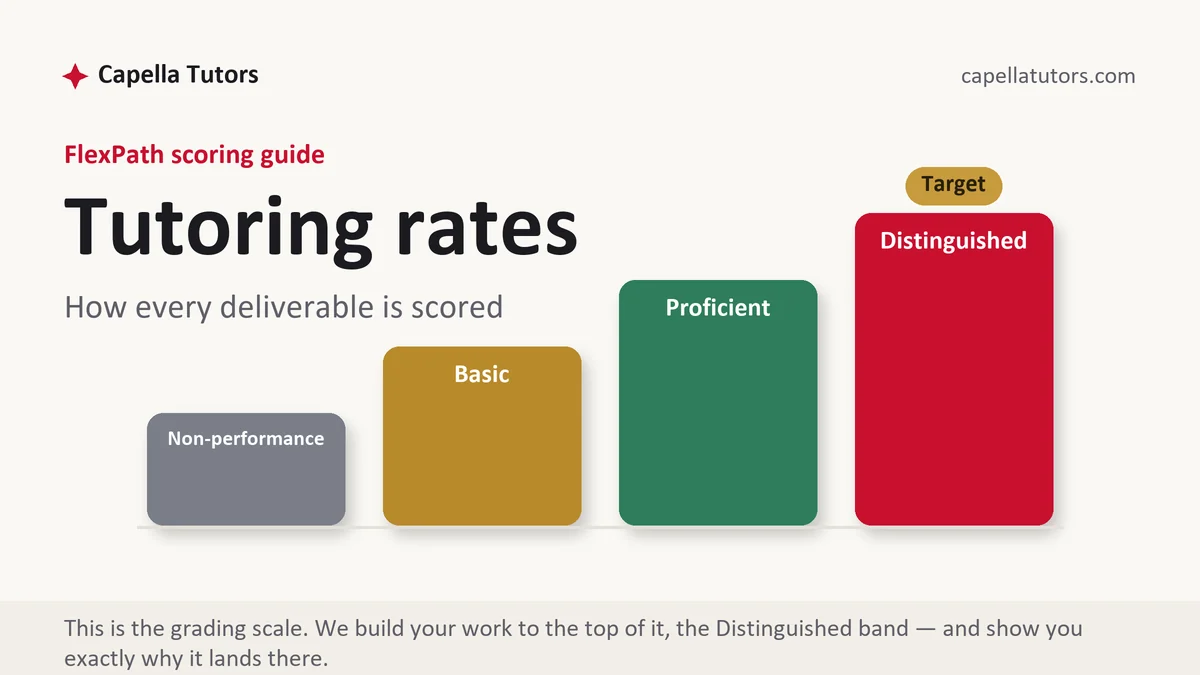
Capella class tutoring rates behave differently from ordinary tutoring rates because Capella grades differently. FlexPath awards no letter for effort: every criterion in the scoring guide is rated Non-performance, Basic, Proficient, or Distinguished, and one Basic row can send a whole attempt back for another try. An hourly meter prices a tutor's time. A per-assessment quote prices the finished artifact, which is the only thing your evaluator reads. That is also who carries the risk. On an hourly plan you pay the same whether the draft clears the guide or not; on a flat quote, the revisions it takes to get there are ours to absorb.
Hourly is not always the wrong instrument. For twenty minutes of APA triage on a reference list you already built, an hourly tutor is cheaper and you should use one. Once the job is a whole criterion-graded deliverable, the hour stops being a useful unit: nobody can say in advance how many hours a scoring guide will take, and the number you care about is the total.
What a vague quote is usually hiding
Most of the money students lose on coursework help goes before any writing starts, inside a quote loose enough to move later. Four phrasings account for nearly all of it, and each has one question that closes it.
| What you are told | What it usually means | The question that closes it |
|---|---|---|
| "Starting at" | The floor price for the smallest job the desk takes, which is rarely yours. | What is the number for this assessment, with this guide, by this date? |
| Priced per page | Pages are not criteria. A short assessment with eight criteria outworks a long reflection with three. | What happens to the price if the guide needs more pages than you estimated? |
| Hourly, billed afterwards | The total is unknowable until it has been spent. | What is the cap, and what do I owe if a criterion still misses? |
| Revisions quoted separately | The real price is the quote plus however many rounds the guide demands. | Are revisions against my scoring guide included, and for how long? |
How to describe your assessment so the number comes back real
Criterion count is the biggest lever inside a quote. Send these six things and the number you get is the number you pay.
- Course code and assessment number exactly as your courseroom prints them, for example NURS-FPX4025 Assessment 2
- The scoring guide itself, attached or screenshotted, because the criteria are the workload
- The deliverable form, since a paper, a recorded Kaltura presentation, and a Vila Health scenario write-up are three different jobs
- Any source rule your guide names, plus anything your instructor has ruled out
- The date you need it in hand to read and revise, not the date it is due
- Whether an earlier attempt came back below Proficient, and what the evaluator wrote, because repairing an attempt is scoped differently from a fresh draft
The scoping mistakes that cost students money
- Sending the prompt instead of the guide. The prompt describes the topic, the guide describes the grade, and only one of them predicts the work.
- Buying speed you already have. Standard is 24 to 48 hours, so a Friday deadline needs no rush on Tuesday. It is the most common self-inflicted overspend we see.
- Describing a presentation as a paper. Slides, speaker notes, and a recording carry work prose does not, and finding that out late moves the number.
More rate questions students ask
Is per-assessment pricing more expensive than an hourly tutor?
Per hour, usually yes. Per finished deliverable, usually no, and the deliverable is what gets scored. Compare totals rather than rates: a friendly hourly rate that needs six sessions and still leaves you to write it has cost you money and the evenings. Ask both sides for the total on one specific assessment and the choice becomes arithmetic instead of impression.
Why did the quote change after I sent the scoring guide?
Because the guide is the specification. A four-page assessment can carry eight criteria, each wanting its own analysis, its own evidence, and the named extra that lifts it to Distinguished. That is the workload the number tracks, and a price given without the guide is a guess wearing a number.
Do you quote FlexPath and GuidedPath differently?
The quote follows the deliverable, not the format. What changes is the calendar: FlexPath work is planned around your own submission pace inside the flat billing session, GuidedPath work around the Thursday and Sunday clock. Tell us which format you are in and the delivery date gets set to the one that matters.