Whatever your Capella class assigns this week, we produce it: discussion posts and peer replies on the GuidedPath clock, FlexPath assessments to the scoring guide, papers, care plans, analyses, and slide decks with the speaker notes evaluators actually read. Standard pieces come back in 24 to 48 hours as premium original drafts with walkthrough notes, written to an A target on GuidedPath and Distinguished on FlexPath, revised free until they get there.
Every deliverable type Capella assigns
| Deliverable | Where it shows up | The trap we handle |
|---|---|---|
| Discussion posts + replies | Every GuidedPath week | Thursday and Sunday 11:59 p.m. Central, and substance rules that filler replies fail |
| Written assessments | All FlexPath courses | Scored only against the scoring guide, criterion by criterion |
| Papers and essays | Both formats | Current APA and evidence currency, the two silent criteria |
| Presentations | Both formats | Evaluators grade the speaker notes, not the slide bullets |
| Care plans and analyses | Nursing and business courses | Structure must mirror the criterion headings or content hides |
| Capstones and projects | Program finales | Multi-part scope that needs a plan, not a sprint |
Discussions: the weekly grind, done right
GuidedPath discussions run on the fixed weekly clock, and they compound: an initial post with real sources early in the week, then substantive peer responses before Sunday night. We draft the initial post in your voice with citations that survive scrutiny, and replies that actually engage the thread instead of congratulating it. If you carry two or three classes, the weekly cadence service on the GuidedPath page plans all of them together so no Thursday ever surprises you.
Presentations: the speaker notes are the assignment
Capella presentation assessments are graded like papers that happen to have slides. The scoring guide criteria are satisfied in the speaker notes; the slides only carry the skeleton. Our decks come with full notes written to the criteria, clean design that will not distract an evaluator, and, where the assessment calls for it, the audio script timed for recording. If your assessment requires Kaltura or a recorded voiceover, the notes arrive ready to read aloud.
Papers, plans, and projects
The long-form work follows the same law as everything at Capella: structure from the criteria, analysis over summary, current evidence attached to every claim. Nursing papers get a working clinician's register from our MSN writers; business analyses get frameworks applied to the case rather than recited; psychology and education papers get the theory-to-practice bridge their rubrics reward. Every draft passes the scoring-guide QA and the separate APA and originality QA before it reaches you, which is why revision requests on our work are rare and fast.
Quick answers
Can you match my writing voice?
Do you do one-off discussion posts?
What about a whole week across all my classes?
Send this week's list
Paste what is due in chat, get scope and price in minutes, and the first premium sample is free.
What arrives with a Capella assignment help request, and what happens to it
A usable Capella assignment help request is three items: the course code, the assessment or assignment name, and the scoring guide or prompt attached in your courseroom. Screenshots are fine. From those three the research analyst rebuilds the guide as an outline, one heading per criterion, with the top-level description sitting under each heading as the writing instruction for that section. Sources are then assigned to criteria rather than to the paper as a whole, so every reference in the draft has a named job. Drafting starts only after that, which is why a criterion rarely goes missing on the way through.
If the scoring guide is not in the request, we say so instead of guessing. Capella revises courses and their guides over time, so a draft built from last term's criteria is a draft built for someone else's assessment. When a student genuinely cannot find the guide, the manager works from the prompt and flags in writing which sections are unverified, and the free revision pass fixes those once you paste the real thing in. That path is slower than sending the guide with the first message, and it is the most common reason a NURS-FPX or MBA-FPX order takes two passes instead of one.
Editing, tutoring, and a model draft are three different orders
Students type "Capella class help" and mean one of three jobs, scoped and priced differently. Naming which one you want in the first message usually saves a day.
| Order | What you send | What comes back | Choose it when |
|---|---|---|---|
| Proofread and align | Your finished draft plus the scoring guide | Your own words tightened, every criterion marked against the guide, the weak rows named; usually same day | You wrote it, you like it, and you want to know where it would score Basic |
| Tutoring walkthrough | The guide and the part you are stuck on | The method explained on your own material, plus an outline you write from yourself | You have the hours but not the map |
| Model draft | Course code, assessment number, scoring guide | An original model written to the Distinguished column with walkthrough notes per criterion, in 24 to 48 hours | You want to see top-of-scale work on your exact assignment before writing your version |
Most long-running clients move down that list rather than up: a model draft in the first course, an outline review in the second, a proofreading pass by the third. Nothing in the pricing rewards keeping you at the top of it, because every order is quoted flat for the work actually asked for, as the rates page sets out.
How a scoring guide changes what "help" even means
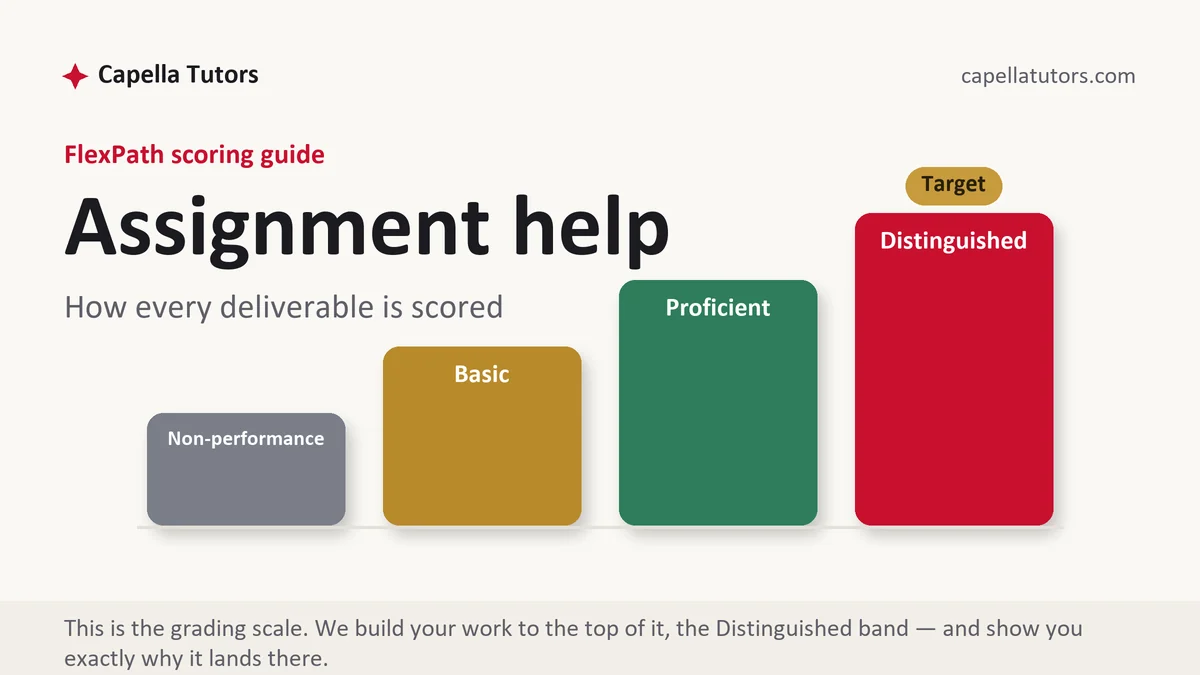
In a course graded by impression, help means better sentences. In a Capella course, help means criterion coverage, and those are not the same job. Every graded assessment carries a scoring guide, each criterion is described at four levels, and the evaluator marks the level your section earned. Strong writing that answers the prompt instead of the criteria still scores Basic. Plain writing that answers every criterion and adds the extra move the top column names scores Distinguished.
That has a consequence for length. Our writers budget words per criterion, not per page. Take a guide with five criteria and an assessment our planning notes put near 1,200 words: about 150 words open it, about 150 close it, and roughly 180 are left for each criterion. A criterion allowed to run to 400 words has taken another criterion's budget, and the starved section is the one that comes back Basic. This is the first arithmetic we run on a draft sent in for a proofreading pass, and it is the fastest self-check to learn, so count the words you gave each criterion before you count anything else. Those targets are our planning tool rather than Capella policy, and your own guide and prompt decide required length.
What we decline
- Courseroom access. No logins, no submissions on your behalf, no messages to faculty in your name. Work arrives by email and you post it yourself.
- Anything timed or monitored. Quizzes, tests, and proctored sessions stay yours alone in every format, the boundary the quiz and exam page maps in full.
- A recycled paper. Nothing delivered here has been sold before, and nothing you receive is offered to anyone afterward.
- A promised transcript. We target the top of the scale on every criterion and revise free until the work reads there. What an evaluator marks is not ours to promise.
- Similarity laundering. Reshuffling a matched passage to slip past a checker is not editing. Restating an idea inside your own analysis, with the citation attached, is.
Assignment help questions students actually ask
How late is too late to send this week's work?
Standard turnaround is 24 to 48 hours, so a Thursday deadline wants a Tuesday order. Same-day work is possible on smaller pieces through the round-the-clock desk, and the honest answer to a two-hour deadline on a full assessment is no. On FlexPath there is a second clock worth planning around: faculty have two business days to evaluate a submitted attempt, weekends excluded, so an attempt sent Friday evening may not come back until midweek.
Can one order cover several classes in the same week?
Yes, and it is easier to scope than several separate orders. Send every deliverable due with its course code and guide, and the manager sequences them by deadline rather than by size. FlexPath caps you at two courses at a time, so a week's list is usually two assessments plus whatever GuidedPath discussions sit beside them.
What if my evaluator marks a criterion Basic anyway?
Send the returned scoring guide with the evaluator's comments attached. The revision is free and it goes back to the same writer, who works from the evaluator's language rather than ours. Most work that returns below target has a criterion answered in the wrong section rather than answered badly, which is a fast fix.