On FlexPath there is nothing to sit: your entire grade is the assessment file, scored against scoring guides, which is why the FlexPath desk is this site's flagship and no exam desk exists beside it. On GuidedPath, where a section includes quizzes or tests, we build the preparation, condensed notes, practice questions with answer logic, a study plan aimed at the score your gradebook needs, and you sit them yourself, every time. And where a course runs simulation scenarios, Capella's Vila Health environment being the famous example, the graded artifact is the written assessment built from the scenario, which is ordinary territory for the assessment desk: send the scenario details and the rubric, and the draft returns grounded in the simulation's own facts.
FlexPath: the no-exam system, used properly
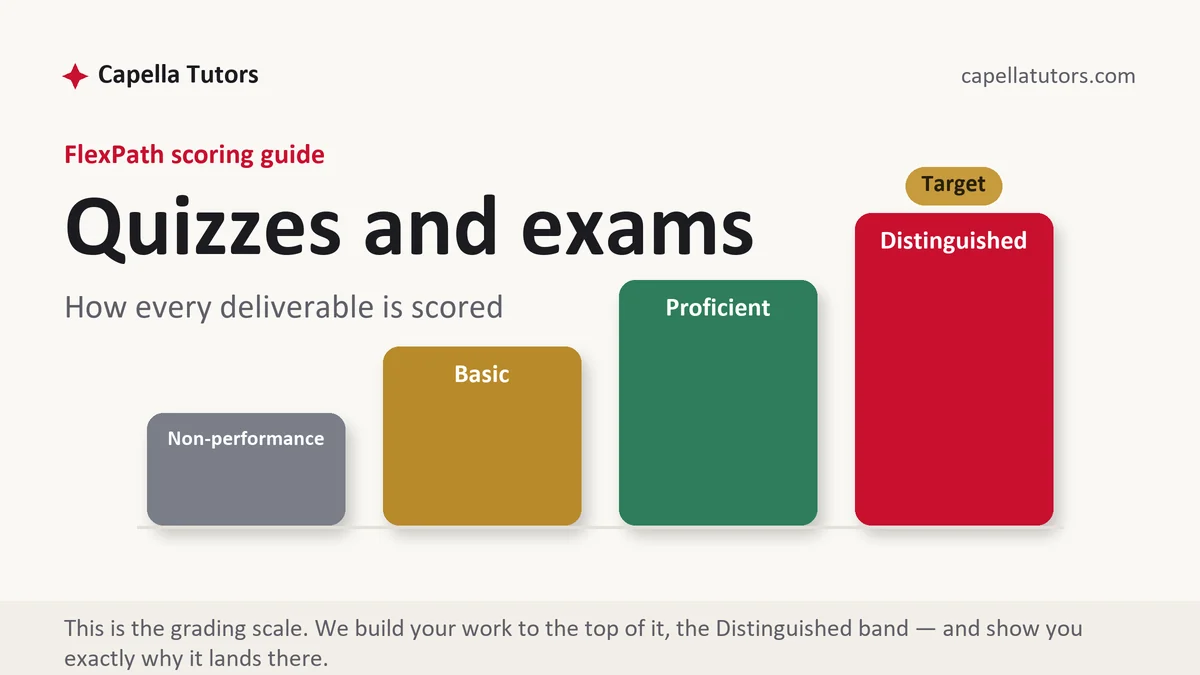
FlexPath's design replaces testing with demonstration: every course is its assessments, revised until Distinguished is reachable, no proctors, no question banks, no timed anything. The practical consequence is that "exam help" at Capella mostly means realizing you do not need it and putting the hours where the grade actually lives, the scoring guides. Students transferring in from exam-heavy schools consistently over-prepare for tests that never come and under-prepare for criterion writing; one free sample from the sample desk recalibrates that instinct in a day.
GuidedPath: quizzes on the weekly clock
GuidedPath courses run faculty-led weeks, and some sections carry quizzes or tests alongside the discussions and papers. The prep kit is the standing one: notes condensed to the tested units, practice at pace with why-this-answer explanations, and the target-score math run from your gradebook so you study to a number. Exam weeks trigger the split, the week's written load moves to the desk, your study hours stay whole, per the GuidedPath desk.
Simulations: scenarios in, assessments out
- Scenario-based assessments, Vila Health among them, grade the document you write from the simulation, not clicks inside it
- Send the scenario's facts, characters, data, constraints, with the scoring guide, and the draft builds from that world exactly
- Scenario fidelity is a scored behavior: generic answers to specific simulations are the classic point leak
- Multi-assessment scenario courses keep one writer, so the world's details stay consistent across the file
The boundary, stated once more
Anything timed, monitored, or sat, wherever it appears, is yours alone; our lane is preparation and the written work around it. That line is permanent, and at Capella it is also barely needed: the university's own design keeps nearly the whole grade in exactly the work this site was built to draft.
Which system owns your course?
Send the course code and what the courseroom shows. The honest map and a free sample come back same-day.
Capella exam and quiz help, sorted by the format your course actually runs
Capella exam and quiz help covers four different objects, and only one of them is a test in the sense most students mean. Work out which row your course sits on before you buy anything, because the preparation is different in each one and the courseroom states it plainly.
| Format | Where it appears | What is actually scored | Where we fit |
|---|---|---|---|
| Written assessment | Every FlexPath course | The file, criterion by criterion, at four levels | Model draft and walkthrough, 24 to 48 hours |
| Timed quiz or test | Some GuidedPath sections | Your answers, inside the window your section sets | Preparation only; you sit it |
| Recorded video assessment | Both formats, through Kaltura | A written scoring guide, not production quality | Criterion-mapped script, slides where needed |
| Simulation scenario | Nursing and health sciences, Vila Health among them | The write-up you produce afterward | Draft built from your own scenario decisions |
Sections and terms vary, so treat that as a map and your own syllabus as the authority. The tool-level mechanics of the last two rows are documented in the Vila Health guide and the Kaltura guide. If your section carries something timed that the map does not name, send a screenshot and a straight answer comes back the same day.
Preparing for a scoring-guide-graded simulation, not a memorization test
A simulation rewards a completely different kind of preparation than a test does. Nothing inside the scenario carries a score, so memorizing it is wasted effort. What carries the score is the document you write afterward, judged against the same four-level guide as any written assessment, which means the useful work happens while you are still clicking.
Keep a decision log open in a second window. Every time the scenario asks you to choose, write four things down: what you chose, why, what in the scenario supports it, and which criterion it will serve later. Capture the specifics as you pass them, the character names, the unit, the numbers printed on the documents you are shown, the constraint that made the easy option impossible. Those specifics separate a write-up that reads like it happened to you from one that reads like it was assembled from a template, and scenario fidelity is scored. Where reflective entries are required they commonly run 100 to 400 words each, with the range in your own guide governing; at that length there is room for one observation, the reasoning, the evidence, and the implication, and nothing else.
What live support can and cannot do while you are being monitored
Stated plainly, so nobody has to ask twice. During anything timed, monitored, or proctored, we do nothing. Nobody joins the session, nobody sits on a call beside you, nobody logs into your courseroom, nobody feeds an answer through a second screen. That is not a limit we are apologizing for, it is the line the whole service is built on, and a deadline does not move it.
What support can do sits on either side of that window. Beforehand: notes condensed to the tested units, practice questions with the reasoning attached rather than a bare key, and the target-score arithmetic run from your own gradebook so you study toward a number. Afterward: a post-mortem on what you missed and why, which is the step students skip and the one that changes the next attempt. At Capella the boundary costs you remarkably little, because the FlexPath design carries no proctors and no question banks and puts the grade in written work. If a service offers to sit a monitored session for you, notice who carries the consequence when it goes wrong, and notice that it is not them.
The study method that maps to criterion-based grading
Studying for a criterion table is a different skill than studying for a test, and it is learnable in an evening.
- Find the verb in the top column of each criterion, analyze, evaluate, compare, justify, recommend, and treat it as the instruction it is; the level below usually asks for the same content with that verb removed
- Turn the criterion list into the outline before you reread the prompt, one heading per criterion, so nothing you write lands outside a scored box
- Mark your own draft Non-performance, Basic, Proficient, or Distinguished on each criterion, then rewrite only the rows that came out low
- Read similarity in a Turnitin draft slot rather than the attempt, since the drafts are private and a fresh submission replaces the old report after 24 hours
- Submit early in the week where you can, because the two business days faculty have to evaluate an attempt do not count weekends
Two rounds of that self-scoring pass usually make the marks predictable. Students who reach the point of calling their own criterion levels correctly before the evaluation lands are the ones who stop needing a desk at all, and that is the intended end of it.
Quiz and exam questions students actually ask
Does FlexPath have exams or proctored tests?
No. Each FlexPath course is graded on its assessments, every one scored against a published guide at four levels, with attempts you can revise. There is no question bank, no proctor, no timer. A student arriving from an exam-heavy program can reclaim the hours they were about to spend on test technique and put them into criterion writing instead.
Will you log in and take my quiz?
No, in any format and at any price. We build the preparation and you sit the quiz yourself. Worth adding that we hold no Capella login at any point, so the question does not arise as a practical matter either.
How do I prepare for a recorded assessment?
Like a paper you happen to read aloud. Build a criterion-by-criterion talking script, rehearse it against the stated time limit, then record. The recording is scored against a written guide, so a criterion skipped on camera scores exactly as it would if you had skipped it on the page, and better lighting does not compensate.