Capella's DNP runs in FlexPath under a Tuition Cap marketed below $32,000, and it is a writing doctorate: practice-focused assessments, evidence syntheses, and a culminating project, scored against scoring guides like every FlexPath course. We support all of it, doctoral-register drafts to the Distinguished column in 24 to 48 hours, project chapters scoped like the long work they are, plus IRB paperwork and virtual practicum support where your track carries hours. Doctoral evaluations take longer to return, which is why the expedite plan honestly budgets three sessions, not one.
The doctorate's shape
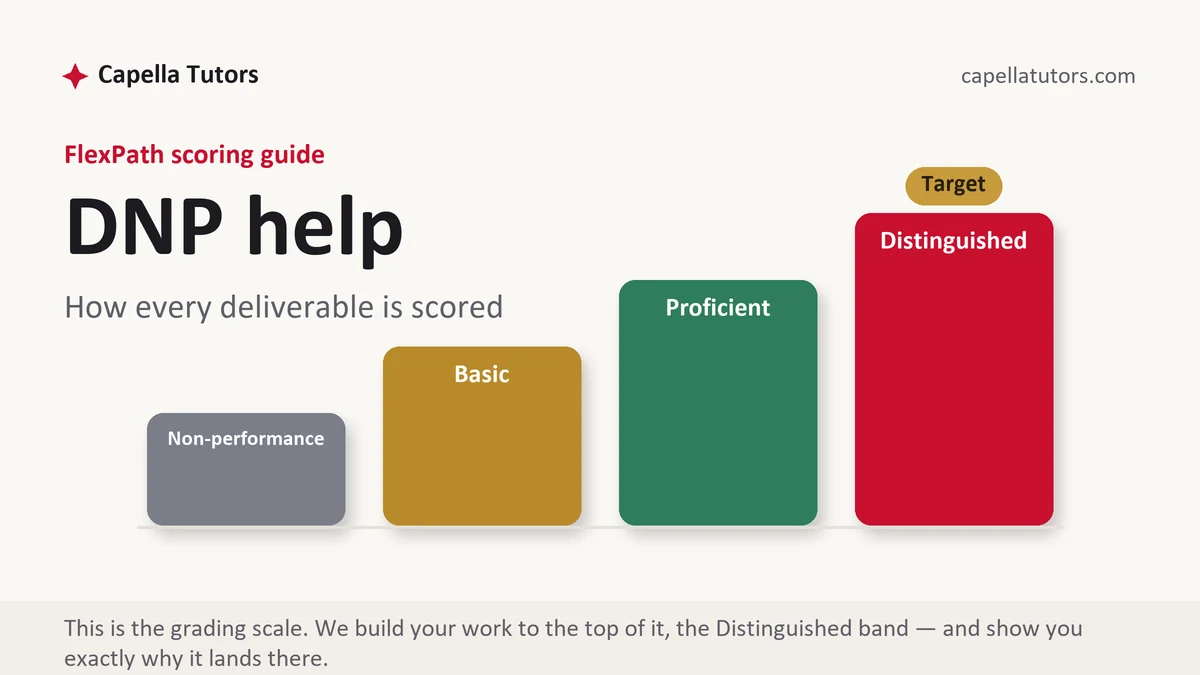
The DNP sits at the top of Capella's FlexPath ladder: 9000-level courses, self-set target dates inside flat-rate 12-week sessions, two courses at a time, and competency scoring with Distinguished at the top. The Tuition Cap changes the psychology, slower students stop bleeding money at the cap, but not the calendar, and for practicing nurses the calendar is the real cost: every quarter in the program is a quarter at pre-DNP pay and pre-DNP standing. The plan treats time, not just tuition, as the thing being saved.
What doctoral-level writing means here
The jump from MSN to DNP writing is register and rigor, not length for its own sake. Scoring guides at this level expect synthesis across bodies of evidence rather than source-by-source reporting, explicit appraisal of evidence strength, practice implications argued with local data, and limitations named without prompting. Our doctoral bench, led by DNP-credentialed specialists, writes to exactly that: drafts that read like a colleague's manuscript, with the walkthrough notes showing where each criterion is satisfied so your revision pass is fast and your defense of the work is real.
The DNP project, treated like the long game it is
The culminating project is where doctorates stall: proposal, IRB or site approvals, implementation writing, and the final deliverable, each gated on the last. We scope it up front into a chaptered plan with real dates, draft each stage through the standard two-QA pipeline, and run the paperwork in parallel, IRB applications prepared and supported, practicum or project hours tracked virtually where your program allows, logs kept current. The single best predictor of an on-time DNP is paperwork that never waits on writing and writing that never waits on paperwork; making that true is the service.
The three-session math
Doctoral FlexPath bills $3,400 to $3,480 per 12-week session at published rates. A typical multi-year doctoral crawl approaches the cap; three expedite-plan sessions bill roughly $10,200 to $10,440, under a third of it, and return your evenings a year or two early. The honest caveat repeats: doctoral evaluations take longer per assessment, so submit-on-grade cadence matters more here than anywhere, and your manager plans around evaluation lag from day one. Numbers and the calculator live on the expedite page.
Bring the course, or bring the project
A single 9000-level assessment or the whole project plan. First premium sample free, doctoral register, 24 to 48 hours.
Doctoral expectations, measured against the master's
Nurses who ask for Capella DNP class help almost always finished an MSN recently and expect the doctorate to be the same work at greater length. It is not. The change is in what counts as evidence, what counts as a claim, and who has to agree with you before the work can proceed.
| Dimension | At the MSN level | At the DNP level |
|---|---|---|
| Evidence handling | Appraise a set of studies against one clinical question | Synthesize a body of literature and say where it converges, where it conflicts, and what it still cannot answer |
| Local data | A national statistic plus what you have seen on your unit | A measured baseline from your own site, collected before you propose anything |
| Strength of claim | Recommend a practice change and name the barriers | Implement or simulate a change and evaluate whether it moved the metric |
| Practicum scale | A minimum of 500 documented hours | A minimum of 1,000 supervised hours in the FlexPath catalog listing |
| Usual failure mode | Appraisal that summarizes instead of comparing | A project that stalls waiting on an approval nobody chased |
One detail tells you how seriously Capella treats the shift: the catalog carries a dedicated 2-point doctoral writing course for nurses. A program does not spend a course on register unless register is where students fail. Compare the master's capstone in NURS-FPX6085 against what follows and the gap is visible in the hour count alone.
The sequence, as the catalog listed it
Treat this as shape rather than as your bill of materials. Capella's FlexPath DNP catalog listing for 2024-2025 set the degree at least 26 program points with a minimum of 1,000 supervised practicum hours, built from a doctoral core at the 8000 level covering doctoral collaboration and case analysis, advanced doctoral writing, nursing research and evidence-based practice, person-centered doctoral practice, executive leadership, technology and health information systems, and advanced global population health; a quantitative design and analysis course; and a five-course project sequence numbered NURS-FPX9000 through NURS-FPX9040. Thirteen courses at 2 points each is exactly 26, so there is no elective slack in the plan.
Capella revises sequences and retires codes between catalog years, so verify against your own program handout before planning around any of it. What is worth planning around is the ratio: five of the thirteen courses are the project, which makes the doctorate one long deliverable with coursework wrapped around it rather than coursework with a paper at the end. Course-level manuals on this site cover the programs beneath the doctorate; the catalog lists what is published.
What a DNP project asks that an MSN paper does not
An MSN paper can be written entirely from the literature and your own experience. A DNP project cannot, and that is the whole difficulty. It asks for four things a master's deliverable never needs: a problem quantified at your own site before you intervene, a change or implementation model that governs how you intervene, a plan naming stakeholders and a timeline, and an evaluation with a metric defined in advance and a window in which you will measure it. Add dissemination, and add the approvals that gate all of it.
What those four share is that each commits you to something before you write it, which is why a project that reads beautifully can still fail. You cannot retrofit a baseline after the intervention, and you cannot invent an outcome measure nobody was collecting at the start.
- A project scoped as research instead of practice improvement. The distinction determines which approvals you need and how long they take.
- No baseline. Without a before number there is no after, and the evaluation criterion has nothing to grade.
- An outcome measure your site does not collect. If nobody pulls that report today, nobody will pull it for you in six weeks.
- A verbal yes from a site with nothing signed. Enthusiasm is not an agreement, and it changes when the person changes jobs.
- Seeking a determination on human-subjects review after the proposal is written. Ask early, since the answer can reshape the design.
Specific deliverable names, gate structures, and review requirements vary by cohort and by year, so confirm yours in your project handbook rather than assuming a classmate's timeline is yours.
Evaluation lag, and how to plan around it
FlexPath gives faculty two business days to evaluate an attempt, and doctoral work sits at the long end of any such window. Work the calendar cost. Submit on a Thursday and a two-business-day evaluation crosses a weekend, so four calendar days pass; do that eight times in a session with nothing else running and you have spent roughly a month waiting rather than writing. The lag is not the problem. Idling through it is.
The fix is structural rather than motivational: never be waiting on only one thing. With two courses open, the attempt out for evaluation in one is drafted-and-queued time in the other, and the lag disappears into the rotation. Our two-course rotation playbook sequences it, and how long FlexPath scoring takes covers what to expect and when to ask. Confirm the current evaluation window in your courseroom, since policy language changes, and read the FlexPath writing manual once even at doctoral level; the criterion method does not change with the degree.
DNP questions students actually ask
Is the DNP project a dissertation?
No, and treating it like one is the most expensive early mistake. A dissertation generates new knowledge; a DNP project translates existing evidence into a practice change at a real site and evaluates the result. That difference shows up everywhere, in the review pathway you need, in whether you require a control group, and in what your final chapter argues. If your proposal is trying to prove something new, rescope it before submitting.
How is a DNP different from a PhD in nursing?
Broadly, the DNP is a practice doctorate aimed at leading change in care delivery, and the PhD is a research doctorate aimed at producing evidence. Both are terminal degrees and neither outranks the other; they answer different career questions. Confirm the specifics against each program's own description, since structures differ by school.
Does the Tuition Cap mean time stops costing me anything?
It caps one of the two costs. Beyond the cap your tuition stops growing, which is real protection, but every additional quarter is still a quarter spent at pre-doctoral pay and pre-doctoral standing, and that cost has no cap. Our Tuition Cap math shows where the tuition curve flattens; the calendar curve never does.