We draft the capstone deliverables here, section by section, first one free and back inside 24 to 48 hours, then revised until your scoring guide is satisfied. The course is NURS-FPX6085, MSN Practicum and Capstone. It is worth 3 points, the largest single block in Capella's 27-point FlexPath MSN, and it carries 200 of the program's 500 documented practicum hours. Students search NURS6085 and NURS-FPX6085; either way, this is the page.
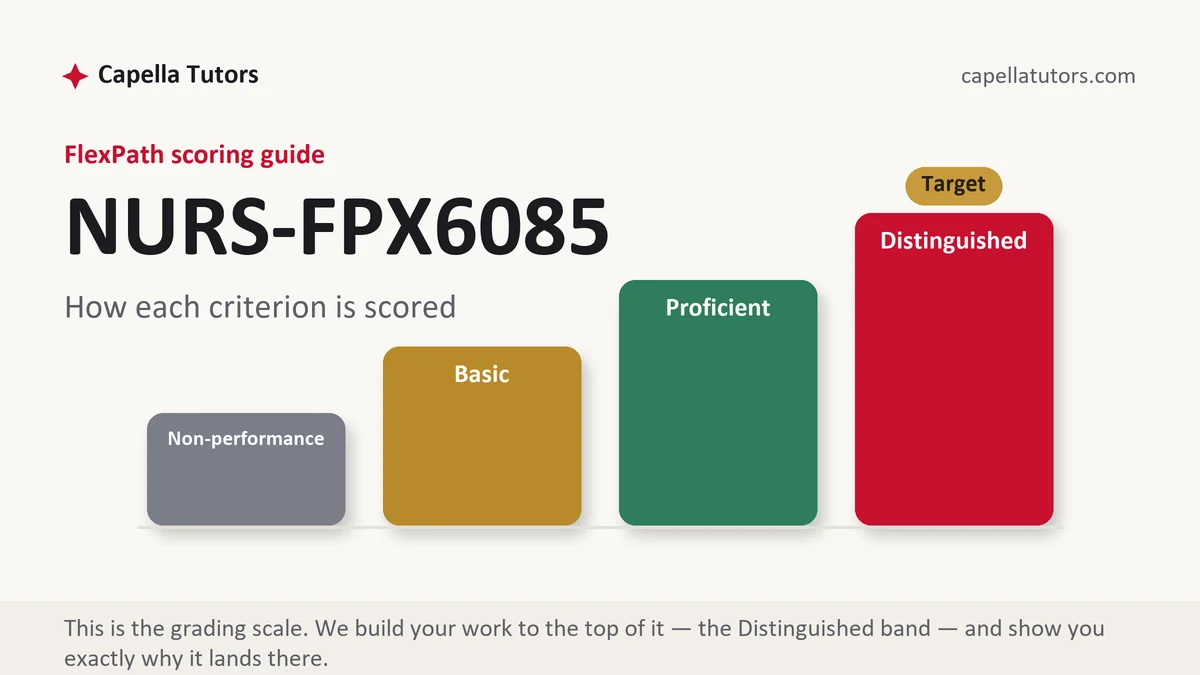
What NURS-FPX6085 actually grades
Two obligations arrive fused. You owe 200 verified practicum hours, and you owe a capstone project that was delivered somewhere real and then argued in writing against criteria scored from Non-performance to Distinguished. The grading does not reward effort in the setting. It rewards a defensible design, a result you can point at, and an account honest enough to include what did not move.
The deliverables usually walk one project through its life: name a problem in your practice setting and show why it matters there, ground the response in current evidence and in your specialization's own literature, put it into practice across your logged hours, measure what happened against a baseline, then reflect on the program outcomes the exercise demonstrates. Read every scoring guide before you commit to a project. A project that suits the opening deliverable and starves the evaluation is the standard way to lose a session.
The point value tells you where this sits. Three points against two for almost everything else means the workload runs half again as heavy, and it usually lands at the end, where it doubles as an audit of everything you were supposed to have learned. Your RN license has to stay current and unrestricted through the finish, and FlexPath's flat 12-week session with up to two open courses is the container it all fits inside.
How we help in this course
A capstone gets scheduled rather than ordered. We take your scoring guides and your target date, break the course into sections, and put a delivery date on each so the writing stays ahead of your hours instead of chasing them. Each section runs the eight-person pipeline: research analyst builds the criterion map, MSN-credentialed writer drafts to it, scoring-guide QA checks that every criterion has an answer, APA and originality QA close it out. Sections come back in 24 to 48 hours, revised until the work meets the guide.
Say the honest part out loud: we write the deliverables and the documentation, not the clinical work. Project plans, evidence reviews, implementation write-ups, outcome analyses, the program-outcome reflection, the paperwork narratives around your site and preceptor. The 200 hours belong to you, worked at your site and verified by whoever oversees you. Our job is to see that the work inside those hours reaches the page as argued evidence rather than a summary of a busy term.
Send the scoring guides, your specialization, your setting, and the problem you are circling, early enough that the project can be shaped rather than rescued.
Two hundred hours and one project, in the same weeks
Run the arithmetic before you register. Two hundred hours across a 12-week session is about seventeen hours a week if you begin in week one, closer to twenty-five if you spend the first month arranging things. Those hours are clock time at a site whose calendar answers to a manager, not to your target dates, and they sit on top of the reading and writing the capstone itself needs.
The hours and the project are the same activity, which is the part students miss. Your baseline comes out of early hours spent watching how the process actually works, not out of what the policy says it should. Your implementation is hours. Your measurement is hours. If your log and your capstone narrative describe different terms, one of them is fiction, and graders read them side by side.
So protect the front of the session. Approvals in hand before hour one, a preceptor who knows your schedule, a site contact who has agreed to what you are about to change. Weeks lost at the start of a flat-rate session are the most expensive weeks in the program.
Outcomes, measured rather than hoped for
Decide what you will measure before you implement anything, and write the measure into the plan. One number, or a small set, obtainable by you, sensitive enough to move inside a few weeks: compliance with a step, time to completion, documentation accuracy. Capture the baseline first. A project that reaches evaluation with no before has nothing to argue.
Then be a grown-up about the size of your evidence. Twelve weeks and one unit will not give you significance, and claiming it is worse than admitting the limit. Distinguished evaluation sections separate process measures from outcome measures, say which they could realistically move, and treat a flat result as a finding to explain rather than a failure to hide. Graders recognize a number that was decided after the fact.
The assessments, one by one
Assessment 1
Send the scoring guide and your target date and a premium original sample of this deliverable returns in 24 to 48 hours, revised free until the criteria are satisfied. Read the full Assessment 1 manual.
Assessment 2
Send the scoring guide and a line about your setting and a premium original sample comes back inside 24 to 48 hours, revised at no charge until every criterion is met. Read the full Assessment 2 manual.
Assessment 3
Send the scoring guide and your problem statement and a premium original sample returns within 24 to 48 hours, revised free until the criteria are satisfied. Read the full Assessment 3 manual.
Assessment 4
Send the scoring guide, your baseline, and your result and a premium original sample comes back in 24 to 48 hours, revised free until the guide is met. Read the full Assessment 4 manual.
How to actually write NURS-FPX6085: where to begin
Begin with the project choice, because everything else is downstream of it. Put every candidate through three filters: a baseline you can collect yourself in your first weeks, an evidence base already visible in the literature, and a full cycle of build, deliver, and measure that fits the hours with slack left for the site being the site. One handoff process on one unit, one onboarding gap for new staff, one documentation field nobody completes; problems that size finish. Anything needing three departments to agree does not.
Then write to the guides mechanically. Each criterion becomes a heading, the Distinguished description goes underneath, and you draft to the description before deleting it. Keep one master file holding your problem statement, your baseline numbers, your source list, your dates, and every design decision. You will quote yourself constantly, and later sections are graded partly on whether they know what the earlier ones said. Version your numbers there too; a baseline that shifts between sections without explanation is what faculty notice and ask about.
One more choice worth making deliberately: write in your specialization's register. A care coordination capstone should read like coordination work, an informatics one like informatics, a leadership one like administration. Generic quality-improvement prose reads as a student who could have written the same paper in any specialization.
| Section | What goes in it | What Distinguished looks like |
|---|---|---|
| Problem and setting | The practice problem, the unit or population it affects, and the baseline that shows its size today. | A problem small enough to move in one session, quantified from your own setting rather than from national statistics. |
| Evidence and design | Current literature plus your specialization's standards, and the intervention those sources justify. | Design choices traced one by one to sources, including a reasonable option you rejected and the reason. |
| Stakeholders and approvals | Who has to agree, who has to change behavior, and what the site required before you could start. | Resistance anticipated with named parties and a concrete plan, not a paragraph about the value of buy-in. |
| Implementation across your hours | What you actually did, when, with whom, and what changed in the plan once reality arrived. | A dated account tied to the log, with the improvised adjustments explained instead of quietly edited out. |
| Outcome evaluation | The measure, the baseline, the post-implementation result, and what the comparison supports. | Honest limits on a small sample, process and outcome measures kept apart, a flat result interpreted rather than buried. |
| Program-outcome reflection | The program's outcomes, each one matched to evidence from the project. | Specific artifacts cited as proof, plus a clear statement of the outcome you met only partly and what would close the gap. |
Developing the synthesis
The capstone asks for synthesis on three planes, and the third separates the grades. Across sources, put studies that disagree in one paragraph and pick a side with reasons: a workflow redesign that held in an academic center may say very little about your community hospital's night shift, and saying so is analysis. Across your own sections, keep the chain visible, so the design answers the barriers your stakeholder analysis found and the evaluation measures what the problem statement called wrong. Across the program, the capstone has to show that your specialization coursework changed how you think, which means those frameworks do real work in the design rather than appear once as a citation. Two habits pay off. Compare your result to the effect sizes in your sources and explain the gap, since a smaller change than the literature promised is normal and interesting. And name the question your evidence could not answer, usually whether anything you started survives your leaving.
Citations that survive faculty review
A capstone reference list gets read as a document in its own right, and it announces the project's quality before anyone reaches your evaluation section. Build it from primary studies and the standards bodies your specialization actually cites, mostly within the last five years, gathered through the Capella library rather than whatever a search engine surfaced. Every source should do identifiable work: this one sizes the problem, this one justifies the design, this one supplies the measurement approach. If you cannot say which job a citation holds, it is padding. Label internal material for what it is, since your unit's audit numbers and your preceptor's account of a workflow are site evidence, valuable and not literature. Keep the mechanics boring: citations inside the claim sentences, a reference list that reconciles both directions, consistent formatting from the first section to the last. And avoid the two habits that read as weakness, one source carrying four unrelated claims, and a summary article standing in for the trial it summarized.
The mistakes that land Basic instead of Distinguished
- A project scoped for a doctoral program, still gathering approvals when the session's clock runs out.
- No baseline captured before implementation, leaving the evaluation with nothing to compare against.
- Hours and narrative that disagree, because the log was rebuilt from memory after the writing was done.
- An outcome claim larger than one unit and twelve weeks can support, stated without limitations.
- A reflection that recaps the project rather than assessing your practice against the program outcomes.
- Specialization coursework left out entirely, so the capstone reads like generic quality improvement.
NURS-FPX6085 questions students actually ask
How do I scope a capstone that 200 practicum hours can actually deliver?
Shrink it until three things are true. You can obtain the baseline yourself, without waiting on a data request that may never clear. There is published evidence from roughly the last five years for the response you plan. And the whole cycle, build, deliver, measure, fits inside the hours with room left over, because 200 hours across a 12-week session is about seventeen hours a week from week one. One workflow on one unit passes all three. A department-wide culture change passes none of them.
Can I take this course at the same time as another one?
FlexPath allows up to two courses open at once, and pairing this one with a light second course is normally fine. Pairing it with another heavy one is how students end a session with the project half implemented. Do the arithmetic before you register: the 200 hours are real clock time at your site, and they sit on top of the reading, writing, and revision the capstone deliverables need. If you have to choose, protect the hours; the writing schedule can flex around them, the site's calendar usually cannot.
What does the program-outcome reflection have to prove?
That you can judge your own practice against the program's outcomes with evidence, not that the capstone went well. Take each outcome, point at the specific thing in the project that demonstrates it, and say what the project revealed about where you still fall short. A reflection that summarizes the capstone sits at Basic. A reflection that names an outcome you only partly met, and what it would take to meet it fully, reads as the graduate-level self-assessment the criteria are looking for.
Building the capstone right now?
Send your scoring guides, your specialization, and the problem you are circling. First premium section free, back in 24 to 48 hours.