This manual is for NURS-FPX6085 Assessment 1, start to submission. Send the scoring guide and your target date and a premium original sample of this deliverable returns in 24 to 48 hours, revised free until the criteria are satisfied. The opening deliverable in NURS-FPX6085 usually asks you to convene and then document the planning conversation that starts the capstone: the student, the preceptor, and the faculty or academic contact agreeing on scope, hours, communication, and dates. Your scoring guide decides the format and the required contents. What follows is how our tutors prepare and write that record, the structure that maps it to the criteria, and an annotated excerpt. Your courseroom may print this as NURS FPX 6085 Assessment 1 or NURS6085 Assessment 1; it is the same deliverable, and NURS-FPX6085 Assessment 1 is what this manual walks through.
One honesty note before the manual: Capella revises courses and scoring guides over time, so always write to the exact scoring guide attached to your assessment in the courseroom. The course identity above is verified on capella.edu; the method and structure below are our tutors' approach to it, not Capella's official rubric text.
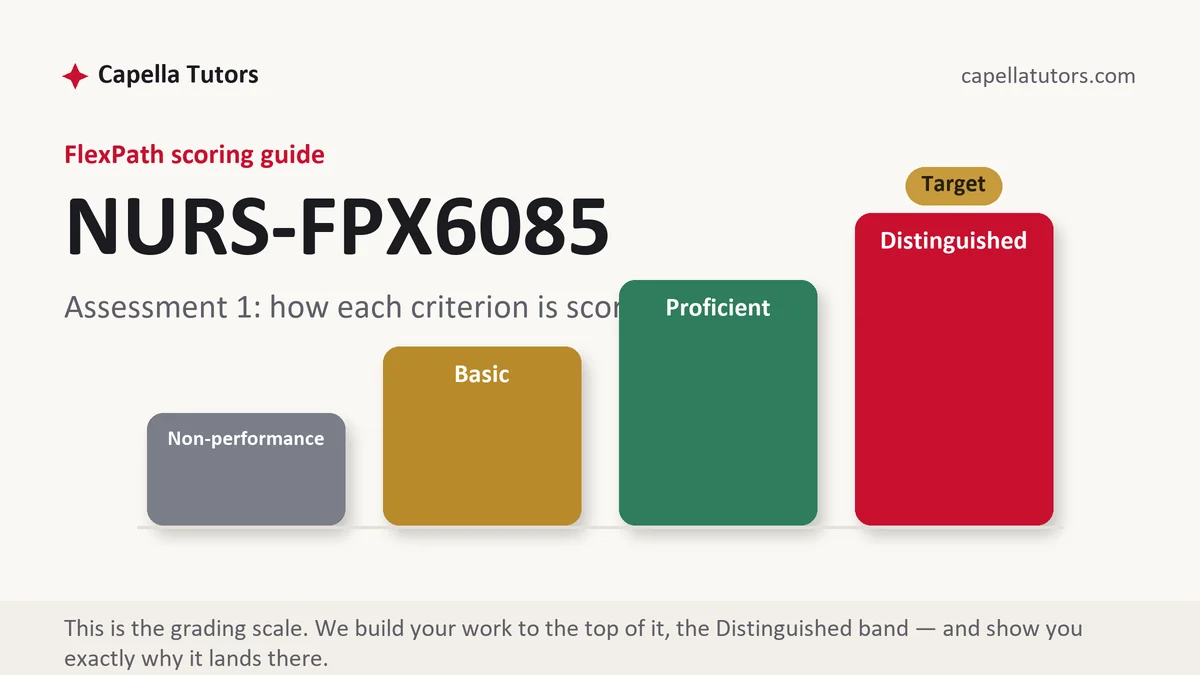
How NURS-FPX6085 Assessment 1 is scored
No letter grades exist in FlexPath. Each criterion resolves to one of four levels, and the level text is the brief for the section it governs:
| Level | What it means on a practicum planning record |
|---|---|
| Distinguished | Every participant, decision, owner, and date is recorded, the project is described narrowly enough that a reader could tell whether it had been done, and the record notes what was left unresolved along with when it will be settled. |
| Proficient | The conversation is documented accurately and the participants and topics are all present, but the project remains described in intentions rather than in commitments with owners attached. |
| Basic | A summary of a meeting that happened. Topics listed, tone recorded, nothing an evaluator or a preceptor could later be held to. |
| Non-performance | A required participant, approval, or agreement element is absent from the record. On this deliverable the missing item is usually a date or a named owner. |
Write it as a governance document rather than a courtesy summary. Two hundred practicum hours and a delivered project are about to be built on the agreements made in this conversation, and the later deliverables in the course are read against what this one says you undertook.
The NURS-FPX6085 Assessment 1 method, step by step
-
Schedule around the least flexible calendar first
Offer your preceptor three specific windows rather than asking when suits, and treat their availability as the fixed point that everything else moves around. Clinical managers and educators hold the most fragmented calendars in the arrangement, and a request without options usually returns as a delay. Book it early in your session, since every week spent arranging the conversation is a week the 200 hours are not accruing.
-
Arrive with a project already narrow enough to discuss
Bring one candidate and one alternative, each stated in a sentence naming the problem, the unit, and what would change. Turning up with an open question wastes the only meeting where all three parties are present and produces a record full of possibilities. A preceptor can accept, refuse, or reshape a proposal in five minutes. Nobody can help you choose a topic in five minutes.
-
Route a written agenda before the call
Send a one-page agenda a few days ahead: the proposed project, the hours arithmetic, the measurement you have in mind, the approvals you believe are needed, the supervision and contact arrangement, and the dates you want confirmed. This is the single act with the largest effect on the quality of the record, because participants who read the agenda arrive with objections ready, and objections raised in the planning conversation are the cheapest ones you will ever handle.
-
Record decisions and owners, not conversation
Write in the register of minutes. Every line should hold a decision, the person accountable for it, and a date. Discussion belongs in the record only where it explains why an option was rejected, which is worth keeping because later deliverables often need it. Reconstructing this from memory a week later produces exactly the vague document the Basic column describes, so take the notes live or immediately afterwards.
-
Convert the notes into a plan the later deliverables can quote
Add the arithmetic the conversation implied. Two hundred hours across a 12-week session runs near seventeen hours a week from week one, so write the weekly commitment down, put the baseline collection window and the implementation window on a timeline, and name what has to be true before each begins. Then open a master file holding the problem statement, the measure, the dates, and every decision, because you will be quoting yourself in every remaining deliverable and continuity between them is graded.
-
Circulate for correction, then file it
Send the record to everyone who was present and ask them to correct anything misstated, then keep the confirmations. A preceptor who has agreed in writing to a schedule is a different proposition from one who nodded on a call, and this documented alignment is what protects you when the site's priorities shift in week six. Self-score against the guide before submitting, and submit early in the week.
A structure that maps to the criteria
Planning targets our tutors use for a typical practicum planning record, not Capella rules; expand whatever your own guide weights.
| Section | What it must do | Guide |
|---|---|---|
| Participants and logistics | Who attended, in what role, on what date, by what method, and how long the conversation ran. | ~120 words |
| Project scope agreed | The problem, the unit or population, the intended change, and the boundary of what is not included. | ~300 words |
| Hours and schedule | The weekly hour commitment, the baseline and implementation windows, and the dates each phase begins and ends. | ~250 words |
| Approvals and access | Every approval, data access, and site permission required, with an owner and a target date for each. | ~250 words |
| Supervision and communication | Contact cadence, verification of hours, escalation path, and how changes to scope will be agreed. | ~200 words |
| Open items and references | What remains unresolved, when it will be settled, plus any standards or sources already shaping the scope, in current APA. | ~200 words |
Annotated sample excerpt
An original model from our team, written to show the register a planning record needs. Take the moves, not the text.
Scope was agreed as structured mobility rounding on a single 24-bed medical unit, three scheduled rounds per shift, with the ambulation status of every eligible patient recorded at each round; the preceptor declined the wider proposal covering both medical units on the grounds that the second unit is mid-way through a documentation transition until October.1 Baseline collection runs weeks two and three from existing mobility documentation, which the unit educator confirmed I may extract without a formal data request.2 Unresolved: whether physical therapy will supply a staff member for the round design session. The preceptor owns that conversation and will confirm by June 12.3
- 1Scope stated with countable boundaries, and the rejected wider option kept with its reason. Recording the refusal protects you if anyone later asks why the project is small.
- 2Names the data source, the window, and the person who cleared access. Baseline feasibility settled in the first deliverable rather than discovered in week six.
- 3An open item with a named owner and a date. This single habit is what moves a planning record from Proficient to the top of the guide.
The full premium sample for your exact assessment, written fresh to your scoring guide and issue, is free to request. Study it, revise it into your own voice, and submit work you understand.
The five mistakes that cost Distinguished
- Minutes without owners. Decisions recorded with nobody attached to them are the reason an accurate record still scores as Basic.
- A scope no reader could test. Improving mobility culture is not a scope; three rounds per shift on one unit is.
- Hours left unarithmetic. Agreeing to 200 hours without writing the weekly figure down is how a session ends with the project half implemented.
- Baseline access assumed. Data you cannot obtain yourself turns into a week-eight emergency, and the planning record is where that gets caught.
- Open items hidden. A record that presents everything as settled looks tidier and reads as less rigorous than one that names what is not.
Pre-submission checklist
- Every participant named with a role, a date, and the method of the conversation
- Scope stated in countable terms, with the excluded ground named
- Weekly hour commitment and phase dates written out, not implied
- Each approval and data access assigned to an owner with a target date
- Open items listed with resolution dates rather than smoothed over
- Record circulated for correction, confirmations kept, criteria self-scored
Starting the capstone this session?
Send your scoring guide, your specialization, and the problem you are circling. We will build the criterion map, draft the record, and put delivery dates on the rest of the course so the writing stays ahead of your hours. We write the deliverables and the documentation, and nothing past them. The 200 hours are yours, worked at your site and verified by whoever oversees you.