Capella's MSN family splits into two very different experiences. The nurse practitioner tracks, FNP and PMHNP, run in GuidedPath with weekly letter-graded deadlines and supervised clinical practicum. The non-NP specializations, like Care Coordination, run in FlexPath with self-paced competency scoring. We support both: weekly discussions, papers, and care plans on the NP clock with an A target, FlexPath assessments to Distinguished, and virtual practicum plus paperwork support where the hours live. Capella markets its fastest-quartile MSN at 14 months for under $15,000; on our plan the FlexPath MSN typically bills two flat-rate sessions.
First, know which MSN you are actually in
The format decides your week. NP students live on GuidedPath's fixed clock, most work due Thursdays and Sundays at 11:59 p.m. Central, letter grades, up to three classes a quarter. FlexPath MSN students set their own target dates inside 12-week flat-rate sessions and are scored Distinguished through Non-performance per criterion. Everything we do is tuned per track, from the guarantee wording, an A on GuidedPath and Distinguished on FlexPath, to the pacing plan behind it.
The NP tracks: FNP and PMHNP
The didactic phase is a writing load with clinical stakes: pathophysiology, pharmacology, and assessment coursework, weekly discussions with peer replies, SOAP-style documentation, and evidence papers, all CCNE-accredited and rubric-graded. Our NP writers are MSN-credentialed clinicians who draft in a working provider's register, and the weekly cadence service maps every class's Thursday and Sunday obligations together. When the supervised practicum arrives, the clinical hours have their own machinery, and the writing support continues alongside it so neither stalls the other.
The FlexPath MSN: Care Coordination and the non-NP road
The non-NP MSN is FlexPath at its purest: no proctored exams in the standard model, every course a chain of written assessments against scoring guides. Care Coordination is the verified flagship here, and its deliverables, coordination plans, stakeholder analyses, quality write-ups, respond beautifully to the criterion-by-criterion method in our FlexPath manual. This is the MSN where the expedite plan fully applies: two courses running, assessments back in 24 to 48 hours, submit on grade, a course pair closing about weekly.
Practicum, without the scramble
MSN practicum requirements vary by specialization, and the trap is always the same: hours and paperwork discovered late, stalling an otherwise-finished degree. Our virtual practicum support completes hours virtually where the program allows, keeps logs and approvals current, and folds IRB or project paperwork in when the track requires it. Tell your manager your specialization on day one and the practicum calendar gets built alongside the writing calendar.
The two-session math
Master's FlexPath bills $2,640 to $3,075 per 12-week session, flat. A typical pace across two years touches eight sessions, $21,120 to $24,600 at published rates; the expedite plan's cadence typically closes a FlexPath MSN in two sessions, $5,280 to $6,150. GuidedPath NP tracks bill per credit instead, so there the plan buys risk control and an on-time finish rather than flat-rate savings, and we say so plainly. The full math and calculator live on the expedite page.
Tell us your track
FNP, PMHNP, or a FlexPath specialization, plus the course you are in. First premium sample free.
Every MSN course we cover
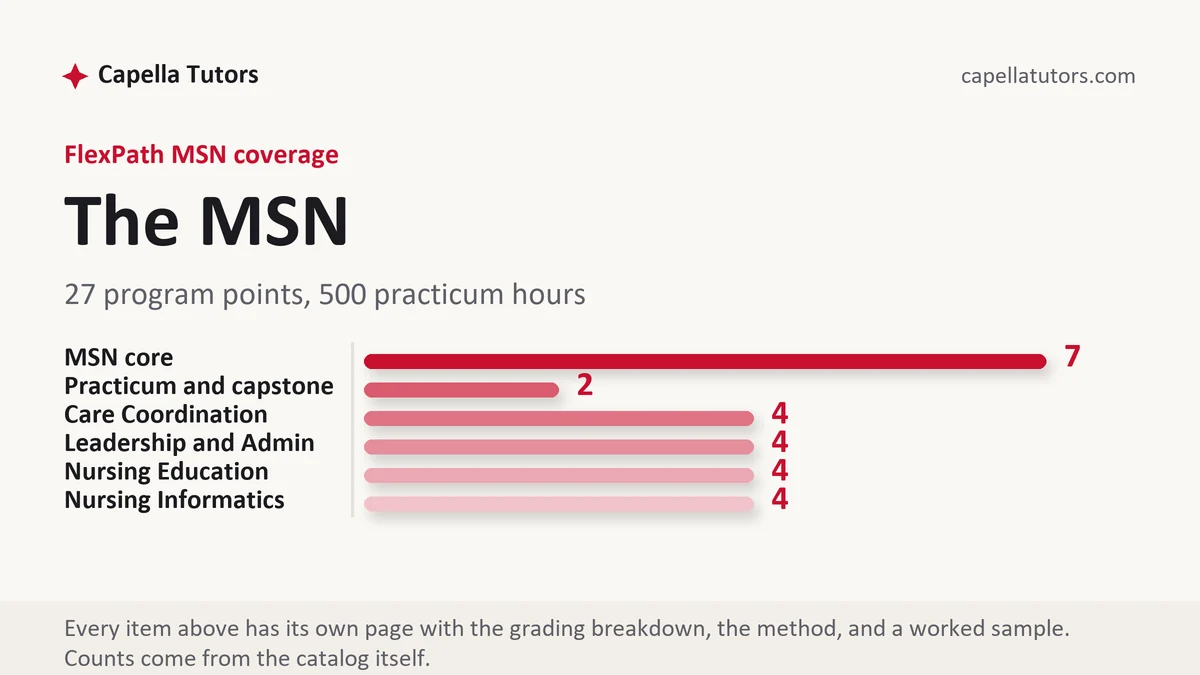
The FlexPath MSN runs 27 program points and 500 practicum hours: a shared core, a four-course specialization, and the practicum pair. Each course below has its own page with what it grades, how to write to its scoring guide, and the help option.
Core, shared by every specialization
NHS-FPX5004, NHS-FPX6004, NHS-FPX6008, NURS-FPX6011, NURS-FPX6016, NURS-FPX6020, NURS-FPX6026
Practicum
Capstone
Care Coordination
NURS-FPX6620, NURS-FPX6622, NURS-FPX6624, NURS-FPX6626
Leadership
NURS-FPX6200, NURS-FPX6222, NURS-FPX6224, NURS-FPX6226
Nursing Education
NURS-FPX6100, NURS-FPX6108, NURS-FPX6112, NURS-FPX6116
Nursing Informatics
NURS-FPX6400, NURS-FPX6422, NURS-FPX6424, NURS-FPX6426
Browse the full course catalog
Choosing between the four FlexPath specializations
Most requests for Capella MSN class help arrive mid-program, by which point the decision that shaped everything is already made: which four-course specialization you attached to the shared core. Most students pick on job title rather than on the work. The four are Care Coordination, Nursing Leadership and Administration, Nursing Education, and Nursing Informatics. All four are the same size and the same price. They are not the same difficulty for you.
| Specialization | The recurring deliverable | Who it goes easily for |
|---|---|---|
| Care Coordination | Coordination plans across settings, plus the ethical and legal analysis behind them | Case managers, discharge planners, anyone who already argues with insurers |
| Leadership and Administration | Safety and quality management writing, and an operations and finance course with real numbers in it | Charge nurses and managers who have held a budget line |
| Nursing Education | Curriculum design, then assessment and evaluation of what the curriculum taught | Preceptors, clinical instructors, staff educators |
| Nursing Informatics | Clinical systems analysis, data mining, and life cycle management of an implementation | Super-users, anyone who has sat on an EHR build |
The tradeoff worth naming: Informatics and Leadership carry the most quantitative writing, harder if numbers are not your register and much faster if they are, while Education and Care Coordination are almost entirely argument and design, which suits strong writers and punishes vague ones. Pick the one whose deliverables you could describe from your own week, because every specialization course asks you to ground the work in a real setting. The criterion method is identical across all four, and the FlexPath writing manual covers it once for all of them.
The 27-point, 500-hour shape, and where the hours hide
Students looking for Capella FlexPath help on the MSN usually know the two headline numbers and not how they resolve. The FlexPath MSN is 27 program points, 54 quarter credits in the GuidedPath equivalent, and a minimum of 500 documented practicum hours. The points are exact rather than approximate: eight core courses at 2 points each is 16, NURS-FPX6085 adds 3, and four specialization courses at 2 each add 8, which is 27 with nothing left over. There is no elective slack to trade away.
The hours are where people get surprised. NURS-FPX6080 carries 100 and NURS-FPX6085 carries 200, which leaves 200 unaccounted for if you assume the practicum lives only in the practicum courses. It does not: the four specialization courses carry roughly 50 hours each, so hour-bearing work starts the moment your specialization starts. Plan on that and the arithmetic stays calm; discover it in your last session and you are logging 200 hours under deadline. Confirm the split for your own specialization in your courseroom, since the distribution can differ.
The practicum paperwork timeline that decides whether a term lands
You are responsible for finding your own preceptor. Capella states that plainly, and it is the sentence that quietly decides whether a 12-week session closes on schedule, because the approval chain has three links and you only control the first one. You identify a preceptor and a site. The site's education or compliance office reviews the affiliation paperwork. Faculty then approve the placement against program requirements. Each link waits on the one before it.
Work one example. Begin asking in week 1 of a session and a colleague says yes in week 3; the education office takes three weeks to return an agreement and faculty review takes one more, so you are cleared in week 7 with five weeks left to log 100 hours around your shifts. Tight, but survivable. Start asking in week 6 and the same chain clears in week 12, so the hours slide into a second billing session and the one you already paid for closes with a single course in it.
- Waiting for the practicum course to open before looking. The search is the long pole and it has no prerequisite.
- A verbal yes with no signed agreement. Hours logged before paperwork clears are usually hours you cannot count.
- One candidate preceptor. People change jobs, go on leave, and get told no by their own managers. Line up two.
Your practicum handbook and your faculty set the actual submission window, so confirm those dates in your courseroom rather than trusting a timeline from a forum.
Why the NP tracks are a different program, plainly
Everything above describes the FlexPath MSN. It does not describe FNP or PMHNP. Those run on GuidedPath, which means quarter credits rather than program points, letter grades rather than criterion levels, per-credit billing rather than a flat session rate, and supervised clinical practicum with its own hour requirements and placement rules. If you are in an NP track, the 27-point map above is not your map and flat-rate session math does not apply to your bill. The two get blended constantly in student forums and the blend produces bad planning, so confirm your own hour requirement, sequence, and placement policy in your handbook. What does carry across is the writing, since discussions, SOAP-style documentation, and evidence papers are still rubric-graded prose, and the GuidedPath weekly service exists because the clock rather than the content is what breaks NP students.
MSN questions students actually ask
Can I switch specializations after I start?
The core transfers cleanly, since all four specializations share it, so a switch made early usually costs nothing but paperwork. A switch made late costs the specialization courses you already completed and the practicum hours attached to them, which is the expensive part. If you are unsure, front-load core courses and delay the specialization decision rather than starting specialization work you might abandon.
Can I do the practicum at my own workplace?
Often yes, and it is usually the fastest route to an approved site, since the affiliation agreement may already exist and you know who signs things. The constraint is that your preceptor cannot simply be your normal charge nurse doing your normal job; the experience has to meet the program's requirements for supervision and scope. Ask your faculty whether your unit qualifies before you ask your manager.
How many courses should I run at once?
Two, which is the FlexPath ceiling, unless one of them is a practicum course. When hours and writing compete for the same evenings, pairing two hour-bearing courses is how both stall. The stable pattern is one hour-bearing course beside one pure writing course, and the two-course rotation playbook works through the sequencing.