Whatever this course has put in front of you, we can send back a premium original sample with a criterion walkthrough inside 24 to 48 hours. The course itself: NURS-FPX6011, Evidence-Based Practice for Patient-Centered Care and Population Health, carrying 2 program points. It sits in the MSN core, so every FlexPath specialization takes it, and it runs on FlexPath scoring inside a 27-point program. Typed either way, NURS6011 or NURS-FPX6011, it is the same course.
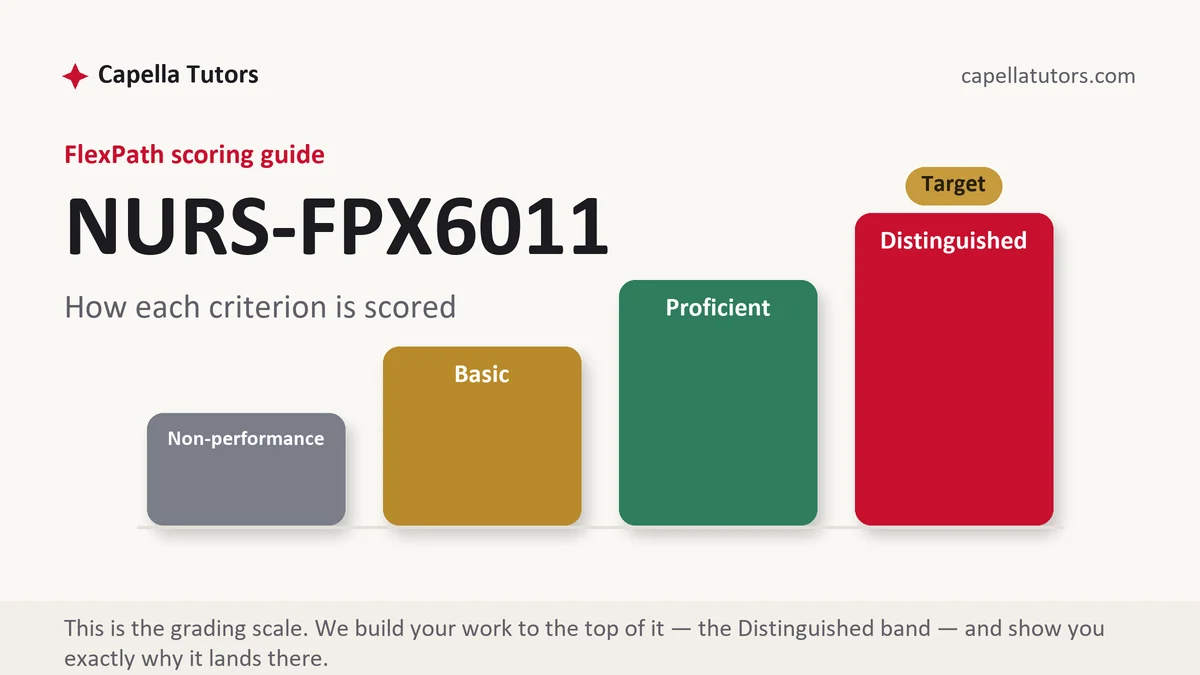
What NURS-FPX6011 actually grades
One skill carries this course: taking a clinical problem, asking it as a question that can be answered, and coming back with a recommendation a unit could act on next month. Graduate reviewers are not reading for an article summary. They read for whether the question was built to be searched, whether someone else could repeat your search from your own description of it, whether the evidence was ranked rather than listed, and whether the recommendation says who changes what. Stop at what the literature says and the criteria have nowhere to award Distinguished, because half the assignment is still sitting there unwritten.
The second half of the course title does real work in the scoring guides. Patient-centered care pulls the argument toward one person, their values, their preferences, their clinical picture. Population health pulls it toward denominators: readmission rates across a cohort, screening coverage across a panel, the gap between two groups inside the same clinic. The assessments in this course usually ask you to hold both at once, an intervention defensible for the patient in front of you and measurable across the group that patient belongs to. Writing only one side of that is the quietest way a competent draft loses points, and your scoring guide decides how heavily each side is weighted.
How we help in this course
Send the assessment prompt and the scoring guide from your courseroom, and the draft comes back as a decision document: the question stated in structured form, databases and search terms named, an appraisal standing behind the synthesis, a recommendation costed in staff time and workflow rather than in enthusiasm. Our research analyst does the database work on this course, so the reference list is assembled from what is genuinely retrievable through the Capella library instead of titles that merely look right.
The studio promise applies to every deliverable here: a premium original sample in 24 to 48 hours, written to the Distinguished column, moved through our eight-person pipeline with two quality passes, then revised free until it satisfies the guide you were given.
What changes at master's level
Undergraduate evidence-based practice coursework is mostly about learning to read research and reflect on having read it. Here you are held responsible for the decision. The criteria assume you can already find a study, so their weight moves to the harder work: choosing between designs that disagree, arguing whether a finding transfers to your setting, and specifying a change with an owner, a start date, and a metric. Reflective phrasing about how your thinking evolved reads as filler in a graduate guide, and it spends words you needed for the appraisal.
The scale changes too. A bedside improvement written for one patient will not clear a criterion that asks about population health outcomes, and a public-health essay with no identifiable patient will not clear one about person-centered care. Write as the nurse who has to defend the proposal twice, once to a patient who asks why this and not that, once to a committee that asks what it costs and how we will know it worked. That double audience is the register the top column is describing.
The assessments, one by one
Assessment 1
Send the prompt and the scoring guide from your courseroom and a premium original sample for this deliverable comes back inside 24 to 48 hours, revised free until the guide is satisfied. Read the full Assessment 1 manual.
Assessment 2
Upload the criteria and the population you are working with, and a premium original sample lands inside 24 to 48 hours with a criterion walkthrough attached and free revisions until it fits. Read the full Assessment 2 manual.
Assessment 3
Tell us which practice change you are carrying and a premium original sample comes back within 24 to 48 hours, written to the Distinguished column and revised free until your guide is satisfied. Read the full Assessment 3 manual.
How to actually write NURS-FPX6011: where to begin
Download the scoring guide before you read the instructions, then rebuild it as your outline: one heading per criterion, the Distinguished wording pasted underneath in a color you will notice. The instructions give you the scenario and the format. The guide gives you the grade. Graduate criteria usually stack two demands in a single sentence, analyze the evidence and explain its relevance to the population you serve, and most lost points come from answering the first demand and walking past the second. Split every criterion into its verbs before you draft a word, and keep the split visible in your document until the last pass.
Build the question before you search. PICOT at this depth means each letter carries a choice you can defend. The population narrows to a group your setting actually treats. The intervention is specific enough that somebody has studied it. The comparison is current practice, stated plainly, not the empty word nothing. The outcome is a measure with a source attached. The timeframe is short enough to evaluate inside a project a real unit would approve. Vague questions produce searches nobody can appraise, and appraisal is where the points concentrate.
Then search as though you will be asked to reproduce it, because the strongest drafts describe the search well enough that a reader could. CINAHL and PubMed through the Capella library for the primary literature, Cochrane for the review layer, with your terms, filters, and date range written down while you work rather than reconstructed afterward. Keep the counts: results returned, abstracts screened, studies kept, and the reason for each exclusion. That paragraph costs ten minutes and lifts a search description a whole level on its own. Rank what survives before you write about it, systematic reviews and meta-analyses above single trials, trials above cohort studies, cohorts above case series, expert opinion last and only where the better tiers are empty.
| Section | What goes in it | What Distinguished looks like |
|---|---|---|
| Problem and question | The clinical or population problem, then the question in structured form. | Every element of the question defended in one clause, with the comparison stated as current practice. |
| Search and evidence base | Databases, terms, filters, date range, and what was kept. | A search a reader could repeat, with screening counts and stated exclusion reasons. |
| Appraisal and synthesis | The quality of what you found and what it collectively says. | Studies weighed against each other by design and applicability, with a verdict rather than a tally. |
| The practice change | What changes, who owns it, which workflow it enters. | A change specified to the level of a shift: role, trigger point, and what staff stop doing. |
| Evaluation and outcomes | The measures, the data source, the interval, the target. | Both layers present, one patient-level indicator and one population-level rate, each with a baseline. |
Developing the synthesis
Synthesis is not a paragraph per article with transitions between them. It is what happens when you put findings into contact and force a verdict. Start by grouping your studies by what they claim, not by author or year, and you will usually find two or three camps. Then make the camps argue. A meta-analysis reports that pharmacist-led medication review lowered readmissions across pooled hospital cohorts; a smaller trial in a rural system found no effect and suggests staffing was the limit. Listing both is Basic. Deciding is Distinguished: the pooled estimate wins on design, but the rural trial wins on resemblance to your unit, so you follow the mechanism and scale the staffing assumption down. Name that reasoning in the text, because a reviewer cannot award analysis they cannot see. Then say what the body of evidence does not settle. Most intervention studies run in settings unlike the one you are proposing for, and a limitation paragraph that says exactly which mismatch worries you, and why the mechanism should still transfer, does more for your score than another paragraph of agreement.
Citations that survive faculty review
Peer-reviewed, roughly the last five years, retrieved through the Capella library so the link resolves for whoever checks it. CINAHL and PubMed cover the primary studies, Cochrane covers the reviews, and a current clinical practice guideline is worth one citation when your recommendation follows it. Every source needs a job you can state: this review establishes effect size, this trial supports feasibility in a comparable unit, this guideline anchors the standard your change moves toward. Sources with no assigned job read as padding, and graduate evaluators notice a reference list longer than the argument it supports. Cite in APA 7 inside the sentence making the claim, with the digital object identifier where one exists, and never let a whole paragraph argue before a parenthetical arrives at the end to cover it.
The mistakes that land Basic instead of Distinguished
- A question so broad that any textbook could answer it, which leaves the appraisal with nothing to compare.
- An evidence section that summarizes five studies in five paragraphs and never puts two of them in the same sentence.
- Levels of evidence mentioned as a concept but never applied to your own retrieved studies.
- A recommendation with no owner, no trigger, and no first date, which reads as an opinion rather than a practice change.
- Outcome measures with no baseline and no data source, so the evaluation plan cannot be run by anyone.
- Population health language attached to an intervention that only ever touches one patient.
NURS-FPX6011 questions students actually ask
How narrow should my PICOT question be?
Narrow enough that a reader could run your search and wide enough that studies exist. Two tests settle it. Search the question first: if CINAHL returns four results, the population is over-specified and you should drop one qualifier, usually the setting. Then read it out loud as a decision: if the answer would not change what anyone does on a shift, the outcome is too abstract and needs to become a measure with a source. Graduate scoring guides reward a question tied to a group your setting actually treats, not a question broad enough to be answered by a textbook.
What do I do when the evidence disagrees?
Say so, then decide. Disagreement is the best thing that can happen to your appraisal criterion, because reconciling it is exactly what the Distinguished column describes and a clean set of agreeing studies gives you nothing to analyze. Weigh the designs first, a systematic review over a single trial, a randomized trial over a retrospective cohort, then weigh applicability, whose population and staffing look like yours. Name the study you are following, name the one you are setting aside, and give the reason in the same sentence.
Do I need real workplace data?
Not usually, and you should never publish protected patient information to satisfy a criterion. What the guides want is a plausible baseline you can source: a unit-level rate you already report, a publicly available benchmark for a comparable population, or a stated assumption labeled as an assumption. Anchoring an outcome measure in a number that has a named origin is what separates a real evaluation plan from a paragraph about monitoring, and a labeled estimate does that job honestly.
In NURS-FPX6011 right now?
Send the prompt and the scoring guide from your courseroom. The first premium sample is free and comes back in 24 to 48 hours.