Send us the scoring guide and we build your NURS-FPX6626 deliverable to the Distinguished column, first premium sample free, returned inside 24 to 48 hours with a walkthrough of the leadership argument. The course is Care Coordination Leadership, worth 2 program points, the closing course of the Care Coordination specialization inside Capella's FlexPath MSN, which totals 27 program points across its core, specialization, and practicum work.
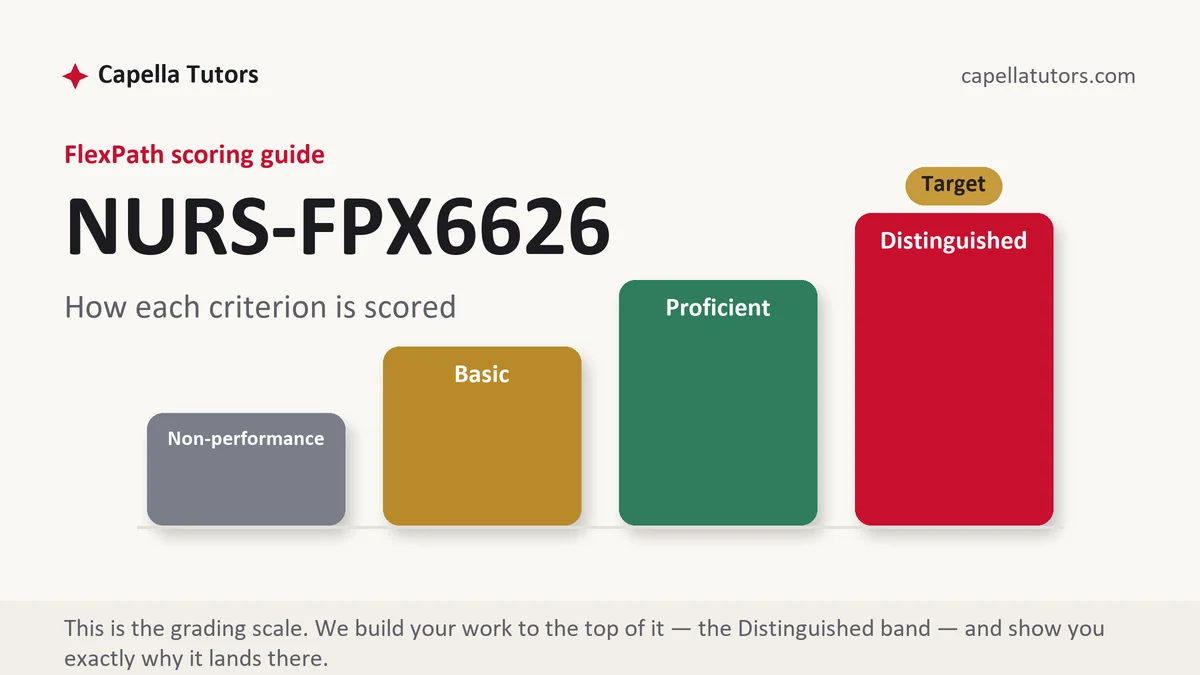
What NURS-FPX6626 actually grades
This course grades authority you do not have. That is the honest description. A coordination program touches physicians, social work, pharmacy, case management, and information services, and the master's-prepared nurse leading it commands none of them directly. So the criteria read for influence mechanics: who has to be persuaded, what each of them wants, which forum makes the decision, and what you do when a department declines to participate. A plan that assumes cooperation has skipped the entire subject.
Second, the guides look for a change approach that survives contact with a real organization. Naming a model earns nothing. What earns the top column is the model driving the plan, with a named resistance at each stage and a specific response to it. The bedside nurses who see one more documentation field. The hospitalist group paid on volume being asked to attend a coordination huddle. Resistance written as a general category is Basic. Resistance written with a face and a reason is Distinguished.
Third, this is where the specialization asks for numbers. Staffing assumptions, caseload ratios, a budget with cost lines and a benefit case, and a sustainability plan that outlives the launch. Coordination sits inside the practicum requirement as well, and Capella's FlexPath MSN requires 500 documented practicum hours, 100 of them carried by NURS-FPX6080 and 200 by NURS-FPX6085, so the program you design here often becomes the spine of later capstone work.
How we help in this course
Drafts for 6626 come out shaped like a proposal an executive committee would actually receive. The problem and the population open it, briefly. Governance follows: the steering group, its membership by role, its decision rights, and the escalation path when the group deadlocks. Then the change plan, staged, with resistance and response written stage by stage. Then the resource case, with arithmetic a finance reader could check. Then sustainability, treated as a section rather than a sentence.
Delivery is 24 to 48 hours per assessment. Two reviewers read the draft before you do, one against your scoring guide criterion by criterion, one on APA 7, source currency, and whether the budget lines and staffing ratios hold together. Revisions are free until the target column is met. Clients closing out the specialization often pair this course with NURS-FPX6624 in one flat-rate FlexPath session.
Change leadership with a named model and a named resistance
Pick a change framework for a stated reason. A staged organizational model suits a launch with a clear before and after, a coalition to build, and short-term wins to publicize. An individual adoption framework suits the situation where the real barrier is a hundred clinicians each changing one habit. Say in one sentence why your situation matches the framework you chose.
Then work the plan through the framework rather than around it. If the model calls for a guiding coalition, name the five people in yours by role and say what each one contributes and what each one wants in exchange. If it calls for urgency, say what data creates it, and be specific: a readmission penalty exposure, a payer contract with quality thresholds attached, a service line losing referrals because discharges stall.
Interprofessional governance deserves its own paragraphs. Write the charter: purpose, membership, meeting cadence, what the group decides versus recommends, and who breaks a tie. Coordination programs die in the gap between two departments that each assumed the other owned the follow-up call, and a charter is the artifact that closes that gap.
Budget, staffing, and the sustainability question
Resource sections fail in predictable ways. They cost the coordinator salary and forget everything else: benefit load, backfill for training days, the analyst hours behind the dashboard, the license fee for the registry tool. Build the cost side as a table, use published wage data rather than a guess, state your benefit percentage as an assumption, and label every estimate as an estimate.
Staffing needs the same discipline. A caseload ratio is a claim, so justify it: what the coordinator does per patient per week, how long each activity takes, how many patients that arithmetic allows. Then say what happens at census peaks and during vacancies, since a plan that only works at full staffing has never worked anywhere.
Sustainability is where the top column is usually won or lost. The mechanics that keep a program alive are unglamorous and specific: the role written into a job description rather than held as a special assignment, the workflow embedded in orientation, the measures moved onto a standing dashboard with a named owner, an annual review with authority to stop the program if it is not working, a named successor for your own role. Programs decay when they depend on one person's attention, and saying so, then designing against it, is the sentence that separates a leader from an enthusiast.
The assessments, one by one
Assessment 1
Send the scoring guide and a premium original sample for this assessment comes back inside 24 to 48 hours, revised free until it meets the guide. Read the full Assessment 1 manual.
Assessment 2
Hand it to us and a premium original sample arrives inside 24 to 48 hours, written to your scoring guide and revised free until it lands in the target column. Read the full Assessment 2 manual.
Assessment 3
Send the guide and we return a premium original sample inside 24 to 48 hours, revised free until it satisfies the criteria. Read the full Assessment 3 manual.
How to actually write NURS-FPX6626: where to begin
Rebuild the scoring guide as your outline before writing a word, one heading per criterion with its Distinguished description underneath while you draft. The assessments in this course generally ask for some mix of a leadership and governance plan, a change strategy with stakeholder analysis, a resource and staffing case, and a document written for people with budget authority, so the guide is the only reliable structure.
Choose your setting for its constraints, not its convenience. A de-identified composite works fine, and it should carry a real limit: a hiring freeze, a 4 percent vacancy rate in case management, a competing record-system upgrade consuming every hour of leadership attention. Plans written against a constraint sound like leadership. Plans written against nothing sound like a brochure.
Draft the stakeholder analysis before the change plan. Every stakeholder gets an interest, a level of influence, and a concession you can offer, and the change plan then has somebody to convince at every stage.
| Section | What goes in it | What Distinguished looks like |
|---|---|---|
| Problem and case for change | The coordination gap, the population it harms, and the organizational exposure it creates. | Urgency evidenced with utilization, penalty, or contract data rather than asserted in adjectives. |
| Governance | The steering group, its membership by role, decision rights, cadence, and escalation path. | A written charter with tie-breaking authority named and the two most likely turf conflicts anticipated. |
| Change strategy | One framework, applied stage by stage, with stakeholders mapped by interest and influence. | Resistance named with a face and a reason at each stage, each with a specific and affordable response. |
| Staffing and budget | Roles and full-time equivalents, caseload logic, cost lines, and the benefit case. | Arithmetic a finance reader could check, with assumptions labeled and hidden costs included. |
| Sustainability and evaluation | How the program survives launch: ownership, embedding, measurement, review, succession. | Named mechanisms rather than intentions, including the condition under which the program should be stopped. |
Developing the synthesis
Leadership evidence in this course is softer than clinical evidence, and pretending otherwise is a mistake. Change model literature is largely descriptive, much of it practitioner writing rather than trial evidence, while the strongest empirical material sits in implementation science and in evaluations of specific coordination programs. Put that asymmetry in the paper. A paragraph that cites a staged change framework beside an implementation study on leadership support, then rules that the framework provides the sequence while the study provides the mechanism, is doing the synthesis the criterion is asking for. Adjudicate on grounds you can state: how close the study setting is to yours, whether the outcome measured is the one you care about. Then name the gap. Most program evaluations report results at twelve months and go quiet, which means the sustainability claims in your own plan rest on reasoning rather than evidence. Say that plainly and the limitations criterion takes care of itself.
Citations that survive faculty review
Run the searches through the Capella library and keep peer-reviewed sources inside roughly five years. CINAHL carries the nursing leadership and role literature, PubMed carries program evaluations and implementation studies. Non-journal authority matters as much here as anywhere in the specialization: AHRQ implementation and toolkit material, CMS program rules and payment policy where they create your case for change, and Joint Commission leadership standards, each cited as a report with the issuing body as author in APA 7. Wage and cost figures need a citation too, from federal labor statistics or a published benchmark. Attach each source to the claim it carries, and if the deliverable goes to stakeholders as a briefing or a deck, keep the citations in the notes with a reference list held to full paper standard.
The mistakes that land Basic instead of Distinguished
- A change model named in the literature review and then never used to structure the plan.
- Stakeholders listed without interests, influence, or anything you could offer them.
- A budget of one salary line, with no benefit load, backfill, technology, or analyst time.
- Caseload ratios asserted as round numbers with no activity arithmetic behind them.
- Sustainability handled as a closing sentence about ongoing commitment rather than as a mechanism.
NURS-FPX6626 questions students actually ask
Which change model should I use?
Any established one, as long as you use it rather than cite it. A staged model works well for a launch with a clear before and after. An individual adoption model works better when the barrier is a hundred clinicians changing one habit each. Pick on that basis, say why in a sentence, then run your actual plan through every stage of the model and name what happens at each one. A model listed in the literature review and abandoned by the plan section earns nothing.
How specific do the budget numbers have to be?
Specific enough to add up, and sourced. Use published wage data for salary lines, state your benefit load as a stated percentage, and count the things people forget: backfill for training days, the analyst time behind the dashboard, license costs. On the benefit side use published avoided-cost figures rather than internal ones. Round numbers are fine when the arithmetic is visible and every assumption is labeled as an assumption.
Does the program have to be for a real organization?
No, but it has to be built for a real constraint. A de-identified composite setting, described generically with its size, payer mix, and staffing model, gives you everything you need. What cannot be invented is the constraint: a budget ceiling, a vacancy rate, a competing initiative already consuming the same leadership attention. Name one and let it shape the plan, and the paper stops sounding hypothetical.
In NURS-FPX6626 right now?
Send the scoring guide and the setting you are leading in. One premium sample free, delivered inside 24 to 48 hours.