This manual is for NURS-FPX6626 Assessment 1, start to submission. Send the scoring guide and a premium original sample for this assessment comes back inside 24 to 48 hours, revised free until it meets the guide. Assessment 1 in this course usually asks for analysis before leadership: the organization as it currently is, the people whose agreement the coordination work needs, and an honest reading of whether the place is ready. Your scoring guide decides the deliverable and the setting it wants. What follows is the method our tutors use for a stakeholder and readiness analysis, a structure built from the criteria, and an annotated excerpt. Your courseroom may print this as NURS FPX 6626 Assessment 1 or NURS6626 Assessment 1; it is the same deliverable, and NURS-FPX6626 Assessment 1 is what this manual walks through.
One honesty note before the manual: Capella revises courses and scoring guides over time, so always write to the exact scoring guide attached to your assessment in the courseroom. The course identity above is verified on capella.edu; the method and structure below are our tutors' approach to it, not Capella's official rubric text.
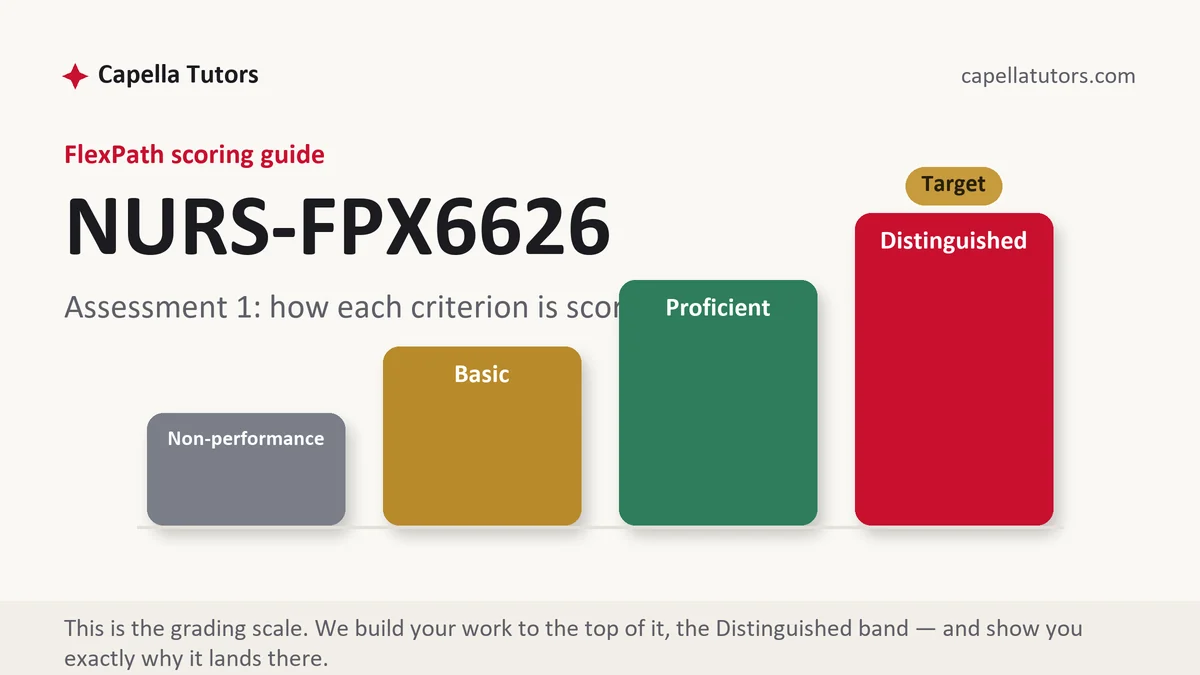
How NURS-FPX6626 Assessment 1 is scored
FlexPath assigns a level to each criterion, and on an organizational analysis those levels separate like this:
| Level | What it means on a stakeholder and readiness analysis |
|---|---|
| Distinguished | Stakeholders are analyzed by interest, influence, and what they would accept in exchange, readiness is judged against a published framework, and the analysis names the one constraint that will decide the outcome. |
| Proficient | A complete and accurate stakeholder map with a fair readiness judgment, presented as description rather than as a diagnosis a leader could act on. |
| Basic | A list of departments that will be involved and a statement that leadership support will be needed, which tells a reader nothing they did not already assume. |
| Non-performance | A required element is absent, most often the influence analysis, the readiness assessment, or the evidence behind either. |
Leadership criteria at master's level are graded on candor. An analysis that concludes the organization is ready and everyone is supportive reads as a document written to be approved, and the criteria are built to catch it.
The NURS-FPX6626 Assessment 1 method, step by step
-
Define the change before assessing readiness for anything
Write the change in one sentence with a boundary: embedding a care manager in each of four primary care sites, holding a defined panel, with the physicians retaining medical decision making. Readiness is always readiness for something specific, and an analysis that never fixed the object of the change produces a generic organizational essay.
-
Map stakeholders by interest, influence, and available trade
Every stakeholder gets three entries and a fourth that most students skip: what they want, how much power they hold over this change, what they will lose, and what you can offer them. Site medical directors want panel control and no new documentation. Practice managers want their room space back. The payer contracting team wants the quality thresholds met. A map without a trade column is a list.
-
Assess readiness against a published framework, cited to its source
Use an established implementation or readiness framework and attribute it to the publication that introduced it rather than to a secondary summary. Rate each domain honestly, note what evidence you rated it on, and say which domain is weakest. Frameworks used properly produce an uncomfortable rating somewhere, and that rating is usually the most valuable sentence in the paper.
-
Find the constraint that will actually decide this
Every organization has one binding limit, and it is rarely enthusiasm. A case management vacancy rate that makes hiring slow, an electronic record upgrade consuming every analyst hour for eight months, a lease that leaves no room for a care manager to sit. Identify it, evidence it, and say what it does to the timeline. Analyses written against a real constraint are the ones that read as leadership work.
-
Write each objection in the objector's own words
Draft the two or three sentences a resisting stakeholder would actually say, then answer them in your analysis. A physician saying the last care manager sent her twelve messages a week and none of them changed a decision is a sharper and more useful finding than a paragraph about resistance to change as a general phenomenon.
-
Draw the conclusion the evidence supports, then self-score
Say plainly whether the organization is ready, partly ready, or not ready, and state the two conditions that would have to change. Then read the draft criterion by criterion, mark your own level, and rewrite anything below the top before submitting early enough for the evaluator's comments to be useful.
A structure that maps to the criteria
Word targets our tutors plan around for a master's organizational analysis, not Capella requirements; your scoring guide decides which criterion gets the length.
| Section | What it must do | Guide |
|---|---|---|
| Setting and proposed change | The de-identified organization, its size and payer mix, and the coordination change being assessed. | ~200 words |
| Stakeholder analysis | Each stakeholder with interest, influence, expected loss, and the concession available to you. | ~400 words |
| Readiness assessment | A named framework applied domain by domain, with the evidence behind each rating and the weakest domain identified. | ~350 words |
| The binding constraint | The limit that will decide the timeline, evidenced, with its consequences for sequencing. | ~250 words |
| Conclusion and conditions | A stated readiness verdict and the specific conditions that would change it. | ~250 words |
| References | APA 7, peer-reviewed leadership and implementation scholarship, frameworks credited to their originating publications. | as needed |
Annotated sample excerpt
An original excerpt from our team, written with the candor a readiness section requires. Take the structure and write your own organization into it.
The site medical directors hold effective veto power, since a care manager without physician endorsement receives no referrals and becomes a documentation role within a month.1 Their stated interest is protecting visit throughput, and their unstated one is avoiding a repeat of a previous embedded role that generated inbox traffic without changing a single medication decision.2 The available trade is narrow and specific: the care manager absorbs prior authorization follow-up and post-discharge calls, two tasks currently landing on the physicians, in exchange for one standing agenda slot each month and agreement that panel assignment stays with the site.3
- 1Influence is described mechanically rather than rated on a scale. Explaining how a stakeholder could stop the change is worth more than labeling them high influence.
- 2The stated and unstated interests are separated, and the unstated one comes from organizational history. Evaluators read that distinction as evidence the writer has worked in a real setting.
- 3The trade is concrete on both sides, which is the part almost every draft omits. A stakeholder analysis that names what you can give is the version a leader could actually use next week.
The full premium sample for your exact assessment, written fresh to your scoring guide and issue, is free to request. Study it, revise it into your own voice, and submit work you understand.
The five mistakes that cost Distinguished
- The involvement list. Departments named as participants with no interests, no power, and nothing offered to any of them.
- Readiness by assertion. A conclusion that the organization is ready, with no framework, no domains, and no evidence behind the rating.
- Frameworks by paraphrase. A readiness or implementation model credited to a textbook rather than to the article that introduced it.
- No constraint. An analysis written as though hiring, space, analyst time, and attention were all freely available.
- Resistance in the abstract. Resistance to change discussed as a category, with no objection written in anybody's actual words.
Pre-submission checklist
- The change defined in one bounded sentence before any assessment begins
- Every stakeholder carries interest, influence, expected loss, and an available trade
- A published readiness framework applied by domain and cited to its original source
- The binding constraint named, evidenced, and connected to the timeline
- At least two objections written in the objector's own voice and answered
- A stated readiness verdict with conditions, APA 7 verified, draft self-scored at the top
Analysis due before the leadership work starts?
Send the scoring guide and the setting you are writing about. A premium original sample comes back inside 24 to 48 hours with the stakeholder map built out, the readiness framework applied, and the constraint named, then revised free until your target column is reached.