Whatever this course puts in front of you, we can return it as a premium original sample with a costed model and a walkthrough, inside 24 to 48 hours. The identity of the course: NHS-FPX6008, Economics and Decision Making in Health Care, worth 2 points of the 27 that finish Capella's FlexPath MSN. It belongs to the MSN core, so every specialization in the program takes it, and it is scored the FlexPath way, criterion by criterion from Non-performance up to Distinguished. Both spellings land here, NHS6008 and NHS-FPX6008.
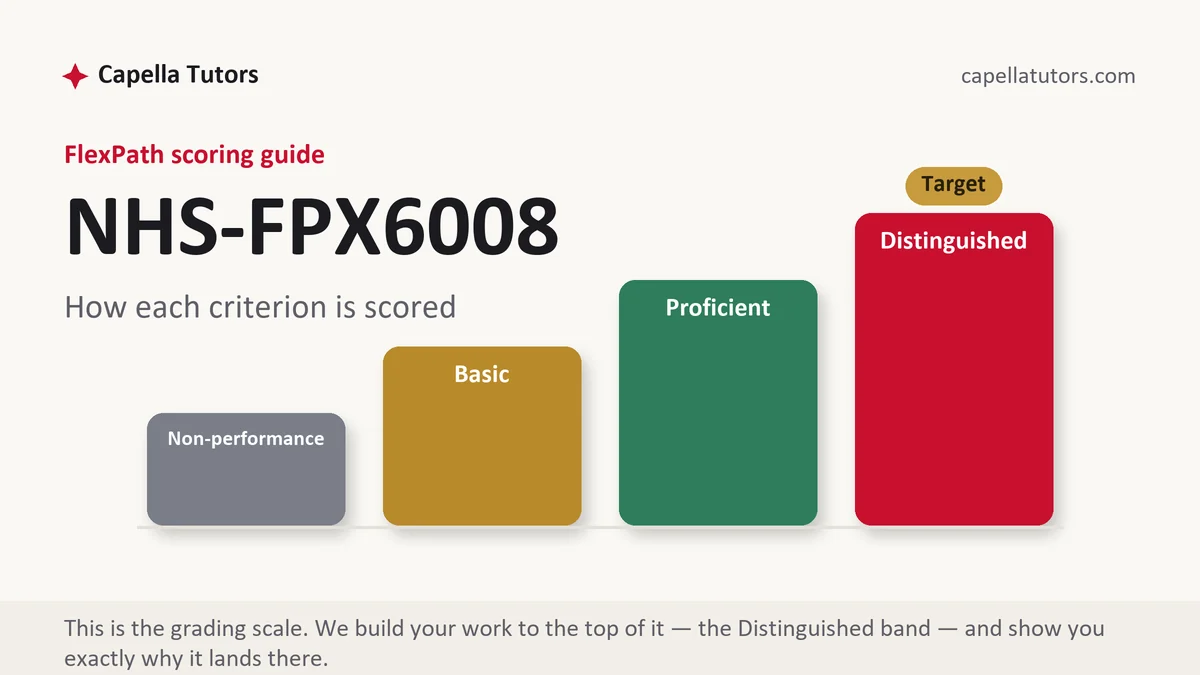
What NHS-FPX6008 actually grades
This course grades whether you can argue for something in money. Nurse leaders lose good proposals by describing them clinically to people who decide financially, and 6008 exists to break that habit. The criteria look for a problem with a cost attached, alternatives with their costs attached, a benefit stated in units somebody can verify, and a recommendation that survives the question every finance committee asks: what do we give up in order to do this. Opportunity cost is the idea the course keeps returning to, because it is the one clinicians routinely skip.
Reimbursement carries weight here for the same reason. A proposal that never says who pays, and how that payer pays, is not a business case. Distinguished work shows sourced numbers and visible arithmetic, and it names what it chose not to quantify. Basic work says the initiative will improve outcomes and reduce cost without ever printing a figure, which is the most common shape of a first submission in this course and the fastest thing to fix.
How we help in this course
Send the scoring guide and whatever numbers you already have, even if that is a rough headcount and a wage guess, and the sample comes back with a defensible cost model instead of adjectives. Our analyst builds the figures before the prose exists: unit costs, volumes, the labor math, the payer assumptions, each one traced to a citable source or labeled as an estimate with its basis shown. Then the writing wraps those numbers in the argument the criteria describe, with alternatives compared, opportunity cost named, and the ask put in language a finance committee reads without translation.
The terms hold here as everywhere. One premium original sample per deliverable, 24 to 48 hours from the moment your materials land, written against the Distinguished descriptions rather than the instructions, eight people on the pipeline, two QA passes, and revisions carried until the guide is met.
The assessments, one by one
Assessment 1
Send the scoring guide and whatever figures you have, even a rough headcount, and a premium original sample comes back inside 24 to 48 hours with the model built and the sources cited, revised free until the guide is met. Read the full Assessment 1 manual.
Assessment 2
Upload the scoring guide and your figures and a premium original sample with a defensible cost model comes back inside 24 to 48 hours, revised free until every criterion clears. Read the full Assessment 2 manual.
Assessment 3
A premium original deck with speaker notes and a costed model comes back in 24 to 48 hours, written to your scoring guide and revised free until it clears. Read the full Assessment 3 manual.
Assessment 4
Hand it to us and a premium original sample arrives inside 24 to 48 hours, written to the scoring guide and revised free until every criterion clears. Read the full Assessment 4 manual.
How to actually write NHS-FPX6008: where to begin
Rebuild the scoring guide as your outline first, then read the criteria for one specific thing: which of them demands a number. Those criteria decide your grade, and they are the ones that cannot be written the night before, because numbers need sourcing. The assessments in this course usually ask you to identify an economic problem in a care setting, build the case for addressing it, and defend that choice against the alternatives. Your scoring guide decides whether the result is a report, a proposal, a budget narrative, or slides with notes, and whether the arithmetic sits in the body or an appendix.
Then go find the figures, in this order. Start inside your own organization: cost per case, the staffing model, volumes, and any quality data you can legitimately access, cited as internal documents where policy allows and replaced by estimates with stated assumptions where it does not. Then go public for benchmarks. CMS publishes payment rules, fee schedules, and program data that anchor the reimbursement side. AHRQ's HCUP data supports utilization and cost-per-stay comparison. Bureau of Labor Statistics wage data gives you a defensible labor cost per hour by role and region, which is the number most nursing business cases need and most invent. Write the source and the year beside every figure as you collect it, because a number without provenance is unusable at the top column even when it happens to be correct.
Then show the arithmetic, which is the habit that separates levels most reliably in this course. A criterion asking for cost-benefit analysis is asking to see the multiplication: this many events a year, this much cost per event, this reduction rate from the literature, therefore this annual benefit set against this implementation cost. Round honestly, state each assumption in a sentence, and put a range on anything uncertain instead of manufacturing precision. Name the opportunity cost out loud, since the criteria usually require it: money spent here is money not spent on the other proposal in the queue, and saying which one and why yours wins is the argument. Keep the register flat. A finance reader wants the number, the source, and the assumption, and nothing rhetorical.
| Section | What goes in it | What Distinguished looks like |
|---|---|---|
| Problem and economic framing | The care problem, restated as a resource problem with a magnitude. | A quantified problem: events per year, dollars per event, and the gap against a published benchmark. |
| Cost analysis | Every cost of acting, including labor, and one-time separated from recurring. | Costs built from cited unit figures with the arithmetic visible and each assumption stated. |
| Benefit analysis | What acting produces, in dollars where possible and in measured units where not. | Benefits tied to a sourced effect size, with the conversion from clinical outcome to dollars shown step by step. |
| Alternatives and opportunity cost | At least one other use of the same money, including doing nothing at all. | The rejected alternative costed too, so the comparison is arithmetic rather than rhetoric. |
| Reimbursement and payer effects | How the proposal interacts with the way this organization actually gets paid. | Payer mix and payment rules named, with the revenue effect kept distinct from the cost effect. |
| Recommendation and budget | The ask, the timeline, and how performance will be monitored. | One number requested, a break-even or payback point, and a metric finance can already track. |
Developing the analysis
Analysis in 6008 means arguing between numbers, not reporting them. Two studies on the same intervention rarely agree on effect size, and the paragraph that earns the criterion is the one that chooses. Weigh the settings first, because a reduction achieved in a large academic center often does not survive translation to a ninety-bed community hospital with a different staffing pattern. Weigh the study design second. Then build your model on the more conservative figure and say why you did, since a business case resting on the most optimistic published number is the one finance discounts hardest, and a case that clears its own pessimistic assumptions is far harder to argue with.
Sensitivity is the move that reads as expert. Run the recommendation at the low estimate and show that it still clears, or show honestly where the break-even point sits and what would have to be true for the proposal to fail. Then close on what the numbers cannot settle. Cost data almost never captures the whole benefit of a nursing intervention, and naming the benefits you deliberately left outside the model, retention, patient experience, regulatory risk avoided, is stronger than folding a guess for them into the total and hoping nobody audits it.
Citations that survive faculty review
Two families of source run this course and the criteria grade both. Data sources are cited as reports, with the publishing agency as author and the year of the data edition rather than the year you downloaded it, and the specific dataset or table should be identifiable from the reference entry. Peer-reviewed health economics and health services literature carries the effect sizes and the cost-effectiveness methods, drawn through the Capella library rather than open search, with roughly the last five years as the working window.
Internal organizational documents are the awkward case. An unpublished budget or a departmental report is cited in text with the organization and year, often kept out of the reference list because a reader cannot retrieve it, and if you cannot share the document at all, swap the figure for a public benchmark and state that you did. Every number in the paper should trace either to a reference list entry or to a stated assumption. An untraceable figure invites an evaluator to discount the entire model, which costs far more than one missing citation.
The mistakes that land Basic instead of Distinguished
- Cost and benefit asserted with no arithmetic. Improves outcomes and reduces cost is a claim, not an analysis.
- One option considered, so there is no comparison to make and no opportunity cost to name.
- Doing nothing left out of the options. The status quo has a price and the criteria expect it priced.
- Benefits double counted, with the same avoided admission credited to two separate lines of the model.
- Wage and volume figures invented when both are publicly available by role and region.
- Reimbursement ignored, so the case saves money for a payer rather than for the organization being asked to spend.
- A recommendation with no number in it, which leaves the decision-maker nothing to approve.
NHS-FPX6008 questions students actually ask
What if my employer will not give me budget numbers?
Build the model from public benchmarks and say that is what you did. Bureau of Labor Statistics wage data by occupation and region gives you labor cost. Published utilization and cost-per-stay data gives you event cost. Your own observation supplies the local volume estimate, labeled as an estimate with its basis in one sentence. A transparent model built on citable figures scores better than a precise one built on numbers you cannot show, and it keeps confidential internal financials out of a paper that leaves the building. List your assumptions in four or five lines and the criteria are satisfied.
Do I need real accounting, or is estimation acceptable?
Estimation is expected, sloppiness is not. Nobody grading this course wants a general ledger. What the criteria want is a model whose every input has a source or a stated assumption, arithmetic a reader can follow, and a range wherever the uncertainty is real. Two habits make estimates defensible: round to the precision your inputs justify, and show the calculation rather than the result alone. If your annual benefit figure appears without the multiplication behind it, the evaluator has no reasoning to grade, and reasoning is what the criterion is written about.
How do I put a dollar figure on a clinical outcome?
Through the event it prevents, and only as far as your sources support. A prevented pressure injury has a published cost range in treatment and added length of stay. A prevented readmission has a payment consequence that depends on the payer and the program. A reduction in turnover converts through the published cost of replacing one nurse. Find a citable cost per event, multiply by the events your effect size predicts, and stop there. Benefits with no defensible price, morale, reputation, staff satisfaction, belong in the argument as named unquantified benefits rather than inside the total. Evaluators notice the difference, and a model that admits its own limits reads as competent rather than timid.
In NHS-FPX6008 right now?
Send the scoring guide plus whatever numbers you already have. First sample free, back inside 24 to 48 hours.