This manual is for NHS-FPX6008 Assessment 2, start to submission. Upload the scoring guide and your figures and a premium original sample with a defensible cost model comes back inside 24 to 48 hours, revised free until every criterion clears. Writing it yourself? The method follows. Assessment 2 of NHS-FPX6008 usually takes the issue you identified and asks whether acting on it is feasible. The deliverable is commonly a needs analysis or business-case style examination over a multi-year horizon, weighing what the change costs against what it returns, with the risks named and their mitigations priced. Your scoring guide decides the length, the horizon, and whether the arithmetic belongs in the body or an appendix. The criteria reward visible calculation over confident adjectives. Your courseroom may print this as NHS FPX 6008 Assessment 2 or NHS6008 Assessment 2; it is the same deliverable, and NHS-FPX6008 Assessment 2 is what this manual walks through.
One honesty note before the manual: Capella revises courses and scoring guides over time, so always write to the exact scoring guide attached to your assessment in the courseroom. The course identity above is verified on capella.edu; the method and structure below are our tutors' approach to it, not Capella's official rubric text.
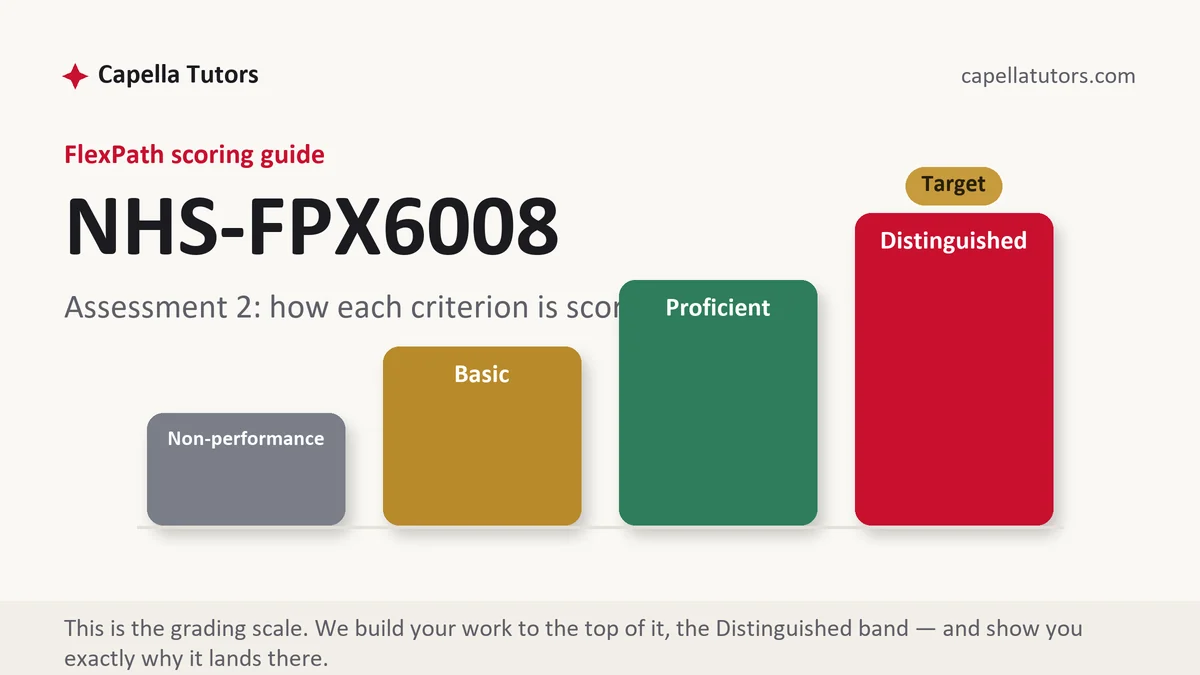
How NHS-FPX6008 Assessment 2 is scored
FlexPath scores this deliverable criterion by criterion against four levels. Read them as the model specification rather than as grading language:
| Level | What it means on a needs analysis for change |
|---|---|
| Distinguished | Every input traces to a cited figure or a stated assumption, the arithmetic is on the page, the analysis runs at a pessimistic input as well as an expected one, and each risk carries a mitigation with a price. Each criterion adds its own further requirement, and your scoring guide is the authority on what it is. |
| Proficient | A complete analysis with sourced costs and a sensible benefit case, but the model runs at one set of assumptions and the risks are listed rather than priced. |
| Basic | Assertion in place of analysis. The change will save money and improve care, with no unit cost, no volume, and no multiplication anywhere in the document. |
| Non-performance | A required component is missing, most often the risk analysis or the multi-year view. Evaluators score the absence rather than the polish of what surrounds it. |
The habit that separates levels most reliably in this deliverable is showing the multiplication. A reader who can follow this many events, at this cost each, reduced by this rate, therefore this annual figure, is a reader who can grade your reasoning. A reader handed only the total has nothing to grade but your confidence. Round to the precision your inputs justify, put a range on anything genuinely uncertain, and state each assumption in its own short sentence rather than burying three of them inside one number.
The NHS-FPX6008 Assessment 2 method, step by step
-
Define the change and the unit of analysis
Write one sentence naming what would change and the unit you will measure it in: chair-hours, visits, avoided admissions, worked hours per case. Every figure in the analysis has to reduce to that unit, and choosing it late is why models end up comparing quantities that do not belong in the same column.
-
Build the baseline, then find where the margin actually leaks
Compute capacity rather than asserting it, set actual volume against it, and identify the two or three drivers that explain most of the gap. A cancellation rate with no standby list and a scheduling template built on a duration nobody has measured recently will move a service line further than any new equipment, and a needs analysis that finds the leak before proposing the fix is far harder to argue with.
-
Model over the horizon your guide names, with assumptions printed
Lay the years out in a table: one-time costs separated from recurring, volume growth stated as an assumption rather than implied, wage inflation named, and the point at which cumulative benefit passes cumulative cost visible in a row rather than claimed in a sentence. Where you have used a public benchmark instead of internal data, say so in the line where it appears.
-
Source the cost and benefit sides differently, and honestly
Costs come from your own organization where policy allows and from public wage and utilization data where it does not. Benefits come from the health services and health economics literature, and the effect size you choose has to survive translation to your setting, so weigh the design and then weigh the setting. Where two studies disagree, choose the more conservative figure and say why you chose it; a case that clears its own pessimistic assumption is the one a finance committee stops arguing with.
-
Price the risks and their mitigations
Every risk in this kind of analysis has a cost and so does every mitigation. Volume shortfall, a staffing vacancy that delays the start, a payer policy change, a competing site opening nearby. State the probability qualitatively if you must, but state the dollar consequence and what the mitigation costs, because a risk section with no numbers in it reads as a formality and is usually scored that way.
-
Self-score against the guide, then submit early in the week
Check that every figure traces either to a reference entry or to a stated assumption, that the arithmetic can be reproduced from what is on the page, and that each criterion has its own labeled section. Mark your own levels, rework the shortfalls, and submit at the start of the week so a two-day evaluation window does not cost you five.
A structure that maps to the criteria
Treat the word targets below as planning figures taken from our own models, nothing more. Your scoring guide decides the length, the horizon, and where the arithmetic lives.
| Section | What it must do | Guide |
|---|---|---|
| Purpose and the proposed change | What would change, in which service, and the decision this analysis supports. | ~200 words |
| Baseline and the cost driver | Volumes, capacity, unit costs, and the point at which margin is lost. | ~350 words |
| Cost of the change | One-time and recurring costs, with labor built from cited wage data. | ~300 words |
| Benefit and the horizon | Benefits year by year across the period your guide names, each assumption printed. | ~350 words |
| Sensitivity and risk mitigation | The model at the pessimistic input, the risks, and what each mitigation costs. | ~300 words |
| Recommendation and references | The ask, the break-even point, and every figure traced to a source or an assumption. | ~200 words |
Annotated sample excerpt
A model excerpt from our team, showing the level of arithmetic the top column expects. Take the method, then build the baseline your own service line has.
The infusion center runs eight chairs, eleven hours a day, five days a week, which is 22,880 chair-hours of annual capacity; billed chair-hours last year were 14,690, or 64 percent utilization.1 Two inputs explain most of the gap: a 12 percent same-day cancellation rate with no standby list, and a scheduling template that books every infusion at 180 minutes when the observed median across our five highest-volume regimens is 118.2 At a contribution margin of 214 dollars per billed chair-hour, derived from last year's departmental revenue less drug acquisition and direct labor, each recovered point of utilization is worth about 49,000 dollars a year, and that figure is what the rest of this analysis argues over.3
- 1Capacity is computed rather than asserted, then set against billed hours. A needs-analysis criterion looks for a baseline a finance reader could reproduce from the same three inputs.
- 2Two named drivers with rates attached, one behavioral and one structural. Diagnosing the leak before proposing the fix is what keeps a recommendation from reading as a preference.
- 3Shows where the contribution margin came from, then converts one point of utilization into dollars. Establishing the unit of value early gives every later comparison the same currency.
The full premium sample for your exact assessment, written fresh to your scoring guide and issue, is free to request. Study it, revise it into your own voice, and submit work you understand.
The five mistakes that cost Distinguished
- A total with no arithmetic behind it. A benefit figure that appears without its multiplication leaves the evaluator nothing to grade except your confidence.
- One scenario only. A model that runs at a single optimistic input is the model finance discounts hardest. Show it at the low estimate too.
- Doing nothing left out. The status quo has a price. A criterion about alternatives expects the null option costed alongside the others.
- Invented wages and volumes. Both are publicly available by role and region. Estimating what could be looked up is the fastest way to lose the sourcing criterion.
- Risks listed without prices. Staffing delays and volume shortfalls have dollar consequences. A risk section with no numbers reads as a formality.
Pre-submission checklist
- One unit of analysis chosen early, with every figure reducible to it
- Capacity and baseline computed from stated inputs a reader could reproduce
- Costs and benefits sourced separately, with the conservative effect size chosen and justified
- The horizon laid out year by year, with one-time and recurring costs separated
- A pessimistic run of the model plus a break-even point stated as a row, not a claim
- Every risk paired with a priced mitigation, APA 7 verified, self-scored before submitting
Want the model built before you write?
Send the scoring guide and whatever numbers you hold, even partial ones. Our analyst builds the cost and benefit model with every input sourced or labeled as an assumption, then the writing wraps it in the argument the criteria describe, back inside 24 to 48 hours.