This manual is for NHS-FPX6008 Assessment 3, start to submission. A premium original deck with speaker notes and a costed model comes back in 24 to 48 hours, written to your scoring guide and revised free until it clears. If you are building it, read on. Assessment 3 of NHS-FPX6008 usually asks you to present the case rather than write it. The deliverable is commonly a slide deck with speaker notes, sometimes narrated, addressed to the people who would have to approve the money. Your scoring guide decides the slide count and whether narration is required. The criteria are written about executive communication under scrutiny: one number to approve, arithmetic a committee can follow at speaking pace, and an honest account of who actually keeps the benefit. Your courseroom may print this as NHS FPX 6008 Assessment 3 or NHS6008 Assessment 3; it is the same deliverable, and NHS-FPX6008 Assessment 3 is what this manual walks through.
One honesty note before the manual: Capella revises courses and scoring guides over time, so always write to the exact scoring guide attached to your assessment in the courseroom. The course identity above is verified on capella.edu; the method and structure below are our tutors' approach to it, not Capella's official rubric text.
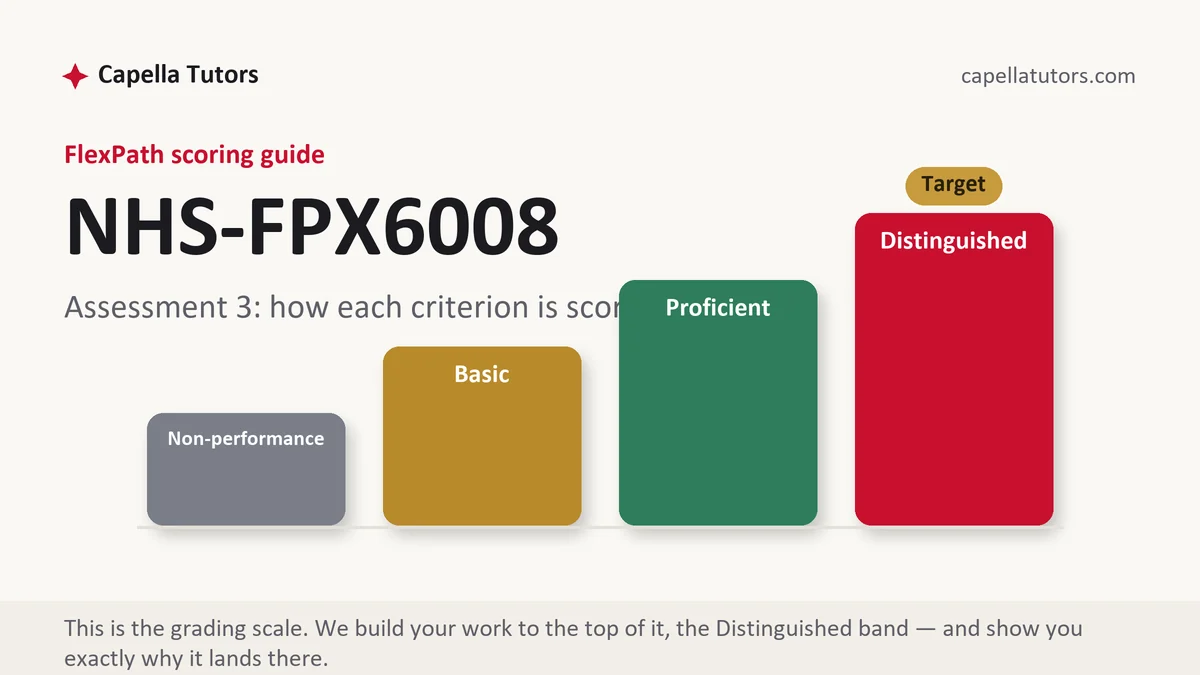
How NHS-FPX6008 Assessment 3 is scored
Every criterion is scored separately against four levels, so a strong model cannot rescue a slide that answers nothing. The level language is the design brief:
| Level | What it means on a business case presentation |
|---|---|
| Distinguished | The ask is a single number on an early slide, the benefit is built from a sourced effect size with the conservative figure chosen out loud, retained benefit is kept separate from avoided cost, and break-even appears with a pessimistic case beside it. Each criterion adds its own demand, and your scoring guide decides what that is. |
| Proficient | A complete, numerate deck that a committee could follow, but the effect size goes unexamined and the retained share of the benefit is assumed rather than argued. |
| Basic | A clinical presentation with a budget slide attached. The intervention is described at length, the money arrives late, and nothing on the surface can be voted on. |
| Non-performance | A required component is absent, most often the speaker notes or the sensitivity view. A deck can look complete and still leave a criterion unanswered. |
Finance committees do not reject nursing proposals for lacking passion; they reject them for arriving without a number, or with a number whose provenance nobody can check. The register that scores at the top of this guide is flat and specific: the figure, the source, the assumption, then the ask. Save the persuasion for the speaker notes, where an objection can be raised and answered in the same breath, and keep the slides carrying evidence a reader can verify without you in the room.
The NHS-FPX6008 Assessment 3 method, step by step
-
Put the ask on the first substantive slide
One number, one owner, one payback horizon. Committees read decks to find the decision, and a deck that withholds it until slide nine loses the communication criterion no matter how good the analysis underneath turns out to be.
-
Build the benefit from a sourced effect size, conservatively
Find the effect in the peer-reviewed literature rather than in vendor material: pharmacist-led discharge medication review, for instance, is examined in journals such as JAMA Internal Medicine, the Journal of Hospital Medicine, and the American Journal of Health-System Pharmacy, and the reported reductions vary widely by intensity and setting. Report the range, say which end you modeled, and say why the top of the range does not transfer to your site. Choosing the conservative figure out loud is the single most persuasive move available in this deliverable.
-
Cost the intervention with labor first and one-time costs separated
Most nursing business cases live or die on the labor line, so build it from a cited wage figure loaded with your own benefit factor, and state the fraction of an FTE you are actually asking for. Keep implementation costs, training hours, and any technology one-time charge out of the recurring column, because a break-even calculation that mixes the two is not reproducible.
-
Say who keeps the benefit
Avoided cost and retained benefit are different numbers, and conflating them is how a nursing case overstates itself. Name the payer mix, distinguish payment arrangements that reward avoided utilization from those that penalize it, and state the share the organization actually keeps, attributed to the department that produced the estimate. A committee that finds this distinction missing will assume the rest of the model is equally loose.
-
Show sensitivity and break-even on one slide
Run the case at the pessimistic input and show that it still clears, or show honestly where it stops clearing and what would have to be true for that to happen. Then name the monitoring metric finance can already pull, and the review point at which the organization would stop funding it. A proposal that specifies its own failure condition reads as competent rather than as promotional.
-
Rehearse, self-score, then submit early in the week
Read the deck aloud against a clock, cut whatever you find yourself explaining because the slide does not, and confirm that the notes carry every citation. Score each criterion yourself, rework the gaps, and submit at the start of the week so a two-day evaluation does not stall your session.
A structure that maps to the criteria
The slide counts below come from our own business-case decks and are planning figures only. A required slide limit, a narration requirement, or an appendix rule in your scoring guide overrides all of them.
| Section | What it must do | Guide |
|---|---|---|
| Title and the ask | The request, the sponsor, and the number you want approved. | 1 slide |
| The problem in dollars | Events, cost per event, and the annual exposure, with sources visible on the slide. | 1 to 2 slides |
| The intervention and its cost | What is being bought, staffed how, at what one-time and recurring cost. | 2 slides |
| Benefit and effect size | The sourced effect, the conservative figure chosen, and the arithmetic behind it. | 2 slides |
| Who keeps the benefit | Payer mix, contract type, and the share the organization actually retains. | 1 slide |
| Break-even, risks, references | Payback point, the pessimistic case, the monitoring metric, and an APA 7 reference slide. | 2 slides |
Annotated sample excerpt
An original model from our team, showing how the slide and the notes split the work in a business case. Study the division, then build the deck your own numbers support.
Slide reads: 0.6 FTE pharmacist, 1,900 reviews a year, 38 readmissions avoided at the low estimate.1 Notes: the 38 comes from the bottom of the published range, not the middle. Trials of pharmacist-led discharge review report reductions between roughly 10 and 30 percent in 30-day readmissions, the larger effects cluster in single-site studies with intensive follow-up calling we are not funding, so I modeled 12 percent against our 315 eligible high-risk discharges.2 At our observed average variable cost of 4,100 dollars per medical readmission that is 1.56 million dollars in avoided cost, of which we keep only the share tied to at-risk contracts and penalty exposure, which finance puts near 40 percent.3
- 1Three numbers and no adjectives. A business-case slide earns its place by being the sentence a committee can vote on.
- 2States the range, explains why its upper end does not transfer to this site, and names the figure actually modeled. Choosing the conservative estimate deliberately is what makes a model difficult to argue with.
- 3Keeps avoided cost and retained benefit apart, and attributes the retention share to the department that produced it. Blending those two is the most common way a nursing business case overstates its own result.
The full premium sample for your exact assessment, written fresh to your scoring guide and issue, is free to request. Study it, revise it into your own voice, and submit work you understand.
The five mistakes that cost Distinguished
- The ask buried. A committee should know what it is voting on by the second slide. Withholding the number reads as evasion rather than as build-up.
- The optimistic effect size. Modeling the best published result guarantees the first question you cannot answer. Model the low end and say so.
- Avoided cost claimed as savings. If a payer keeps most of the benefit, the organization is not saving that money. Name the share you actually retain.
- Labor estimated rather than sourced. Wage data by role and region is public. An invented labor line undermines every number that depends on it.
- No failure condition. A case with no monitoring metric and no review point cannot be governed, and an evaluator reads that absence as an unfinished plan.
Pre-submission checklist
- The ask, as one number with an owner, on an early slide
- The effect size reported as a range, with the modeled figure justified as the conservative choice
- Labor built from cited wage data and loaded with a stated benefit factor
- One-time and recurring costs kept in separate columns
- Retained benefit distinguished from avoided cost, with payer mix named
- Break-even, a pessimistic run, a monitoring metric, and an APA 7 reference slide, self-scored before submitting
Want the deck and the model built together?
Send the scoring guide and the initiative you are proposing. The analyst builds the cost and benefit model, the writer turns it into slides a finance committee reads without translation, and the deck with full speaker notes comes back in 24 to 48 hours.