This manual is for NHS-FPX6008 Assessment 1, start to submission. Send the scoring guide and whatever figures you have, even a rough headcount, and a premium original sample comes back inside 24 to 48 hours with the model built and the sources cited, revised free until the guide is met. Prefer to write it? Start here. Assessment 1 of NHS-FPX6008 usually asks you to name an economic problem in your own setting and prove it is one. The deliverable is commonly short, which fools people into treating it as a warm-up; it is actually the foundation the later work in this course is built on, since a poorly chosen issue cannot be costed, defended, or advocated for later. Your scoring guide decides the length and the required elements. The criteria reward a problem with a number attached and a clear account of who absorbs it. Your courseroom may print this as NHS FPX 6008 Assessment 1 or NHS6008 Assessment 1; it is the same deliverable, and NHS-FPX6008 Assessment 1 is what this manual walks through.
One honesty note before the manual: Capella revises courses and scoring guides over time, so always write to the exact scoring guide attached to your assessment in the courseroom. The course identity above is verified on capella.edu; the method and structure below are our tutors' approach to it, not Capella's official rubric text.
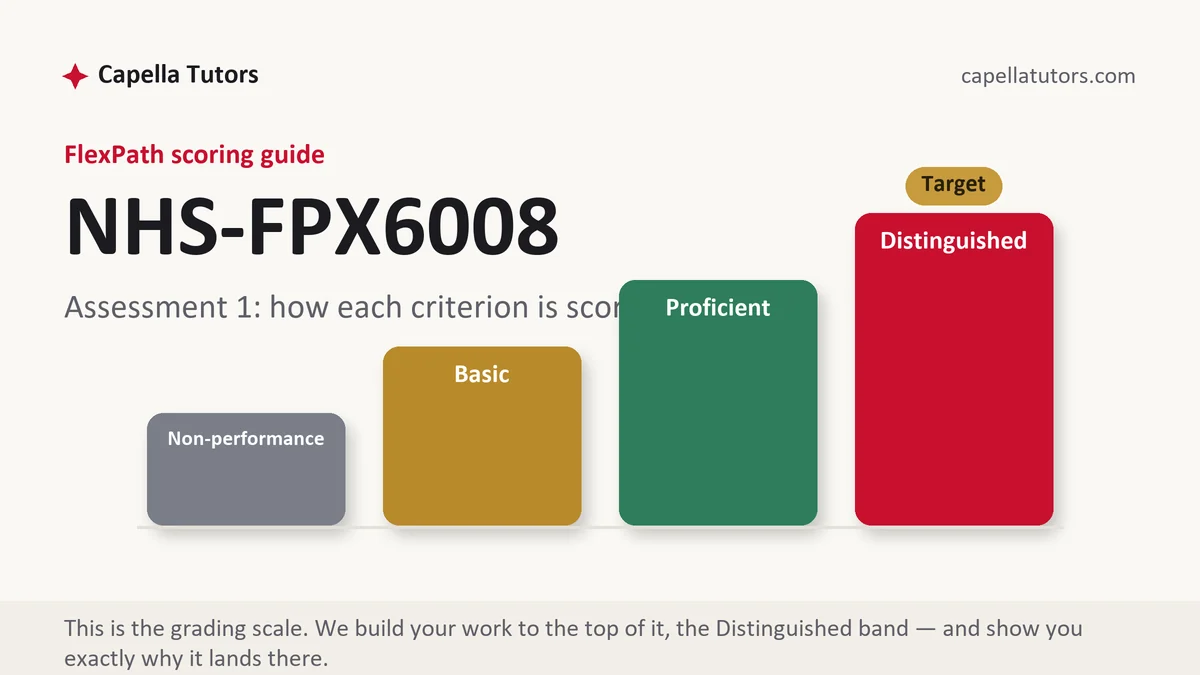
How NHS-FPX6008 Assessment 1 is scored
Each criterion in the guide carries its own level, and there is no total score to hide a weak section inside. The level descriptions tell you what the report is:
| Level | What it means on an economic issue report |
|---|---|
| Distinguished | The issue arrives quantified from named public or organizational data, the burden is traced to the specific parties who carry it, the equity effects are argued from figures rather than assumed, and the report says plainly what the evidence cannot settle. Each criterion also adds its own requirement, and your scoring guide is the authority on it. |
| Proficient | A real issue with real sources and a sound account of its effects, but the magnitude stays approximate and the distributional analysis stays general. |
| Basic | A topic rather than an issue. Rising costs and staffing pressure described in adjectives, with no local figure and no source vintage in sight. |
| Non-performance | A required element never appears, most often the equity analysis or the evidence gap. The report can read well and still leave a criterion unanswered. |
Health economics has a working vocabulary and the criteria expect you inside it. Cost is what is given up, not what is charged; a benefit has to be attributed to somebody in particular; and an opportunity cost exists whether or not you mention it. Writers who use those distinctions deliberately move up the guide quickly, because the same paragraph then answers two criteria at once, the one about economic analysis and the one about communication to a professional audience.
The NHS-FPX6008 Assessment 1 method, step by step
-
Choose an issue that already has a number in your setting
The best issue is one you can measure this week: a service line running below break-even, a vacancy rate with agency premium attached, a policy change with a payroll consequence. If you cannot find a single local figure for it, the issue is too abstract for this course and every later assessment will inherit the problem.
-
Quantify the magnitude before you argue about it
Establish the size of the problem from sources a master's evaluator can check. Bureau of Labor Statistics occupational employment and wage data gives defensible labor cost by role and metropolitan area, the AHRQ healthcare cost and utilization data supports cost-per-stay and volume comparison, and CMS publishes payment rules and program data for the reimbursement side. Write the source and the data year beside every figure as you collect it, because a number whose vintage you cannot state is unusable at the top of the guide even when it happens to be right.
-
Trace who absorbs the cost, party by party
An economic issue is a distribution problem. Say what it costs the organization, what it costs the workforce in hours or turnover, what it costs patients in access or out-of-pocket terms, and what it costs the surrounding community. Keep the ledgers separate. Blending them is how a report ends up claiming a saving that in fact accrues to a payer rather than to the hospital being asked to spend.
-
Bring the peer-reviewed evidence at the right grain
Draw the evidence layer through the Capella library rather than open search, from journals such as Health Affairs, Medical Care, the Journal of Health Economics, and Nursing Economics, and carry the study design into your sentence. A difference-in-differences estimate across states and a single-site cross-sectional association support very different claims, and using the language of causation for the second is the error a master's evaluator notices first. Report the setting too, since an effect measured in academic medical centers frequently does not transfer to a community hospital with a different case mix.
-
Name the equity effects and the evidence gap
Ask which populations carry more of this burden and answer with data: payer mix, distance to the nearest alternative site, the share of your panel in a given county. Then state what the literature cannot settle for a setting like yours, and how you reasoned around the hole. A named gap with a stated workaround reads as rigor; a confident sentence with no citation behind it reads as guessing, and evaluators read those two very differently.
-
Self-score against the guide, then submit early in the week
Check every figure for a source and a year, every claim for its matching criterion, and every paragraph for a number. Mark each criterion yourself, rework anything below the top column, then submit at the start of the week so a two-day evaluation window does not become a weekend.
A structure that maps to the criteria
The word targets below are our planning figures for a short economic issue report. Your scoring guide decides the length and the required components, and a short brief has to earn every line.
| Section | What it must do | Guide |
|---|---|---|
| The issue and its local shape | The economic issue, the setting, and the magnitude in numbers. | ~250 words |
| Who absorbs the cost | Effects on the organization, the workforce, patients, and the surrounding community. | ~300 words |
| Evidence base | Peer-reviewed and agency sources, with designs, settings, and data years stated. | ~300 words |
| Equity and access effects | Which populations carry more of the burden, argued from data rather than assumption. | ~250 words |
| The gap in the evidence | What the literature cannot settle for a setting like yours, and how you reasoned around it. | ~200 words |
| References and data provenance | Every figure traced to a citation or to a stated assumption, current APA 7. | as needed |
Annotated sample excerpt
An original model paragraph from our analysts, written at the register the top column describes. Learn the moves, then frame the issue your own setting actually has.
Our 118-bed community hospital runs a medical-surgical average of one nurse to six patients on days; the ratio bill before the legislature would require one to five, which at our current census and 82 percent worked-hours productivity means 6.4 additional worked full-time equivalents on that unit alone.1 At the state metropolitan mean hourly wage for registered nurses reported by the Bureau of Labor Statistics for 2025, loaded with our 31 percent benefit factor, those positions cost roughly 1.02 million dollars a year before shift differentials.2 The economic issue is not the ratio. It is that 68 percent of our discharges are Medicare or Medicaid, so the added cost cannot be recovered through negotiated rates and has to come out of money already committed elsewhere.3
- 1Converts a policy into a staffing requirement using the hospital's own census and productivity assumption. A criterion about local relevance is answered by arithmetic, not by asserting that the issue affects us.
- 2Prices the positions from a named public dataset with its year, and keeps the benefit load visible as a separate factor. Source and vintage beside the figure is the habit that keeps a model auditable.
- 3Relocates the real problem from the cost side to the revenue side, which is the reframing that gives the rest of the report somewhere to go and sets up the opportunity-cost argument later in the course.
The full premium sample for your exact assessment, written fresh to your scoring guide and issue, is free to request. Study it, revise it into your own voice, and submit work you understand.
The five mistakes that cost Distinguished
- A topic instead of an issue. Rising health care costs cannot be analyzed in four pages. A service line, a vacancy rate, or a payment change can.
- Figures with no provenance. A number without a source and a data year invites the evaluator to discount the whole report, which costs far more than one missing citation.
- Association written as causation. Reported alongside is not caused by. The verb you choose is the claim you are making, and a master's evaluator grades the verb.
- Ledgers blended. A saving that lands on a payer is not a saving for the organization being asked to spend. Keep the parties separate and say who gains.
- Equity asserted rather than shown. Vulnerable populations are affected is a placeholder. Payer mix, travel distance, and panel composition are evidence.
Pre-submission checklist
- One issue, narrow enough to carry a local figure you can actually obtain
- Every number paired with its source and its data year, in the sentence or the reference list
- Costs traced separately to organization, workforce, patients, and community
- Study designs and settings stated where a claim rests on them
- Equity effects argued from data, and one named gap in the evidence with your workaround
- APA 7 forms for agency data and journals, self-scored criterion by criterion before submitting
Want the issue report built on real numbers?
Tell us the setting and send the scoring guide. Our analyst pulls the wage, utilization, and payment data before a word is drafted, and the premium original sample lands in 24 to 48 hours with free revisions until every criterion clears.