Help on any deliverable in this course starts here: a premium original sample with a walkthrough, returned inside 24 to 48 hours, written to the Distinguished column. The course itself is NURS-FPX6422, Clinical Information Systems and Application to Nursing Practice Analysis, carrying 2 of the 27 points in Capella's FlexPath MSN and sitting in the Nursing Informatics specialization. Its business is holding one real system up against real nursing practice and reporting the mismatch in language an executive committee can act on.
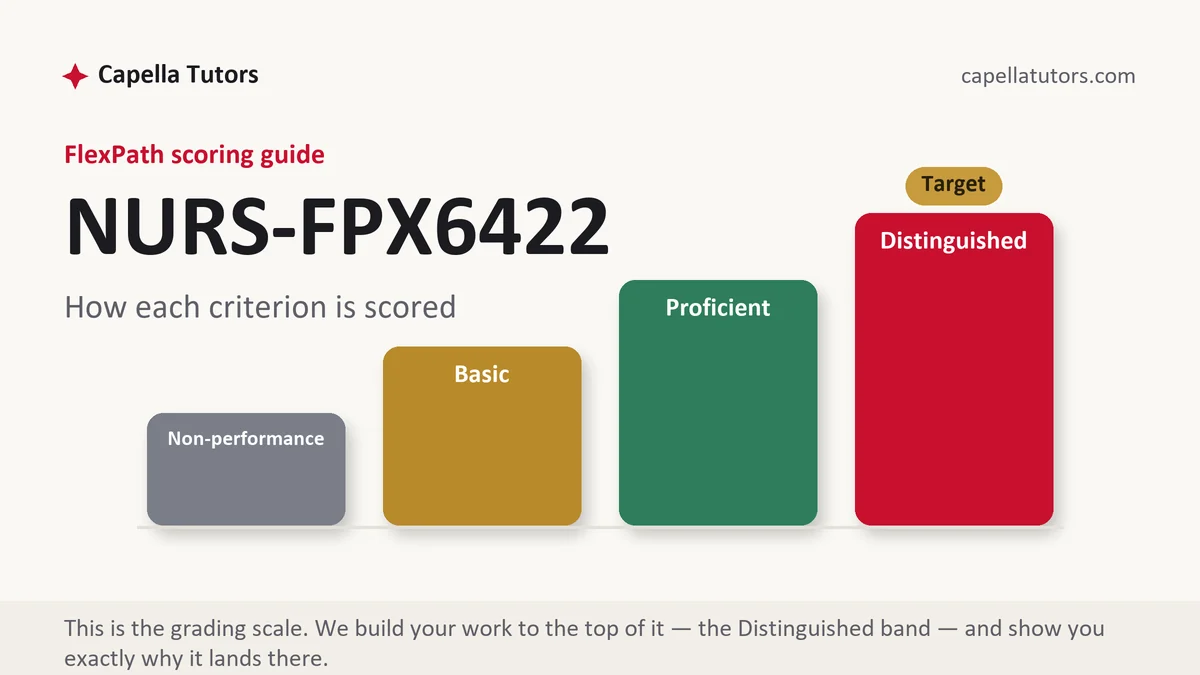
What NURS-FPX6422 actually grades
Four pressures run through the criteria. Workflow has to be captured as it happens, not as the policy manual imagines it. Usability and safety have to be judged with method behind the judgment, not taste. The data has to be followed out of the system and into whatever receives it. And the whole thing has to close with a gap analysis whose recommendations someone could actually fund and schedule.
The failure mode is predictable, and evaluators see it constantly: a paper that lists everything annoying about the electronic record. That scores Basic, because a complaint has no severity, no frequency, and no owner. Distinguished work in 6422 reads like a finding submitted to a safety committee, with the harm named, the frequency estimated, the fix classified, and the person accountable for it identified by role.
How we help in this course
Tell us the module you have access to and what you have already noticed about it, and the draft is built on that ground rather than on a generic hospital. Our writers know where the credit sits in this course: the observed step count, the honest workaround, the interoperability break nobody had documented before you wrote it down.
Every order runs the same route. Your scoring guide is decoded criterion by criterion before drafting, a subject-matched writer produces the analysis, then two review passes follow, one checking the draft against the criteria and one checking APA and originality. Turnaround is 24 to 48 hours, and revisions are free until the work hits target.
Workflow analysis that reads like observation
Choose a task with a clear start and stop: admission medication reconciliation, a blood product administration, a shift handoff, a discharge instruction print. Then walk it and record what a stopwatch and a notepad can capture. Actor, step, screen, field, click, handoff, wait. Count something real, screens touched, minutes elapsed, separate applications opened, times the nurse logged in again. Numbers convert opinion into evidence faster than adjectives ever will.
Record where staff leave the system, because that is where the analysis earns its grade. The folded brain sheet, the second monitor with a spreadsheet on it, the taped-up cheat sheet of order names, the photograph of a wound sent through a personal phone: each of those is a workflow finding and, in the last case, a privacy finding too. Draw the current state and the proposed state as two maps with roles as lanes, then state the delta in plain numbers rather than claiming the new version is better.
Usability findings a committee could act on
Usability at graduate level means applying a method and naming it. A heuristic walkthrough asks whether the screen shows system state, prevents error rather than scolding after it, stays consistent across modules, and lets a nurse recognize instead of remember. A think-aloud session with two or three colleagues surfaces more in twenty minutes than a semester of speculation. Either approach is defensible; unmethodical impressions are not.
Then push each finding toward safety, since that is the axis the criteria weigh most. Alert volume and override behavior, look-alike entries adjacent in a drop-down, defaults that carry a previous value forward, patient identifiers hidden below the fold, dose fields that accept an impossible number. The Office of the National Coordinator's SAFER guides give this section a spine, and the usability and safety literature reachable through the Capella library supplies the evidence. Write each item with its potential harm, its likely frequency, a severity call, and the level at which it can be fixed.
The assessments, one by one
Assessment 1
Hand this one to us and a premium original sample arrives inside 24 to 48 hours, revised free until your guide is satisfied. Read the full Assessment 1 manual.
Assessment 2
This deliverable comes off our desk as a premium original sample inside 24 to 48 hours, with revisions free until it meets your guide. Read the full Assessment 2 manual.
Assessment 3
Send the scoring guide and this analysis comes back as a premium original sample inside 24 to 48 hours, revised free until it meets the guide. Read the full Assessment 3 manual.
Assessment 4
A premium original sample for this deliverable lands inside 24 to 48 hours and stays in revision until your guide is met. Read the full Assessment 4 manual.
How to actually write NURS-FPX6422: where to begin
Open the scoring guide before the instructions and turn the criteria into your headings, with the Distinguished wording pasted underneath each one. Then narrow the scope hard. The unit of analysis in this course is a system plus a practice, never a system alone, and a paper about an entire enterprise record has no place to put a detail. One module, one task, one setting is the shape that scores.
Collect evidence you can cite. Some of it is yours: observation notes with times, the themes in help-desk tickets, override or downtime reports if your organization shares them, what the unit super user says breaks weekly. Some of it is published: peer-reviewed studies on that class of system, standards documents, safety alerts. Ask permission before you observe colleagues, strip identifiers out of everything you write down, and describe internal documents by type rather than quoting them at length. Careless handling of institutional data becomes a privacy problem inside a privacy course.
Handle interoperability as a route, not a concept. Name the sending system, the standard carrying the data, whether the value arrives coded or as text, the screen where a clinician meets it, and the point where it silently fails. Unmapped local codes, units that do not match, an allergy list that arrives as a paragraph, a result that lands in a document nobody opens: those are the concrete failures the criteria are looking for. Federal material on healthit.gov, including certification requirements and the information blocking rules, gives the regulatory frame for why an exchange is expected to work at all.
| Section | What goes in it | What Distinguished looks like |
|---|---|---|
| Introduction and scope | The setting, the system or module, and the practice you are examining. | Scope narrow enough to observe, with the reason for choosing it stated. |
| Current-state workflow | The task step by step, by role, with counts and wait points. | Workarounds documented where they happen, including what staff do outside the system. |
| Usability and safety | Findings from a named method, each tied to a potential patient harm. | Severity and frequency assigned, and the fix level identified for each finding. |
| Interoperability and data flow | Where the data comes from, what carries it, and who consumes it downstream. | One break traced end to end, with the clinical consequence of the break stated. |
| Gap analysis | Requirement, current state, gap, and risk, laid out so nothing is implied. | Gaps ranked by risk rather than by irritation, with the ranking defended. |
| Recommendations and evaluation | What to change, who owns it, what it costs, and how you will know it worked. | Each recommendation carries a measure, a baseline, and a date to look again. |
Developing the analysis
The gap analysis is where this course is won, and it wants a discipline, not prose. For each item hold a fixed chain: the requirement or standard, the current state, the distance between them, the risk that distance creates, the recommendation, the owner, the measure. Rank by risk, so a rarely used screen with an ugly layout sits below a dose field that accepts a decimal error. Sort recommendations by type as well, because a configuration change, a training change, a policy change, and a vendor enhancement request move through different approval paths on different timelines, and lumping them together makes the whole list unexecutable. Somewhere in the section, put a tradeoff on the page: tightening an alert catches more errors and also raises the override rate that made the alert useless. Then say what you could not see. An analysis that admits it observed day shift only reads more credible than one that claims coverage it never had.
Citations that survive faculty review
Keep three tiers separate and label them by function. Peer-reviewed research from the Capella library, CINAHL, and PubMed carries claims about outcomes, error rates, and clinician behavior, held to roughly the last five years because system generations turn over quickly. Standards and policy material carries the requirement claims: SAFER guides and certification criteria on healthit.gov, published HL7 specifications, HIMSS and AMIA work on usability and clinical decision support, and the American Nurses Association's informatics scope and standards for role expectations. Vendor documentation is legitimate for one thing only, what the software is configured to do, and never for what the software accomplishes. Cite in APA 7, keep the citation inside the sentence doing the analytical work, and give every entry a criterion to serve.
The mistakes that land Basic instead of Distinguished
- Scope inflation. Analyzing the whole electronic record, which produces generalities no evaluator can score as analysis.
- Complaints without severity. A list of irritations with no harm, frequency, or ranking attached.
- The policy workflow. Describing the process as the manual writes it, with no observation and no workaround anywhere in sight.
- Interoperability as vocabulary. The word used three times and no data element ever followed from one system to another.
- Unownable recommendations. Fixes with no owner, no cost, and no measure, which are wishes rather than recommendations.
NURS-FPX6422 questions students actually ask
Which clinical system should I analyze?
Pick a module, not an enterprise record. Barcode medication administration, the electronic medication administration record, a smart pump library, an early warning score tool, a bed management board, or the discharge instruction builder all give you a bounded task with a beginning and an end. Whole-record analyses collapse into generalities because nobody can observe them. The test is simple: if you cannot watch one nurse complete the task in one sitting, the scope is too wide for a graded analysis.
How do I write about interoperability without an IT background?
Trace one data element along its path and describe the path in plain terms. Say which system creates the value, which standard carries it, whether it arrives as a coded field or as text a human must read, where the receiving clinician sees it, and what happens when the mapping is missing. A potassium result moving from the laboratory system into the record, or an allergy that arrives from an outside hospital as free text nobody reconciles, is enough. You do not need to know the message format internally; you need to know where the handoff breaks and who notices.
What makes a gap analysis Distinguished instead of a list of complaints?
Every gap has to be anchored, sized, and assigned. Anchor it to a requirement or standard rather than to irritation, size it by how badly and how often it can hurt someone, and assign a named owner plus the measure that would show the fix worked. Separate the fixes by type as well: a configuration change, a training change, a policy change, and a vendor enhancement request travel through entirely different approval routes, and a recommendation that ignores that distinction cannot be executed.
In NURS-FPX6422 right now?
Send the deliverable you are on, the scoring guide, and the system you have access to. Your first premium sample costs nothing and arrives inside two days.