This manual is for NURS-FPX6422 Assessment 3, start to submission. Send the scoring guide and this analysis comes back as a premium original sample inside 24 to 48 hours, revised free until it meets the guide. Assessment 3 of NURS-FPX6422 is the course's core analytic deliverable. Your scoring guide decides the format, and the assessment usually asks you to analyze how a clinical information system performs inside a real workflow: what the steps actually are, where the system and the work disagree, what the users do about it, and which findings a committee could act on next month. Your courseroom may print this as NURS FPX 6422 Assessment 3 or NURS6422 Assessment 3; it is the same deliverable, and NURS-FPX6422 Assessment 3 is what this manual walks through.
One honesty note before the manual: Capella revises courses and scoring guides over time, so always write to the exact scoring guide attached to your assessment in the courseroom. The course identity above is verified on capella.edu; the method and structure below are our tutors' approach to it, not Capella's official rubric text.
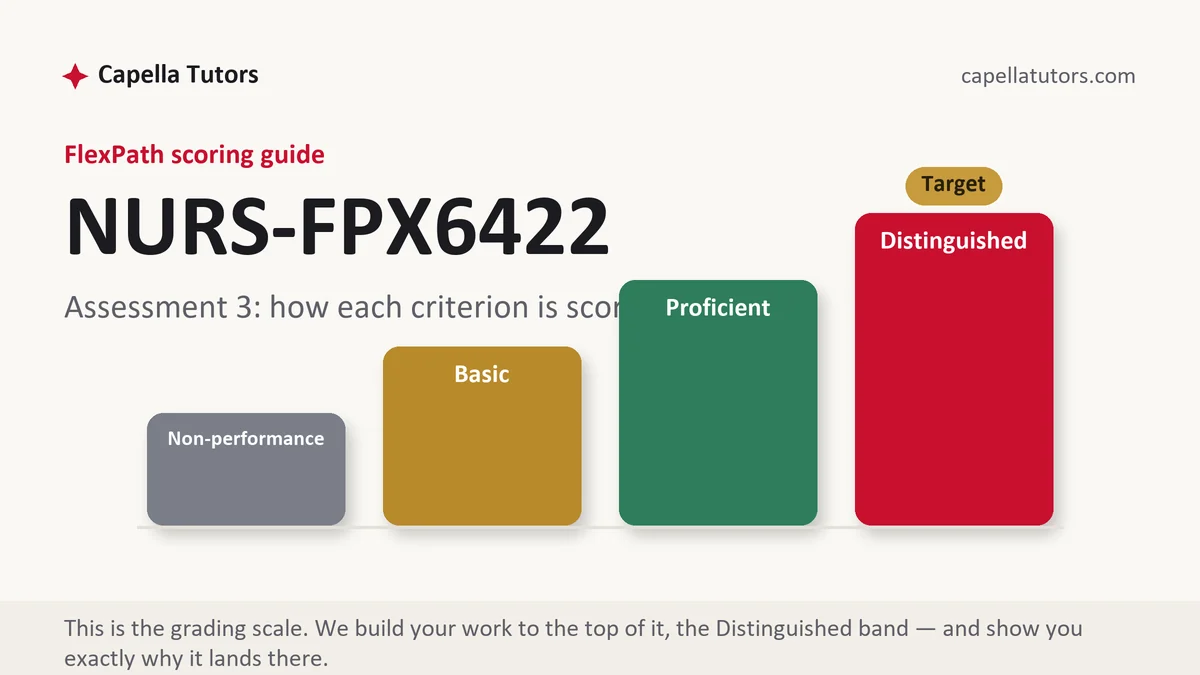
How NURS-FPX6422 Assessment 3 is scored
Each criterion resolves to one of four levels. On a workflow and usability analysis the levels separate on whether the findings are actionable:
| Level | What it means on a workflow and usability analysis |
|---|---|
| Distinguished | Observed steps counted against a denominator, each usability finding tied to a specific screen or step, severity assigned, and a fix proposed at the level of build, training, or policy with an owner attached. |
| Proficient | The workflow is mapped accurately and the problems are identified. Solid analysis that hands the committee a list rather than a decision. |
| Basic | A narrative description of how the system is used, with frustrations reported as themes. Readable, and capped, since no finding has a location. |
| Non-performance | A required criterion has no section, most often the analysis of alternatives or the evaluation of the recommendation. Nothing written earns nothing. |
The move that separates the top of this guide from the middle is location. A finding written as staff find the labeling process confusing cannot be fixed by anyone. The same finding written as the specimen label screen requires the accession number before the collector can be selected, which forces a back-navigation on 23 of 40 observed collections, names the screen, the step, the count, and the denominator, and it can be assigned to someone on Monday.
The NURS-FPX6422 Assessment 3 method, step by step
-
Map the work as performed, not as documented
Start from a written policy if one exists, then watch the task and record what actually happens. Number the steps, count the screens, count the clicks and the navigations, and mark every point where the user leaves the intended path. The gap between the documented and the performed workflow is the subject of this deliverable, and it only appears if you record both.
-
Count observations and report the denominator
Observation without arithmetic reads as anecdote. Fix how many task instances you watched, in which settings, on which shifts, and then report every finding as a proportion of that total. Twenty-three of forty observed collections is a finding; commonly is an impression. Say who you watched and who you did not, because a workflow observed only on day shift is a day-shift finding.
-
Use a recognized usability method and name it
Pick a method and apply it consistently: a heuristic evaluation against a published set, task-based testing with success and error rates, or think-aloud sessions with representative users. The ONC SAFER guides on healthit.gov give you a structured self-assessment frame for electronic record safety, and AMIA and HIMSS have published usability work that gives your severity language a source. A named method makes findings comparable; adjectives do not.
-
Explain workarounds as system evidence
When clinicians route around a system, treat the workaround as data about the design rather than as a behavior problem. Describe what the workaround accomplishes, what it costs in safety or traceability, and what the system would need to do to make it unnecessary. This framing is both more accurate and better scored, since the criteria are asking you to analyze the system.
-
Assign severity and propose the right layer of fix
Rank each finding by frequency and consequence, then say whether the remedy belongs in the build, the training, or the policy. Misassigning the layer is the most common recommendation error in informatics work: a design defect handed to education comes back unchanged, and a genuine knowledge gap handed to configuration produces a build nobody needed.
-
Close with a measure and a review date
For your top recommendation, state the metric, its denominator, the baseline you observed, the target, the review date, and who reports it. Add one sentence on how you would tell a real improvement from a change in how the work is recorded, and one on what your observation design cannot establish.
A structure that maps to the criteria
Word targets below are our tutors' planning proportions for an analysis of this scope, not Capella rules; expand wherever your scoring guide asks for more.
| Section | What it must do | Guide |
|---|---|---|
| System, setting, and question | The module under analysis, the sites and shifts observed, and the question the analysis answers. | ~200 words |
| Method and denominators | How many task instances, over which period, with which users, using which named usability method. | ~250 words |
| The workflow as performed | Numbered steps, screens, and navigations, with the documented process shown alongside the observed one. | ~300 words |
| Findings with severity | Each finding located on a screen or step, counted, rated for frequency and consequence. | ~300 words |
| Recommendations by layer | Build, training, or policy for each finding, with the accountable owner and the sequence. | ~250 words |
| Evaluation, limits, references | Metric, baseline, target, review date, what the design cannot establish, and current APA sources. | ~200 words |
Annotated sample excerpt
A model excerpt from our writers, showing what a finding looks like when a committee can act on it. Take the structure and rebuild it from your own observations.
Across 40 observed specimen collections on two units, day and night shift, the label screen required the accession number before the collecting clinician could be selected, and in 23 collections the nurse had not yet been given an accession number at the bedside, so the sequence broke and the label was generated at the workstation after the specimen was already in hand.1 The workaround that follows is consistent and rational: nurses pre-print two labels for anticipated draws at the start of the shift, which removes the trip back to the workstation and also removes the only step in the process that ties a label to a collection time.2 We rate this high frequency and high consequence and assign it to build rather than to education, because no amount of instruction resolves a screen that asks for a value the workflow supplies later; the requested change is to make the collector field independent of accession entry, owned by the laboratory information system analyst.3
- 1Gives the denominator, the settings, and the shifts before the count, then names the exact screen dependency that produces the break. Every element of the finding has a location.
- 2Reads the workaround as evidence about the design and states precisely what safety property it removes. Describing the loss in traceability terms is more useful than calling the practice unsafe.
- 3Assigns severity, chooses the layer of fix with a stated reason, and names an owner. This is the sentence that lets a committee schedule the work.
The full premium sample for your exact assessment, written fresh to your scoring guide and issue, is free to request. Study it, revise it into your own voice, and submit work you understand.
The five mistakes that cost Distinguished
- Findings without a location. Confusing, cumbersome, and time-consuming are reactions. A screen, a field, and a step are findings, and only findings can be assigned.
- Counts without denominators. Twenty-three observations of a problem means nothing until the reader knows twenty-three out of how many, watched where, on which shifts.
- Workarounds treated as noncompliance. Blaming users for routing around a design forfeits the analysis credit and usually points the recommendation at the wrong layer.
- Everything sent to training. Recommending education for a configuration defect is the most reliable way to produce a finding that reappears unchanged next quarter.
- No named method. Usability language borrowed without a source reads as opinion, while a heuristic set, a task-based protocol, or the SAFER guides give the same sentences authority.
Pre-submission checklist
- The module, sites, shifts, and observation period stated before any finding
- A named usability method applied consistently, with its source cited
- Documented workflow shown beside the observed workflow, steps numbered
- Every finding located on a screen or step and counted against its denominator
- Severity assigned, and each fix routed to build, training, or policy with an owner
- Metric, baseline, target, review date, and one stated limit of the observation design
Want the analysis drafted for you?
Send the scoring guide, the system, and whatever you have already observed. Our writers build the workflow map, locate the findings, and assign the severity language the criteria are looking for, then two quality reviewers grade the draft the way a Capella evaluator would. Back inside 24 to 48 hours with free revisions.