This manual is for NURS-FPX6422 Assessment 4, start to submission. A premium original sample for this deliverable lands inside 24 to 48 hours and stays in revision until your guide is met. Assessment 4 of NURS-FPX6422 asks you to decide something. Your scoring guide sets the format, and the assessment usually asks for a reasoned recommendation about whether and how to adopt, retune, or retire a clinical information system capability, argued from evidence, priced honestly, and governed by criteria a committee could apply without you in the room. Your courseroom may print this as NURS FPX 6422 Assessment 4 or NURS6422 Assessment 4; it is the same deliverable, and NURS-FPX6422 Assessment 4 is what this manual walks through.
One honesty note before the manual: Capella revises courses and scoring guides over time, so always write to the exact scoring guide attached to your assessment in the courseroom. The course identity above is verified on capella.edu; the method and structure below are our tutors' approach to it, not Capella's official rubric text.
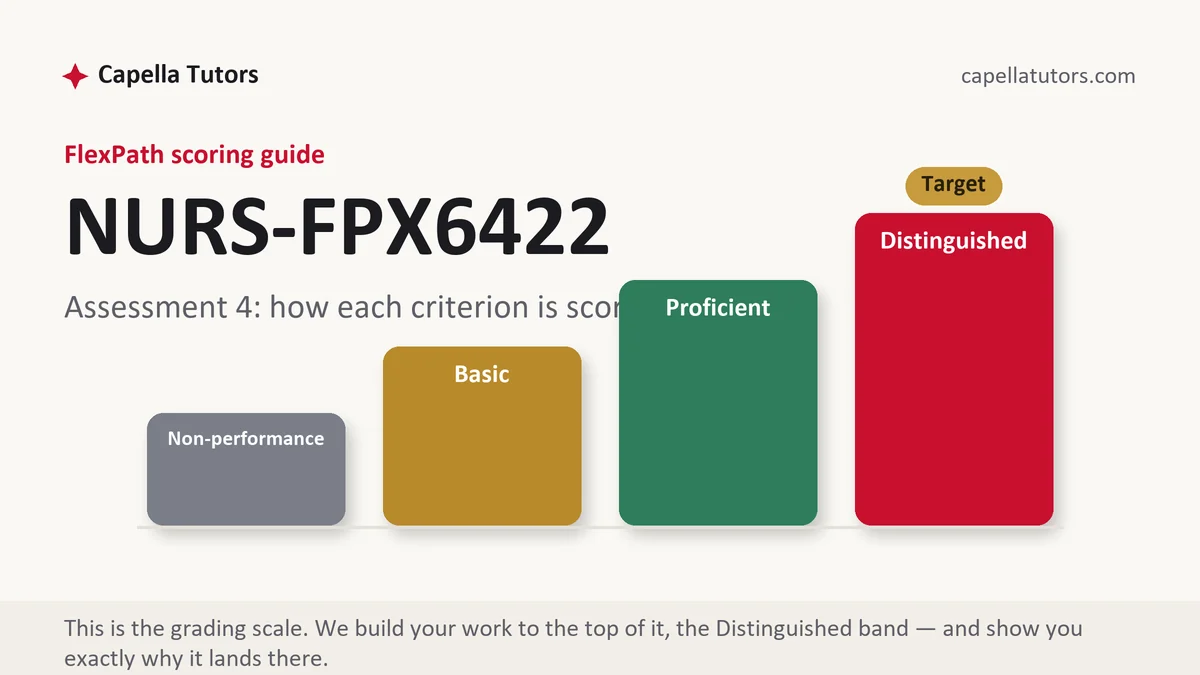
How NURS-FPX6422 Assessment 4 is scored
Four levels per criterion, and on a decision brief the levels sort by whether the recommendation is testable:
| Level | What it means on a system decision brief |
|---|---|
| Distinguished | The recommendation carries thresholds someone else could apply, the tradeoff is quantified in both directions, and the brief states the result that would require reversing the decision. |
| Proficient | A defensible recommendation with evidence behind it and costs acknowledged. Convincing, and one move short, because nothing in it can be tested against a future number. |
| Basic | A thorough discussion of considerations, ending in general support for the technology. The most common submission, and the criterion caps it. |
| Non-performance | A required element is unaddressed, usually the alternatives or the evaluation criteria. An unwritten comparison is not a comparison. |
Decisions about clinical systems are almost never about whether a capability works. They are about where to set it, who absorbs the cost of the setting, and who is accountable for revisiting it. A brief that argues for the technology in general has skipped every question that matters at this level.
The NURS-FPX6422 Assessment 4 method, step by step
-
State the decision as a threshold, not a direction
Better sensitivity is a direction. Move the trigger from two qualifying criteria to three within a stated window, accepting the modeled effect on detection, is a threshold. Thresholds can be evaluated, delegated, and reversed. Directions can only be agreed with, which is why they do not score at the top of the guide.
-
Report both sides of the tradeoff with denominators
Any change to a detection rule moves two numbers in opposite directions, and a brief that reports only the improvement is not analysis. Give the reader positive predictive value with its denominator, the count of true findings the change would have missed in your window, and the count of false ones it would have avoided. Then say plainly which of those two errors your organization has decided it would rather make.
-
Model on your own data before citing anyone else's
Retrospective silent testing on a local extract is worth more to a committee than a published effect size from a different population. Run the proposed setting against a defined historical window, report what it would have done, and describe the data-quality checks you ran first, including how you handled encounters with missing values rather than dropping them quietly.
-
Keep association and causation in separate sentences
Retrospective comparisons support associative claims. Units that adopted the new setting recorded fewer overrides is defensible; the setting reduced overrides is not, unless your design earns it. Name the confounders you can see, the secular trends in your window, and what a stronger design would have needed. Reviewers at this level read the verb choices closely.
-
Price the human cost of the setting
Every threshold has a cost carried by someone: an additional confirmation step, a delay, a review queue that needs staffing, a group of patients whose findings arrive later. Name who carries it and how much of it there is. A brief that finds a change free has not located the cost, and locating it is most of the analytical work.
-
Write the governance and the reversal condition
Name the committee that owns the setting, the review interval, the metric that gets reported at each review, and the specific result that would require the change to be reversed or escalated. Anchor the governance in recognized material: ONC resources on healthit.gov, the SAFER guides, AMIA and HIMSS governance publications, and peer-reviewed informatics literature for the empirical claims, all in current APA.
A structure that maps to the criteria
The proportions below are how our tutors plan a brief of this kind, not Capella requirements; your scoring guide sets the real structure.
| Section | What it must do | Guide |
|---|---|---|
| The decision, stated once | The capability, the specific setting proposed, the owner, and the date, in the opening paragraph. | ~150 words |
| Evidence from local data | The retrospective window, the data-quality checks, and what the proposed setting would have done. | ~300 words |
| The tradeoff quantified | Both error types with denominators, and the organization's stated preference between them. | ~300 words |
| Alternatives considered | Two or three options including no change, each with its cost and its carrier named. | ~250 words |
| Governance and review | Owning committee, review interval, reported metric, escalation path, and reversal condition. | ~250 words |
| Limits and references | What the retrospective design cannot establish, the confounders you can see, and current APA sources. | ~200 words |
Annotated sample excerpt
An original model excerpt from our team, written at the altitude a governance committee works at. Study the moves and build your own brief around your own decision.
Applied silently to the 9,340 adult medical admissions in the twelve months ending May 31, the proposed trigger change would have fired 1,204 times rather than 3,417, raising positive predictive value from 0.11 to 0.28 and reducing the alerts a nurse sees on a typical shift from roughly nine to three.1 The same model would have delayed or missed 14 of the 386 encounters that met the retrospective definition, and the median delay in the cases it still caught was 42 minutes; the committee should decide the question in that form, because 14 later detections and 2,213 fewer interruptions are the two prices on the table and only one of them is visible at the bedside.2 This is retrospective association in a single system with a documentation practice that changed in October, so it supports a decision about where to set the trigger and does not establish that the setting itself would change outcomes.3
- 1Reports the modeled result against a stated population and window, and converts the statistic into the unit a nurse experiences. Both the denominator and the translation are doing work.
- 2Puts both error types in front of the committee with their counts, then frames the decision as a choice between two named prices. Refusing to hide the cost of the recommendation is the top-of-guide move.
- 3Names the design, the confounder, and the boundary of the claim in one sentence. The limitation is specific to this analysis rather than a generic caution about retrospective data.
The full premium sample for your exact assessment, written fresh to your scoring guide and issue, is free to request. Study it, revise it into your own voice, and submit work you understand.
The five mistakes that cost Distinguished
- A direction instead of a threshold. Recommending better specificity gives the committee nothing to approve, nothing to delegate, and nothing to review.
- One side of the tradeoff. Reporting the reduction in false positives without the detections lost is the omission an experienced reviewer looks for first.
- Borrowed effect sizes. A published result from another population is context, not evidence, when a local retrospective window was available to you.
- Causal verbs on retrospective work. Reduced and prevented require a design that supports them; associated with and followed by are the honest forms and they cost nothing.
- Governance without a reversal condition. A review interval with no stated result that would undo the decision is a calendar entry rather than a control.
Pre-submission checklist
- The decision written as a specific threshold with an owner and a date
- Local retrospective window defined, with the data-quality checks reported
- Both error types quantified against denominators, and the preference between them stated
- The human cost of the setting named, along with who carries it
- Alternatives priced beside the recommendation, including no change
- Owning committee, review interval, reported metric, and an explicit reversal condition
Want the decision brief handled?
Send the scoring guide and the capability you are writing about, with any numbers you can share. Our research analyst builds the evidence table first, a subject-matched informatics writer drafts to the Distinguished column, and two quality passes follow before delivery inside 24 to 48 hours. Free revisions until the brief meets your guide.