Any deliverable in this course can be built for you as a premium original sample with the legal sourcing done properly, back inside 24 to 48 hours. The course identity: NHS-FPX6004, Healthcare Law and Policy, worth 2 points toward the 27 that complete Capella's FlexPath MSN. It sits in the MSN core, which means every specialization in that program passes through it, and it runs in FlexPath, so each criterion is scored from Non-performance to Distinguished on its own. Both spellings find it, NHS6004 and NHS-FPX6004.
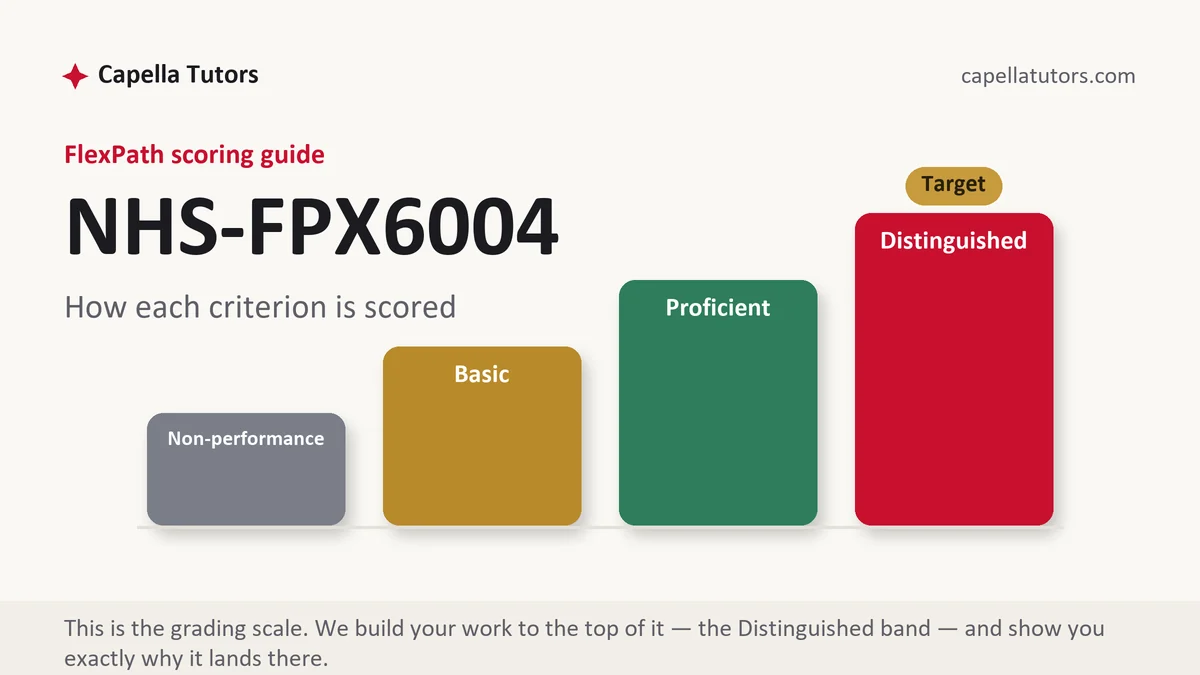
What NHS-FPX6004 actually grades
This course grades legal reasoning aimed at a decision someone has to make. Not law school reasoning, and not opinion writing either. The criteria want a practice problem, the statute or regulation that governs it, and a recommendation a person with authority could sign. HIPAA appears because privacy is where nursing practice and federal law touch most often. The Affordable Care Act appears because coverage rules generate the access problems nurse leaders inherit. Scope of practice appears because it is the cleanest example of state and federal authority occupying the same question with different answers.
Distinguished work here quotes the governing rule accurately, then argues from it toward a decision. Basic work describes the rule and stops, or argues a policy preference without ever naming the authority that would have to change for the preference to matter. Evaluators read for one thing above all else: whether the writer can tell the difference between what the law requires and what the writer believes is right. Both belong in the paper. They belong in different paragraphs.
How we help in this course
Send the scenario and the scoring guide and the sample comes back with the legal layer handled the way faculty expect it: the controlling statute or regulation identified by name and section, quoted where quotation earns its space, and applied to your facts instead of summarized at them. Our policy writers work in the register the criteria describe, a document addressed to a board, a director, or a legislative aide, with the ask on the first page. Where state authority governs, the draft cites your state's nurse practice act and the board rules interpreting it rather than a generic national statement, and that single choice is the largest quality difference in this course.
Delivery terms do not soften for a legal topic: a premium original sample in 24 to 48 hours, aimed at the top column of the scoring guide you upload, routed through the eight-person pipeline and its two QA passes, with free revisions until every criterion is satisfied.
The assessments, one by one
Assessment 1
Send the scoring guide and the data set and a premium original sample comes back inside 24 to 48 hours, written to the top column and revised free until every criterion clears. Read the full Assessment 1 manual.
Assessment 2
A premium original sample with the legal sourcing handled comes back inside 24 to 48 hours, written to the guide you upload and revised free until it clears. Read the full Assessment 2 manual.
Assessment 3
Hand it over and a premium original sample, agenda and objectives and evaluation plan included, arrives inside 24 to 48 hours with free revisions until the guide is met. Read the full Assessment 3 manual.
How to actually write NHS-FPX6004: where to begin
Start from the scoring guide, and read it first for the audience question, since audience decides the document. The assessments in this course usually ask you to take a practice or organizational problem, locate the law or policy that governs it, and write to someone with the power to change something: an executive team, a policy committee, a regulator, a legislator's staff. Your scoring guide decides the format, the length, and how much legal detail belongs in the body rather than an appendix. Rebuild the criteria as your headings before you draft, with the Distinguished wording parked underneath each one, and the shape of the deliverable stops being a guess.
Then find the actual authority, and find it at the source. Secondary description of a law is where most Basic submissions come from. HIPAA lives in the Code of Federal Regulations, reachable through eCFR, with the HHS guidance pages doing the plain-language work alongside it. ACA provisions and their current implementation sit with CMS, and the statute text is on Congress.gov. Scope of practice is state law, which means your state legislature's site for the nurse practice act and your state board of nursing for the rules that interpret it. Read the section you intend to cite, not a summary of it. One accurately quoted regulatory sentence does more for a criterion than three paragraphs of paraphrase.
Then settle the authority question explicitly, because most of the criteria depend on it. Federal law sets a floor across much of health regulation and states may go further, which is why a privacy analysis that ignores a stricter state statute is incomplete rather than merely short. Preemption is the term for what happens when the two collide, and the version a policy memo needs is simple: name both rules, say which controls the situation in front of you, and state the practical instruction to staff that follows. Writers who resolve that in one clean paragraph pick up points across several criteria at once, since the recommendation, the implementation plan, and the stakeholder section all rest on it.
| Section | What goes in it | What Distinguished looks like |
|---|---|---|
| Problem and practice context | The situation, the setting, and who is affected by it. | A problem stated so the legal question is obvious, scoped to a decision that is actually available to someone. |
| Governing law or regulation | The statute, rule, or standard that controls, cited by name and section. | Primary source quoted where the wording matters, with the state layer addressed and not just the federal one. |
| Legal and ethical analysis | What the rule requires once applied to these particular facts. | The application argued, including the part the rule leaves unsettled, with ethics kept in its own paragraph. |
| Policy recommendation | What should change, and which body holds the power to change it. | A recommendation addressed to the correct authority and written tightly enough to be adopted as drafted. |
| Implementation and stakeholders | Who acts, what it costs them, and who will resist. | Opposition anticipated and answered on its own terms rather than waved off as resistance to change. |
| Communication to decision-makers | The framing that audience needs, in the format the guide names. | The ask on the first page, the evidence behind it, and no legal jargon left untranslated. |
Developing the synthesis
Synthesis in 6004 means holding three kinds of source in one argument without treating them as interchangeable. Law binds. A professional association standard persuades, and may help define the standard of care, but it does not bind on its own. Peer-reviewed evidence tells you whether a policy works, which is a different question from whether it is permitted. The strongest paragraphs in this course put the three in that order: this is what the regulation requires, this is what the professional standard recommends beyond the requirement, and this is what the literature reports happens when organizations follow or ignore it.
Conflicts between the three are the opportunity, not the problem. A state scope rule that permits less than the evidence supports is a real argument, and the honest version of it concedes that the law governs until it changes, then aims the recommendation at the body that could change it. Say what your sources cannot settle as well. Regulatory questions frequently have no published outcome data at all, and a writer who names that gap, then reasons from mechanism and precedent instead, reads as competent. A writer who papers over it with a confident sentence and no citation reads as guessing.
Citations that survive faculty review
Legal sources have their own APA 7 forms, and this is the course where getting them wrong shows. A federal regulation is cited by title and section with the year of the CFR edition. A statute is cited to the code, not to a news article about the code. State law is cited to the state statute or to the board's rule number. Agency guidance is cited as a web document with the agency as author. Keep the primary sources doing primary work: cite HHS for what the privacy rule requires, and cite a journal article for what compliance with it costs a hospital.
For the evidence layer, the health policy and health services literature through the Capella library is the right well, and independent policy analysis organizations are usable for coverage figures and trend data as long as you label them as analysis rather than authority. Give every source a criterion to serve, then check the dates. Anything describing ACA implementation or state scope rules changes often enough that a five-year-old summary can simply be wrong, and a confidently cited wrong rule costs more than a missing citation ever will.
The mistakes that land Basic instead of Distinguished
- The law described but never applied. A flawless summary of HIPAA that never touches your scenario answers no criterion in the guide.
- Federal authority cited and state authority ignored, in a question where state law actually controls the answer.
- A recommendation addressed to nobody. Policy proposals need a body with the power to adopt them, named.
- Legality and ethics fused into one paragraph, so the evaluator cannot tell which criterion is being answered where.
- A blog post, news item, or vendor page standing in for the rule itself.
- Opposition unacknowledged. Every policy change costs someone something, and pretending otherwise reads as thin analysis rather than confidence.
- Terminology left untranslated. Preemption, covered entity, and delegated authority all need a plain-language gloss for a lay decision-maker.
NHS-FPX6004 questions students actually ask
Do I have to cite the statute itself, or is a journal article enough?
Cite the statute or regulation itself for anything the law requires, because that is what the criterion is written about. Journal articles cover the parts law cannot tell you: whether a rule works, what compliance costs, how staff behave under it. The test is what kind of claim the sentence makes. A sentence saying covered entities must do something needs the regulation. A sentence saying compliance programs reduce breach rates needs a study. Mixing those two up is the most common citation error in this course, and it is usually punished twice, once on the legal criterion and once on the evidence criterion.
What do I do when state law and federal law disagree?
Say so plainly, then answer the question your reader actually has. Federal health regulation generally sets a minimum that states may exceed, so the usual answer is that the stricter rule governs the behavior you are writing about. Name both rules, state which one controls here, and give the operational instruction that follows for staff in that state. If the two genuinely conflict rather than stacking, say that too, and note that resolving it is a legal determination rather than yours to make. Evaluators reward the writer who identifies the tension over the writer who quietly picks one and hopes nobody checks.
Who am I supposed to be writing to?
Whoever your scoring guide names, and if it names nobody, pick the smallest body that could actually implement your recommendation. An organizational policy change goes to an executive or policy committee. A scope of practice change goes to the state board or the legislature. A coverage or billing problem goes to whoever owns the payer relationship. Then write for that reader: the ask first, the legal basis second, the evidence third, implementation last, and no unexplained legal terminology anywhere. A memo a real director could act on scores above an essay about the issue, because the criteria in this course are written about communication to decision-makers rather than about the topic in general.
In NHS-FPX6004 right now?
Send the scoring guide and tell us which law or policy problem the assessment hands you. First sample free, 24 to 48 hours.