This manual is for NHS-FPX6004 Assessment 1, start to submission. Send the scoring guide and the data set and a premium original sample comes back inside 24 to 48 hours, written to the top column and revised free until every criterion clears. Doing it yourself? Here is the method. Assessment 1 of NHS-FPX6004 usually asks you to read performance data as a compliance question. You take a dashboard or a set of unit metrics, compare each one against a benchmark that a law, a regulation, or a national body has set, and explain what the shortfall means for the organization and for the people it serves. Your scoring guide decides the format and whether a specific audience is named. The criteria are not really about the numbers. They are about whether you can attach a metric to the authority that makes it matter. Your courseroom may print this as NHS FPX 6004 Assessment 1 or NHS6004 Assessment 1; it is the same deliverable, and NHS-FPX6004 Assessment 1 is what this manual walks through.
One honesty note before the manual: Capella revises courses and scoring guides over time, so always write to the exact scoring guide attached to your assessment in the courseroom. The course identity above is verified on capella.edu; the method and structure below are our tutors' approach to it, not Capella's official rubric text.
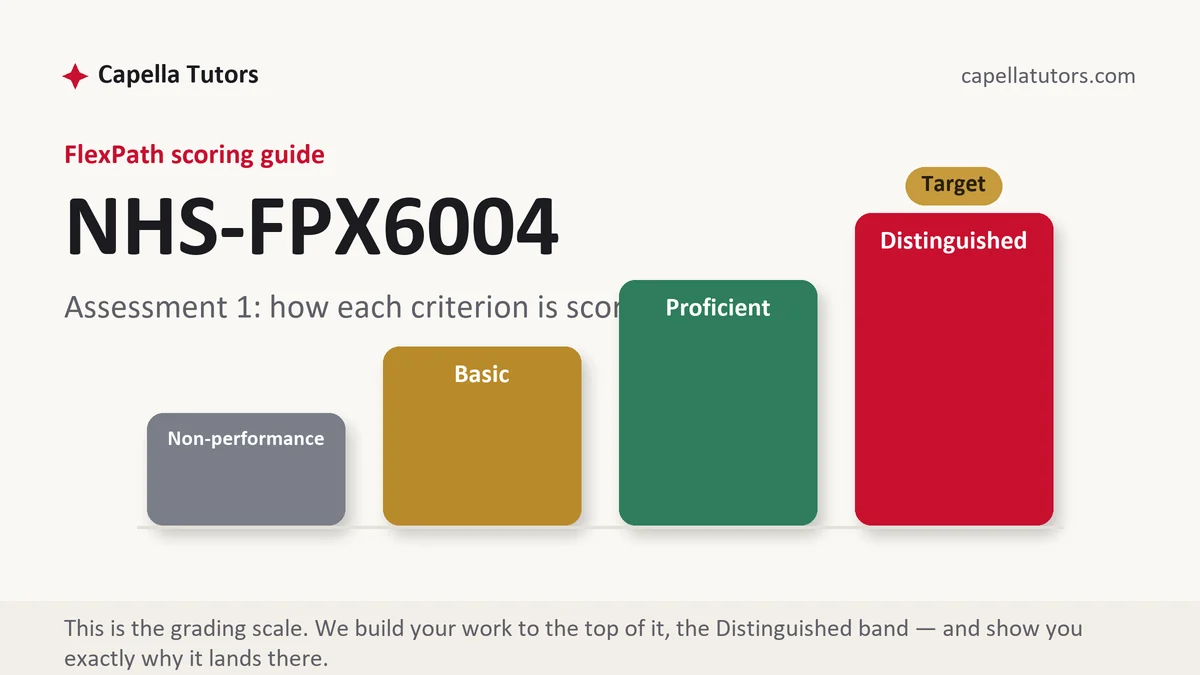
How NHS-FPX6004 Assessment 1 is scored
There is no point total in FlexPath and no partial credit for effort. Every criterion is judged on its own and lands on one of four levels, so the level wording is your specification:
| Level | What it means on a benchmark and metrics evaluation |
|---|---|
| Distinguished | Each metric sits against a benchmark traced to the rule, statute, or national standard that establishes it, the consequences of the shortfall are argued for the organization and for patients, and the evaluation closes with a change a named body could authorize. Every criterion also carries its own additional requirement, and your scoring guide is the authority on it. |
| Proficient | The metrics are compared against real benchmarks with sound reasoning, but the authority behind the benchmark stays vague and the consequences stay general. |
| Basic | The dashboard described in prose. Numbers restated, no benchmark with a source attached, and an ending that asks for more education. |
| Non-performance | A required element is absent, most often the benchmark source or the consequence analysis. Missing is what floors a criterion, not weak. |
The question that decides this course arrives early: who says so. A metric measured against an internal target is a management conversation; the same metric measured against a requirement in the Code of Federal Regulations or a national body's standard is a compliance argument, and the criteria are written about the second. Settle the authority in your first paragraph and several criteria improve at once, because the consequence analysis and the recommendation both rest on it.
The NHS-FPX6004 Assessment 1 method, step by step
-
Read the criteria for the audience before you read the data
The scoring guide usually names, or implies, who receives this evaluation: a compliance committee, a director, an executive team. That reader decides how much regulatory detail belongs in the body and how much belongs in an appendix. Rebuild the criteria as headings first, park the top-level wording under each, and the shape of the document stops being guesswork.
-
Isolate the metrics a rule actually governs
Not every number on a dashboard has legal weight. Sort your metrics into three piles: those a regulation requires, those a national body sets an expectation for, and those the organization chose for itself. The first pile carries the paper. In a privacy example the governed metrics are things like encryption of portable devices, breach notification timing, workforce training completion, and audit control review, and each one exists because a rule says it should.
-
Trace each benchmark to its source and quote the operative words
Read the section you intend to cite in eCFR or in your state code rather than a summary of it, then quote the phrase that creates the obligation. This is also where the distinction between a required implementation specification and an addressable one has to be handled correctly, because addressable does not mean optional, it means an organization must either implement the control or document why an equivalent alternative was reasonable. A writer who explains that distinction accurately picks up points on the legal criterion and on the analysis criterion at the same time.
-
State the consequence in two registers
One register is organizational: notification obligations, enforcement exposure, corrective action, the state privacy layer where it is stricter than the federal floor. The other is human: what the shortfall does to the patients whose information or care is affected. Support each with evidence a master's evaluator respects, which means agency data such as the HHS Office for Civil Rights breach reporting portal alongside peer-reviewed work in journals such as JAMA Network Open, Health Affairs, and the Journal of the American Medical Informatics Association. Report what the source measured, not just its conclusion.
-
Name the body that can fix it and what you are asking of it
Close on a change addressed to whoever holds the authority to adopt it: a compliance committee for a control standard, an executive team for capital, a board for policy. Attach the metric that would show the fix worked and the date by which the number should move. A recommendation with no addressee is the most common way a strong evaluation loses its final criterion.
-
Self-score against the guide, then submit early in the week
Walk your draft through the guide criterion by criterion, marking the level you would award, and confirm each criterion has its own labeled section. Fix anything below the top column, verify that every regulation you cited is current, then submit at the start of the week so a two-day evaluation window does not become a five-day one.
A structure that maps to the criteria
The word targets below are our planning figures for this kind of evaluation, not Capella requirements. Your scoring guide decides the length, the audience, and the format.
| Section | What it must do | Guide |
|---|---|---|
| Purpose and the data | What you are evaluating, over what period, and for whom this evaluation is written. | ~150 words |
| Metric-by-metric comparison | Each metric beside its benchmark, with the source of the benchmark named in the sentence. | ~350 words |
| Authority behind the benchmarks | The statute, regulation, or standard that makes each benchmark binding or expected, cited by section. | ~250 words |
| Consequences of the shortfall | What the gap exposes the organization to, and what it does to patients, argued from evidence. | ~300 words |
| Recommendation and responsible body | The change, the body with power to adopt it, and the metric that would show it worked. | ~250 words |
| References and citation layer | Regulations, agency guidance, and peer-reviewed sources in current APA 7 forms. | as needed |
Annotated sample excerpt
An original model excerpt from our team, at the register the top column describes. Study the moves, then write the evaluation your own data supports.
Of the 1,240 clinician-assigned tablets in the ambulatory division, 71 percent carry full-disk encryption, and the device lost from the infusion clinic in March was among the 29 percent that did not.1 The Security Rule treats encryption as an addressable implementation specification rather than an optional one, which means the organization may adopt an equivalent alternative but must document why encryption was not reasonable and appropriate; this division holds no such documentation, so the operative benchmark is 100 percent.2 Measured against that benchmark the gap is 360 devices, and it is what turns one lost tablet from an unfortunate event into a reportable breach with no available safe harbor.3
- 1A denominator, a rate, and the specific event located inside the gap. Evaluators reading a data criterion look first for whether the writer can place a real incident inside a real distribution.
- 2Explains the regulatory term instead of borrowing it. Addressable is the word most often misread as optional in this course, and reading it correctly is what supplies the benchmark the paragraph needs.
- 3Converts the percentage into a count, then states the legal consequence in a single clause. Note the restraint: it reports the loss of safe harbor rather than predicting a penalty, which is not the writer's determination to make.
The full premium sample for your exact assessment, written fresh to your scoring guide and issue, is free to request. Study it, revise it into your own voice, and submit work you understand.
The five mistakes that cost Distinguished
- Benchmarks with no author. A target that came from a spreadsheet cannot ground a compliance argument. Name the rule, the section, or the national body that sets the expectation.
- Secondary sources standing in for the rule. An article about a regulation is not the regulation. Read the section at the source and cite what it actually says.
- Required and addressable used interchangeably. The distinction changes what the organization owes and whether a shortfall is defensible, and collapsing it costs you on the legal criterion.
- Consequences written as adjectives. Serious, concerning, and unacceptable measure nothing. Notification obligations, enforcement exposure, and evidence of patient harm measure something.
- A recommendation aimed at education. More training is the default ask and the weakest one. Name the control, the owner, and the body that has to approve it.
Pre-submission checklist
- Every metric paired with a benchmark whose source is named in the same sentence
- At least one regulation cited by title and section, read at the source rather than in summary
- Required and addressable obligations distinguished wherever the rule distinguishes them
- Consequences argued in two registers, organizational exposure and patient effect, each sourced
- A recommendation addressed to the body that could adopt it, with a metric and a date attached
- APA 7 legal and agency citation forms checked, every rule current, self-scored before submitting
Want the metrics evaluation done properly?
Send the dashboard, the scoring guide, and the setting. Our research analyst pulls the governing rule and the benchmark sources, and a premium original sample comes back in 24 to 48 hours with two QA passes behind it and free revisions until every criterion clears.