This manual is for NHS-FPX6004 Assessment 2, start to submission. A premium original sample with the legal sourcing handled comes back inside 24 to 48 hours, written to the guide you upload and revised free until it clears. If you are drafting it yourself, work through the method below. Assessment 2 of NHS-FPX6004 usually asks for a proposal: a policy, plus the practice guidelines that make it operable, addressed to a body with the power to adopt it. Your scoring guide decides the length, the audience, and how much legal detail belongs in the body rather than an appendix. What the criteria consistently want is adoptable text rather than an essay about an issue, which means the proposal has to survive being read by somebody whose signature would put it into effect. Your courseroom may print this as NHS FPX 6004 Assessment 2 or NHS6004 Assessment 2; it is the same deliverable, and NHS-FPX6004 Assessment 2 is what this manual walks through.
One honesty note before the manual: Capella revises courses and scoring guides over time, so always write to the exact scoring guide attached to your assessment in the courseroom. The course identity above is verified on capella.edu; the method and structure below are our tutors' approach to it, not Capella's official rubric text.
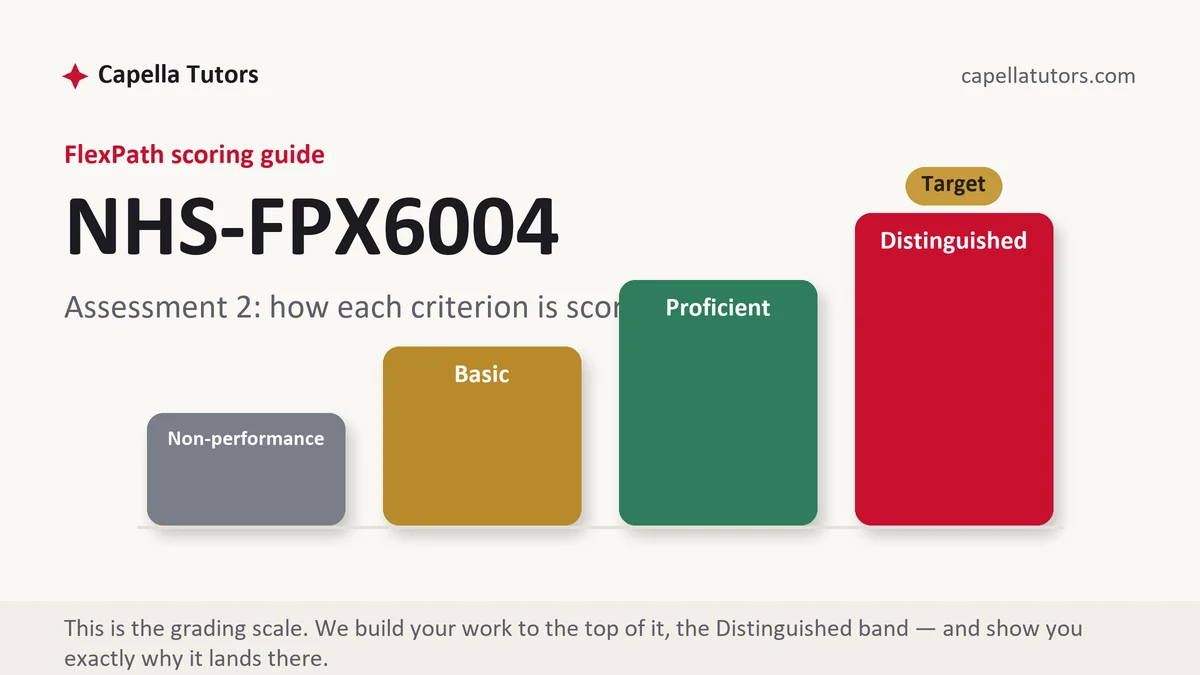
How NHS-FPX6004 Assessment 2 is scored
FlexPath grades each criterion separately against four levels, with no points and no averaging. Read the levels as the brief for the document:
| Level | What it means on a policy proposal |
|---|---|
| Distinguished | The proposed policy is written as text a committee could adopt, grounded in the statute or rule that governs, carried by evidence with its designs stated, and paired with practice guidelines specific enough to change behavior on a unit. Each criterion states its own further requirement, and your scoring guide decides what it is. |
| Proficient | A sound, sourced proposal with real guidelines, but the legal basis stays at the level of description and the opposition is acknowledged rather than answered. |
| Basic | An argument that something should improve. The policy is a preference, the guidelines are aspirations, and no body is named that could adopt either. |
| Non-performance | A required component is absent, most often the practice guidelines or the stakeholder analysis. Evaluators score the gap and not the quality of the surrounding writing. |
The move that separates the top two levels is the answered objection. Every policy change spends somebody's money, authority, or flexibility, and a proposal that never names the person who loses something reads as thin rather than as confident. State the strongest version of the opposition, in the terms that opposition would use, then answer it with evidence or with a concession. Conceding a narrow point deliberately is what makes the rest of the proposal credible.
The NHS-FPX6004 Assessment 2 method, step by step
-
Write the ask before you write the background
One paragraph, at the top, stating what you want adopted and who has to adopt it. If the ask cannot be written before the background exists, the proposal does not have one yet. This also keeps the document in the right genre: a policy proposal opens with the recommendation and defends it afterward, unlike a paper, which builds toward a conclusion.
-
Find the legal floor, then find the state layer
Federal law sets a minimum across much of health regulation and states may go further, so the controlling rule for a workforce question is frequently a state statute or a board regulation rather than anything federal. Read your state's provision at the source, cite it by section, and say plainly which rule governs the behavior in front of you. A proposal that cites only a federal standard where state law is stricter is incomplete rather than merely brief.
-
Turn the policy into practice guidelines
The policy states the rule; the guidelines state what a charge nurse does at 19:00 on a Friday. Hours caps, consecutive-shift limits, a protection clause against retaliation, the escalation ladder that must be exhausted before a shift can be called an emergency, and the person who approves exceptions. A criterion asking for guidelines is asking for behavior at that grain, and vagueness here is the single most common reason an otherwise strong proposal stalls at Proficient.
-
Build the evidence base at the right level
Support the mechanism with peer-reviewed work rather than with advocacy material: the shift-length and fatigue literature in journals such as the Journal of Nursing Administration, Nursing Outlook, Health Affairs, and the American Journal of Public Health. Carry the design and the setting into your sentence, since a multi-hospital observational cohort and a single-unit pre-post study license different claims. Professional association position statements belong in the argument too, but label them accurately: they persuade and may inform the standard of care, and they do not bind the way a statute does.
-
Name the stakeholders, cost them, and answer the objection
List who is affected and what each one gains or loses: managers losing a coverage tool, finance absorbing premium pay or agency hours, staff gaining a protected refusal, patients gaining a rested clinician. Then answer the strongest objection in its own currency. If the answer is that the alternative costs more, show the comparison rather than asserting it.
-
Self-score against the guide, then submit early in the week
Read the proposal against each criterion, mark the level yourself, and check that the legal citations are current and correctly formed. Rework anything below the top column, then file at the start of the week so the evaluation window, which can run two business days, does not stall your session.
A structure that maps to the criteria
The word targets below are planning figures from our own drafts of this deliverable. If your scoring guide names a length, an audience, or a required appendix, the guide decides.
| Section | What it must do | Guide |
|---|---|---|
| Executive summary and the ask | The proposed policy in one paragraph, with the body being asked to adopt it named. | ~200 words |
| Problem and local evidence | The practice problem with counts, dates, or rates drawn from your own setting. | ~250 words |
| Governing law and standards | The statute, regulation, or board rule that controls, cited by section, with the state layer addressed. | ~300 words |
| The policy and its practice guidelines | The adoptable text, then the behavior-level rules that make it operable on a unit. | ~350 words |
| Evidence for the policy | Peer-reviewed support for the mechanism, with designs and settings stated in the prose. | ~250 words |
| Stakeholders, objections, implementation | Who resists, what it costs them, the answer to each objection, and the rollout with owners. | ~300 words |
Annotated sample excerpt
A model excerpt from our team, showing how the top column reads in a proposal. Take the structure, then write the policy your own setting needs.
Recommendation: no registered nurse in this facility may be required to work more than twelve consecutive hours or more than sixty hours in any seven-day period, and a nurse who declines additional hours after a twelve-hour shift may not face discipline, reassignment, or loss of preferred scheduling.1 Our state's nurse overtime statute already prohibits mandatory overtime outside a declared emergency, and the department log records forty-one instances last quarter entered as voluntary in which the nurse was told that coverage would otherwise fail.2 This proposal therefore creates no new obligation. It closes the distance between what the statute requires and what our scheduling practice produces, and it names the escalation steps that must be exhausted before any shift is called an emergency.3
- 1The ask arrives first, in the language a policy manual would use, with numbers and a protection clause. A policy criterion wants adoptable text, not a discussion of the topic.
- 2Sets the governing state statute beside local data. That pairing is what turns a preference into a compliance argument, and the count makes the problem auditable by somebody other than the writer.
- 3Reframes the proposal as closing a gap rather than as reform, which is the version an executive committee can approve, and shuts the loophole the policy would otherwise leave open.
The full premium sample for your exact assessment, written fresh to your scoring guide and issue, is free to request. Study it, revise it into your own voice, and submit work you understand.
The five mistakes that cost Distinguished
- The law described but never applied. A clean summary of the statute that never reaches your facility answers no criterion in the guide.
- A proposal addressed to nobody. Policies are adopted by named bodies. Without one, the implementation criterion has nothing to attach to.
- Guidelines written as values. Promote safe staffing is not a guideline. A cap, a refusal right, an escalation ladder, and an exception approver are guidelines.
- Advocacy material cited as authority. Position statements and campaign pages persuade; they do not bind. Mislabeling them costs you twice, once on the legal criterion and once on evidence.
- Opposition waved off as resistance to change. The manager losing a coverage tool has a real problem. Answering it in the manager's own terms is what the top column is describing.
Pre-submission checklist
- The ask stated in one adoptable paragraph, with the adopting body named
- The controlling statute or rule cited by section, with the state layer addressed explicitly
- Practice guidelines written at the level of behavior, including who approves exceptions
- Peer-reviewed evidence carried with its design and setting stated in the sentence
- Each stakeholder's loss named and the strongest objection answered on its own terms
- APA 7 legal citation forms verified, rules current, self-scored criterion by criterion before submitting
Want the policy proposal drafted for you?
Send the scoring guide and the practice problem. The draft comes back with the controlling statute identified by section, guidelines written at unit level, and the opposition answered, inside 24 to 48 hours, revised free until every criterion is satisfied.