Send us the prompt and the scoring guide and a premium original sample comes back in 24 to 48 hours, revised until it matches the guide. The course itself is NURS-FPX6080, MSN Practicum: Professionalism in Person-Centered Care and the Workplace Environment. It is worth 2 points of the 27 in Capella's FlexPath MSN, and it carries 100 of the program's 500 documented practicum hours. Students type it as NURS6080 and NURS-FPX6080; both spellings land here.
What NURS-FPX6080 actually grades
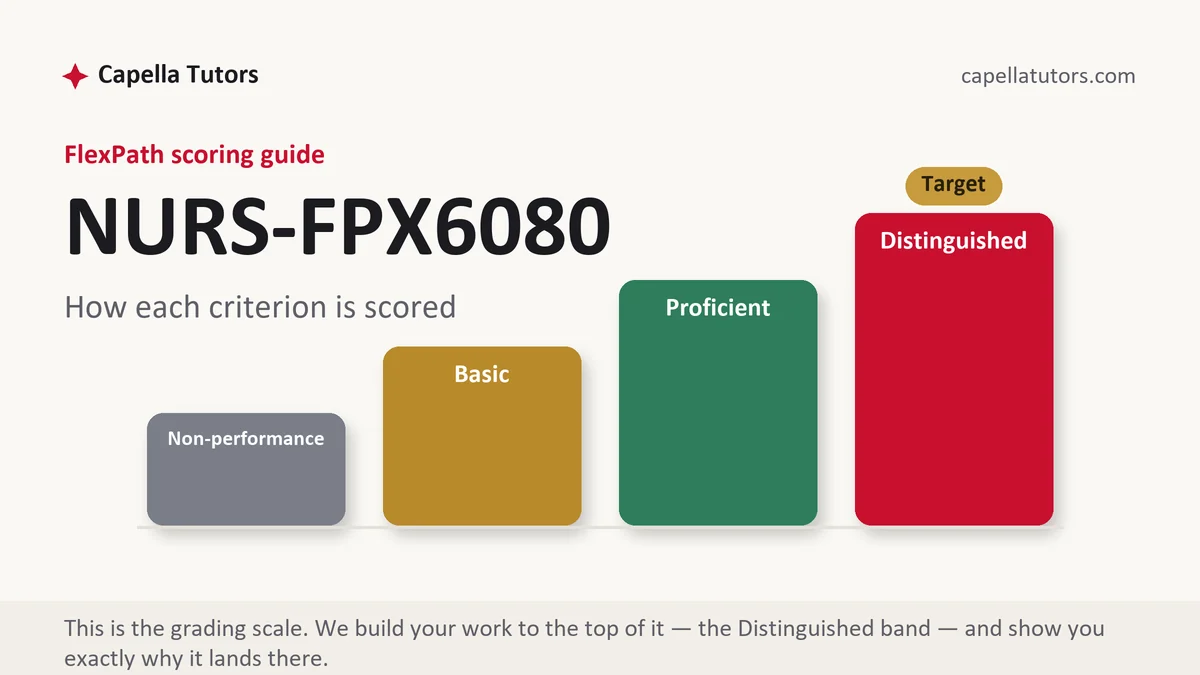
This course grades two separate things, and most students arrive ready for only one. The written half behaves like every other FlexPath assessment: criteria scored from Non-performance up through Basic and Proficient to Distinguished, each asking you to argue something about professional standards, person-centered care, and the unit you work in. The documentation half behaves like a compliance file. One hundred hours have to exist on paper, tied to an approved site and an approved preceptor, with dates and signatures that survive somebody checking them.
Neither half rescues the other. Clean prose does not close a course whose hours were never verified, and a complete log does not lift a reflection that reads like a shift diary. Practicum guides keep asking for one move: describe what happened, then argue what it means against a standard or a source. Description alone sits at Basic. The argument scores.
Two constraints shape the term. You have to hold a current unrestricted RN license the whole way through, so a lapse becomes an academic problem and not only a licensing one. And FlexPath bills in flat 12-week sessions with up to two courses open at a time, so your hours compete for calendar with whatever else you have running. Pair this course with a light one and both tend to close.
How we help in this course
Work here moves through the same eight-person pipeline as the rest of the desk. A research analyst reads your scoring guide criterion by criterion and writes the target: what a Distinguished answer has to contain on each line. A subject-matched writer, MSN-credentialed and used to practicum documentation, drafts against that map. Scoring-guide QA confirms every criterion was answered, then APA and originality QA close it out. The first premium original sample lands inside 24 to 48 hours, and revisions continue until it meets the guide.
The boundary is worth stating plainly. We write the deliverables and the documentation: professionalism analyses, the narrative pieces about your site and your role, plan documents, reflective work, the write-ups that carry your logged hours into prose. We do not complete anyone's clinical hours. Those 100 hours are yours, worked at your site, signed by your preceptor. What we do is make the hours you put in read as evidence instead of anecdote.
Practically, send the prompt, the scoring guide, your specialization, and a few honest sentences about your setting and your role. Rough notes are enough; nobody can invent a site.
Securing a site and preceptor without losing weeks
The costliest failure in this course is administrative. Site agreements move at the speed of someone else's legal department, preceptor forms sit in someone else's inbox, and none of it pauses your billing session. Start the paperwork one course before you need it, the way every student we have watched close this course in a single session did.
Ask three things early. Whether your employer already holds an agreement with the school, because an existing agreement can turn weeks into days. What your preceptor needs from you in writing, since most sign quickly once they see one page covering hours, dates, and what the role actually obligates them to. And which approvals faculty needs finalized before hour one counts, because hours logged ahead of approval are the most common kind of wasted work.
Keep dated copies of everything you send. When something stalls, a record of your own follow-ups is what moves it, and that record often becomes source material for the plan and reflection deliverables.
Documentation that reads as evidence, not diary
Log hours the day they happen. Reconstructed logs are visible from across the room: the times go round, the activities go generic, and the detail that would have carried a strong reflection is gone. A usable entry names the date, the hours, the setting, what you did, and which competency or standard the activity touched. That last field costs ten seconds while you still remember and is close to impossible a month later.
The reason for detail is not compliance. The log is your evidence file. When an assessment asks you to analyze professionalism in your workplace environment, a Distinguished answer names one interaction, on a specific date, read against a published standard. A Basic answer says communication on the unit could improve. Same student, same unit; the difference is whether the note existed.
So write each note in the register you will need later: what happened, what you observed, what it implies. Two sentences. That is the cheapest work in the course.
The assessments, one by one
Assessment 1
Send the prompt and the scoring guide and a premium original sample of this deliverable comes back in 24 to 48 hours, revised free until every criterion is satisfied. Read the full Assessment 1 manual.
Assessment 2
Hand us the prompt and the scoring guide and a premium original sample lands inside 24 to 48 hours, then gets revised at no cost until the guide is satisfied. Read the full Assessment 2 manual.
Assessment 3
Give us the scoring guide and your log and a premium original sample of this deliverable comes back within 24 to 48 hours, revised free until the criteria are met. Read the full Assessment 3 manual.
How to actually write NURS-FPX6080: where to begin
Open every scoring guide in the course before you write a word of any of them. Practicum courses build: an early deliverable establishes your site, your role, and your plan, later ones analyze what you observed, and a closing one reflects across the set. The assessments here usually ask you to document the arrangement, examine professionalism and person-centered care in your own setting, and account for what your hours produced. A plan written blind promises things the later deliverables cannot use.
Then build each document the same way. Copy the criteria in as headings. Paste the Distinguished description underneath each one. Write to the description rather than the criterion title, because the title names the topic and the description sets the bar. Delete the pasted text last. It is the only reliable defense against a paper that says intelligent things about the wrong subject.
Do not hedge your setting into vapor. Anonymize the unit and the people, keep the specifics of the situation. Faculty can tell a de-identified real case from a hypothetical, and every criterion that asks for application rewards the first.
| Section | What goes in it | What Distinguished looks like |
|---|---|---|
| Practicum arrangement and plan | Your site, your role, your preceptor's role, the hours you intend to work, and what you plan to accomplish in them. | Objectives narrow enough to complete in the hours available, each tied to a program competency rather than to a job duty. |
| Hour documentation | Dated entries with setting, activity, and the standard or competency each block touched, verified by whoever signs for you. | Entries specific enough that a later assessment can quote them, with no gaps between the log and the narrative built on it. |
| Professionalism analysis | Observed practice in your setting read against professional standards and scholarly sources. | A named, de-identified situation judged against a cited standard, with the gap explained rather than deplored. |
| Person-centered care and the work environment | How the setting supports or obstructs care built around the patient, and what the environment does to the people delivering it. | Structural causes identified honestly, including the one you cannot fix from your role, and why it still matters. |
| Reflective documentation | What the hours changed in your practice, argued against the program's competencies. | Specific moments mapped to specific competencies, with a candid account of what you handled badly and what you learned. |
Developing the synthesis
Synthesis in a practicum course means setting your observations beside the literature and letting them argue. Say you watched a handoff skip a patient's stated preference. One body of evidence holds that structured communication tools fix that reliably; another holds that adoption decays without leadership reinforcement. Naming both is Basic. Deciding which one describes your unit, and why the evidence you set aside does not fit, is Distinguished. Practicum writing also holds two voices at once, the participant who was there and the analyst who assesses it, and that seam is where most drafts come apart. Keep the observation concrete and the analysis cited, and never let the analysis restate the observation in better vocabulary. Across deliverables, say which of your plan's expectations survived contact with the site. Naming one you got wrong scores higher than a term of tidy successes.
Citations that survive faculty review
Practicum deliverables get cited more thinly than students expect, and that thinness is the usual reason a competent document stops at Proficient. Any claim about what good practice looks like needs a source behind it: professional standards documents, the position statements your specialization uses, peer-reviewed work from roughly the last five years. Pull them through the Capella library rather than open search, because faculty check what you used. Cite your own site data honestly; your unit's numbers and your preceptor's account of a process are internal evidence, labeled as internal, never dressed up as literature. Hold the mechanics tight: citations inside the sentences that make the claim, a reference list matching the text both directions, nothing listed that never got used. Then carry your strongest sources forward, so a standard you cited in your plan reappears in your evaluation doing different work.
The mistakes that land Basic instead of Distinguished
- Hours reconstructed from memory late in the session, round and generic and useless as evidence.
- Paperwork begun inside the course instead of ahead of it, spending billed weeks on other people's signatures.
- Reflection that narrates the term rather than judging it against a standard or a program competency.
- Professionalism discussed in the abstract when the criteria asked about your setting, your role, your observed practice.
- A site anonymized so thoroughly that nothing specific survives for the analysis to work on.
NURS-FPX6080 questions students actually ask
How early should I start the practicum paperwork?
One course earlier than feels necessary. Agreements and approvals run through people who do not share your deadline, and a stalled form burns billed weeks you cannot get back. Ask now whether your employer already holds an agreement with the school, give your preceptor a one-page summary of what signing commits them to, and confirm with faculty exactly which approvals must be complete before your first hour counts. Hours worked ahead of approval are the ones students most often end up working twice.
What counts as a practicum hour, and how should I log it?
Your faculty and your specialization set what qualifies, so confirm the boundaries in writing before you start counting rather than after. The habit matters more than the edge cases: enter each block the day it happens, with the date, the hours, the setting, the activity, and the competency or standard it touched. Nobody has regretted logging in too much detail. The 100 hours in this course are a fifth of the program's 500, so a thin log here is a problem you inherit twice.
How do I write a reflection that scores Distinguished instead of Basic?
Anchor it, then judge it. A Basic reflection tells the story of the term. A Distinguished reflection takes one dated, de-identified moment, sets it against a professional standard or a piece of published evidence, says what the comparison reveals about your practice, and names what you would do differently and why. Include something that went badly. Graders read honest self-assessment as evidence of the competency, and a flawless term as evidence of nothing.
In NURS-FPX6080 right now?
Send the prompt, your scoring guide, and a line about your practicum site. Your first premium sample costs nothing and comes back inside two days.