This manual is for NURS-FPX6080 Assessment 1, start to submission. Send the prompt and the scoring guide and a premium original sample of this deliverable comes back in 24 to 48 hours, revised free until every criterion is satisfied. Assessment 1 is where a practicum stops being an intention and becomes a record. The opening deliverable in NURS-FPX6080 usually asks you to document the arrangement you have secured, the site, the preceptor, your own role in it, and the objectives your 100 hours are going to pursue. Your scoring guide decides which elements are required and in what form. Below is the method our tutors use for a practicum setup document, a structure that maps to the criteria, and an annotated sample excerpt. Your courseroom may print this as NURS FPX 6080 Assessment 1 or NURS6080 Assessment 1; it is the same deliverable, and NURS-FPX6080 Assessment 1 is what this manual walks through.
One honesty note before the manual: Capella revises courses and scoring guides over time, so always write to the exact scoring guide attached to your assessment in the courseroom. The course identity above is verified on capella.edu; the method and structure below are our tutors' approach to it, not Capella's official rubric text.
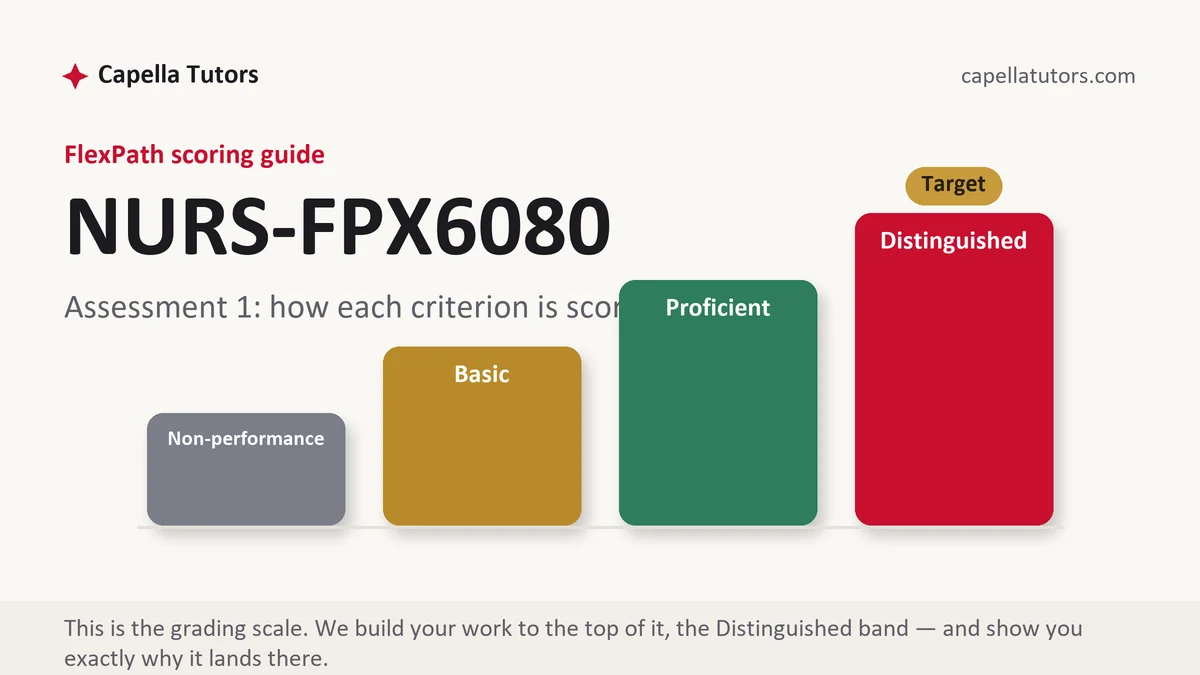
How NURS-FPX6080 Assessment 1 is scored
Nothing in FlexPath resolves to a letter grade. Each criterion lands on one of four levels, and the level wording is the writing brief for that section:
| Level | What it means on a practicum setup document |
|---|---|
| Distinguished | Roles are named, dates are real, and every objective is measurable, reachable inside the hours you actually have, and anchored to a program competency instead of a job duty. The extra move on this deliverable is almost always saying how each objective will be evidenced. |
| Proficient | Site, preceptor, role, and objectives are all present and clearly written. Complete work, one move short, because the objectives still read as intentions nobody could later verify. |
| Basic | A description of where you work and what you hope to get out of the term. No dates, no verification path, objectives broad enough to belong to any student in the program. |
| Non-performance | A required element is missing, usually an approval detail or a signature-bearing date. Practicum criteria fail on omission far more often than on weak prose. |
Treat this document as load bearing rather than introductory. Later deliverables in the course quote it, and evaluators read the closing reflection against the objectives you set here. Objectives written vaguely to keep your options open become the reason the reflection has nothing specific to argue against.
The NURS-FPX6080 Assessment 1 method, step by step
-
Read the scoring guide as an approval checklist
Practicum criteria are unusual in that several of them ask for facts rather than analysis. Go through the guide and sort every criterion into two piles: the ones that want a documented fact, such as a site, a role, or a confirmed approval, and the ones that want an argument, such as why these objectives suit this setting. The fact criteria are lost by omission and cost nothing but attention. Handle them first so your working time goes to the ones that can actually be argued well.
-
Date the paperwork backward from your session
Build a short timeline before you draft. Put your session end date at the right, the first hour you can legitimately log at the left, and every approval that has to clear between them in order. The gap you find is usually alarming, which is the point of doing it in writing. Site and preceptor placement is the documented bottleneck in graduate clinical courses, and the delay is administrative rather than academic. An education office that batches agreements monthly will not accelerate because your session is billed weekly.
-
Write objectives your preceptor can sign and you can finish
Three or four objectives are plenty for 100 hours. Each one needs a verb an observer could confirm, a boundary in time, and a product. Compare "strengthen my leadership in person-centered care" with "co-facilitate four unit huddles and revise the huddle prompt so patient-stated goals are read aloud, by week eight." The second can be scored, signed, and later reflected on. The first cannot be assessed by anyone, including you.
-
Bind each objective to a competency and a source
For every objective, name the program competency it serves and one professional source that establishes why the activity matters. Master's evaluators read this pairing as evidence that the plan came out of the discipline rather than out of your task list. Standards and position statements from your specialization's professional bodies carry more weight here than a textbook, and a peer-reviewed study from the last five years carries more than either.
-
Draft the arrangement as a record, not an introduction
The narrative sections want particulars, written in the register of a file that somebody may audit. Setting type, population served, unit size, your role and its limits, your preceptor's credential and reporting line, the supervision arrangement, and the status of each approval with its date. De-identify people and the organization, keep every operational specific. A document describing an unnamed hospital in unnamed terms has anonymized away the material the criteria are asking to see.
-
Circulate for correction before you submit
Send the draft to your preceptor and, where your faculty expects it, to your site contact, and ask one question: is anything here wrong. Corrections at this stage are cheap. A preceptor's job title recorded incorrectly in the opening deliverable propagates into every later document in the course, and the later ones are the ones graded against it. Then self-score each criterion and send it early in the week, since FlexPath evaluations can take up to two business days.
A structure that maps to the criteria
These lengths are planning targets our tutors use for a typical practicum setup document, not Capella requirements. Expand any section your own guide weights heavily.
| Section | What it must do | Guide |
|---|---|---|
| Purpose and scope | State what the document establishes, the hours it governs, and the timeframe it covers, in a few flat sentences with no throat clearing. | ~120 words |
| Setting and population | Describe the de-identified site, the population it serves, the unit or department, and the practice conditions that will shape what is achievable. | ~250 words |
| Roles and supervision | Your role and its limits, your preceptor's credential and reporting line, how supervision and contact will work, and who signs for your hours. | ~250 words |
| Objectives | Three or four measurable objectives, each with its verb, its deadline, its product, and the program competency it serves. | ~350 words |
| Evidence and documentation plan | What each objective will produce as evidence, how hours will be recorded, and the cadence of preceptor verification. | ~250 words |
| Approvals and references | The status and date of each required approval, plus current APA references for the standards and studies behind the objectives. | as needed |
Annotated sample excerpt
An original model excerpt from our team, written to show the register a setup document needs. Learn the moves from it, then write your own.
The preceptor agreement was submitted to the hospital's nursing education office on March 3 and remains unsigned as of March 24, because that office reviews external academic agreements in a monthly cycle rather than on receipt.1 Two of the four planned objectives depend on observation only and can begin the day approval clears, while the third requires access to the unit's education records and is therefore scheduled after week four.2 No hours have been logged, and none will be logged before written faculty confirmation, since hours accrued ahead of approval are not recoverable under the practicum requirements.3
- 1Names the obstacle with dates and states the mechanism behind it. An evaluator learns that the delay was structural and tracked, not that the student was slow.
- 2Sequences the objectives around the constraint instead of restating the plan as though the constraint did not exist. This is the sentence that separates a plan from a wish.
- 3Records the decision and its reason. Practicum criteria reward documented compliance judgment, and this line becomes quotable evidence in the closing reflection.
The full premium sample for your exact assessment, written fresh to your scoring guide and issue, is free to request. Study it, revise it into your own voice, and submit work you understand.
The five mistakes that cost Distinguished
- Objectives nobody could verify. Growth verbs with no product and no date are the single most common reason a competent setup document stops at Proficient.
- Paperwork narrated instead of dated. Saying approval is in progress is worth nothing; the date it was submitted, the office holding it, and the review cycle are worth the criterion.
- Objectives sized for a year. One hundred hours will not redesign a department. Plans that overreach read as inexperience to anyone who has supervised a practicum.
- Over-anonymized setting. Removing the unit type, the population, and the staffing pattern along with the names leaves the application criteria nothing to grade.
- No competency mapping. Objectives tied to job duties rather than program competencies fail the criterion that asks the plan to belong to your degree.
Pre-submission checklist
- Every criterion in the guide has its own labeled section, fact criteria answered first
- Three or four objectives, each with a verb, a deadline, a product, and a named competency
- Each approval carries a status and a date rather than a description of effort
- Setting and population specific, individuals and organization de-identified
- Standards or peer-reviewed sources behind the objectives, cited in current APA
- Preceptor has confirmed the factual details, and you have self-scored every criterion
Want the setup document handled?
Send the scoring guide, your specialization, and a few honest lines about your site and preceptor. A team of eight, including a research analyst and two QA reviewers, returns a premium original sample written to the Distinguished column in 24 to 48 hours, revised until it lands there. We write the deliverables and the documentation, and we never complete anyone's clinical hours, because those 100 hours are yours to work and your preceptor's to verify.