This manual is for NURS-FPX6080 Assessment 2, start to submission. Hand us the prompt and the scoring guide and a premium original sample lands inside 24 to 48 hours, then gets revised at no cost until the guide is satisfied. The middle deliverable in NURS-FPX6080 usually asks you to examine professionalism and person-centered care as they actually operate in your own practicum setting, and to judge what you observed against professional standards and current evidence rather than describe it. Your scoring guide decides the required elements. What follows is how our tutors build that analysis, the structure that keeps it aligned to the criteria, and an annotated excerpt of the register it needs. Your courseroom may print this as NURS FPX 6080 Assessment 2 or NURS6080 Assessment 2; it is the same deliverable, and NURS-FPX6080 Assessment 2 is what this manual walks through.
One honesty note before the manual: Capella revises courses and scoring guides over time, so always write to the exact scoring guide attached to your assessment in the courseroom. The course identity above is verified on capella.edu; the method and structure below are our tutors' approach to it, not Capella's official rubric text.
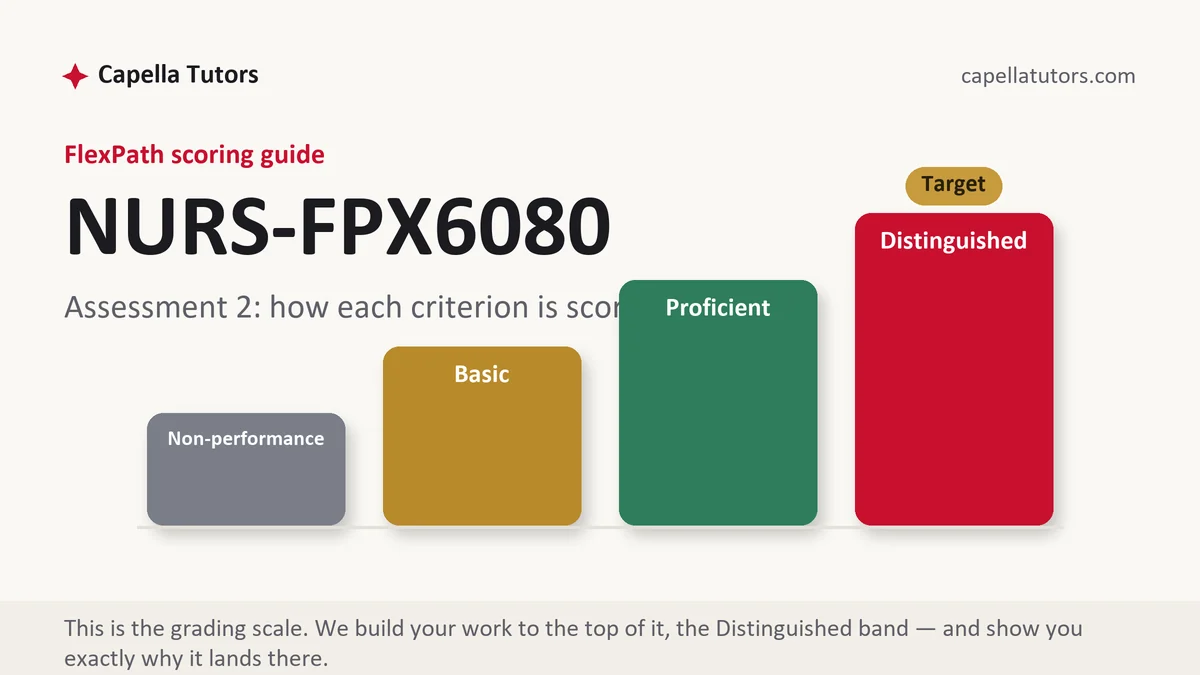
How NURS-FPX6080 Assessment 2 is scored
Letter grades do not exist in FlexPath. Every criterion resolves to one of four levels, and the language of the level tells you what the section has to accomplish:
| Level | What it means on a professionalism analysis |
|---|---|
| Distinguished | A specific observed practice is measured against a named standard, the size of the gap is explained by conditions in the setting, and the account distinguishes what an individual nurse controls from what the environment imposes. Judgment, sourced, with the limits of your own vantage point stated. |
| Proficient | The observation is accurate and a standard is cited, but the two sit next to each other rather than being made to argue. The commonest near miss on this deliverable. |
| Basic | An account of unit culture with professionalism defined in general terms. True, unobjectionable, and unconnected to any criterion that asks for analysis of your setting. |
| Non-performance | A required element never appears, most often the evidence base or the workplace-environment half of the question. A criterion reaches the floor through omission rather than through being handled poorly. |
Understand what the criteria mean by evidence here. This is not a literature review with an anecdote attached. It is an appraisal in which your own practicum observations are the case and the published standards are the measuring instrument. Master's evaluators grade the fit between the two.
The NURS-FPX6080 Assessment 2 method, step by step
-
Convert each criterion into a heading before you pick a topic
Open the guide, paste the criteria into a blank document as headings, and put the Distinguished wording under each one. Only then choose what to write about, because the criteria will tell you whether the assessment wants one episode examined closely or a pattern traced across several. Choosing the subject first and mapping it to criteria afterwards is how strong writing ends up in the wrong document.
-
Choose one episode, not the whole unit
Pull a single dated situation out of your log: a specific meeting, a handoff, an orientation session, a decision that went a particular way. One episode analyzed to the bone outperforms four summarized, because every criterion asking for application has something concrete to grade. Culture-wide claims cannot be supported from 100 hours and evaluators know it.
-
Set the episode against a published standard
Find the standard, competency framework, or position statement that speaks directly to what you saw, then quote the relevant expectation and state plainly how far the observed practice sat from it. This is the analytical engine of the whole deliverable. Without an external yardstick, professionalism collapses into personal preference, and personal preference does not score.
-
Separate the professional obligation from the workplace constraint
Practicum analysis goes wrong when it blames individuals for structural conditions or excuses individuals by pointing at structure. Say which part of the gap belonged to a person's professional obligation and which part the environment produced through staffing, scheduling, documentation systems, or how education time was funded. Distinguished work holds both and names the one that cannot be fixed from your role, then explains why it still belongs in the analysis.
-
Cite the way a master's evaluator expects
Four to six sources is a working range, and each one should have an identifiable job: this establishes the standard, this reports what happens when the standard is not met, this supplies the mechanism, this contests one of the others. Pull them through the Capella library, keep most of them inside five years, and prefer primary studies to the review articles summarizing them. Label your site's internal material for what it is, since your unit's turnover figure and your preceptor's account of a process are site evidence, valuable and not literature. A source carrying four unrelated claims reads as padding to anyone who reviews manuscripts.
-
Self-score, then cut the narration
Mark each criterion yourself against the four levels and revise anything below the top. Then run one pass with a single question: does this sentence judge, or does it merely retell? Practicum drafts arrive at our desk roughly forty percent narration. Deleting the retelling almost always raises the analysis criteria without a word being added, and it leaves room to submit early in the week when evaluation queues are shortest.
A structure that maps to the criteria
Lengths below are our tutors' planning targets for a typical professionalism analysis in this course, not Capella rules. Weight them toward whichever criteria your guide emphasizes.
| Section | What it must do | Guide |
|---|---|---|
| Introduction | Name the setting in de-identified terms, name the practice you examined, and state the judgment the analysis will defend. | ~150 words |
| The observed practice | The dated episode described concretely, with roles, sequence, and the conditions in effect, and nothing evaluative yet. | ~300 words |
| The standard applied | The professional expectation quoted or paraphrased precisely, with the source, and the distance between it and what happened. | ~300 words |
| Environmental analysis | The structural factors that produced the gap, separated from individual obligation, each supported rather than asserted. | ~300 words |
| Implications and recommendation | What the gap costs in patient and staff terms, and one change specific enough to be attempted at your level, with its evidence. | ~250 words |
| Conclusion and references | The judgment restated with its limits acknowledged, then current APA references reconciled against the text both directions. | ~150 words |
Annotated sample excerpt
An original model from our writers, offered as study material for the moves rather than as text to reuse.
The residency program's revised onboarding schedule allots new graduates two shifts of paired practice before independent assignment, while the professional guidance the program cites in its own charter describes a supported transition measured in months rather than shifts.1 The gap is not a lapse of individual professionalism; the schedule was rebuilt in February after two experienced preceptors moved to day shift, leaving the unit with more new hires than available pairings.2 What the schedule does transfer to the individual nurse is the judgment call about when to ask for help, an obligation the same guidance places on the organization rather than on the novice.3
- 1Puts the observed practice and the external expectation in one sentence with the units of measurement made comparable. The gap becomes a fact instead of an impression.
- 2Explains the cause structurally, with the dated event that produced it. Diagnosis rather than complaint, which is what the environment criterion pays for.
- 3Splits obligation from constraint and points out who the standard actually assigns it to. This is the sentence that carries the analysis criterion to the top level.
The full premium sample for your exact assessment, written fresh to your scoring guide and issue, is free to request. Study it, revise it into your own voice, and submit work you understand.
The five mistakes that cost Distinguished
- Professionalism defined instead of examined. A page establishing what the concept means burns the word count the application criteria wanted.
- The standard cited but never applied. Naming a framework and then not measuring anything against it is the reason accurate drafts sit at Proficient.
- Blame where structure belongs. Attributing a scheduling failure to individual attitude fails the workplace-environment criterion outright.
- Claims larger than your vantage point. One hundred hours on one unit cannot establish organizational culture, and asserting it invites the evaluator to discount the rest.
- Site data dressed as literature. Internal numbers cited as though peer reviewed is a credibility problem, and it is visible in the reference list.
Pre-submission checklist
- One dated, de-identified episode carries the analysis, described before it is judged
- A named professional standard is quoted and the observed gap measured against it
- Individual obligation and environmental constraint are argued separately
- Four to six sources, mostly within five years, each with an identifiable job
- Internal site evidence labeled as internal, never listed as literature
- Narration cut, every criterion self-scored, submission sent early in the week
Need this analysis written with backup?
Send the scoring guide, your specialization, and rough notes on the situation you want examined. A research analyst maps the criteria, an MSN-credentialed writer drafts to that map, and scoring-guide and APA review close it out inside 24 to 48 hours. We write the deliverables and the documentation, never the clinical hours themselves, which stay yours and your preceptor's.