This manual is for NURS-FPX6080 Assessment 3, start to submission. Give us the scoring guide and your log and a premium original sample of this deliverable comes back within 24 to 48 hours, revised free until the criteria are met. The closing deliverable in NURS-FPX6080 usually asks you to account for the practicum as a whole: the hours you documented, what they produced, and what the experience demonstrates about your practice measured against the program's competencies. Your scoring guide decides the exact elements and the verification your faculty requires. Below is the method our tutors use, the structure that keeps it criterion aligned, and an annotated excerpt. Your courseroom may print this as NURS FPX 6080 Assessment 3 or NURS6080 Assessment 3; it is the same deliverable, and NURS-FPX6080 Assessment 3 is what this manual walks through.
One honesty note before the manual: Capella revises courses and scoring guides over time, so always write to the exact scoring guide attached to your assessment in the courseroom. The course identity above is verified on capella.edu; the method and structure below are our tutors' approach to it, not Capella's official rubric text.
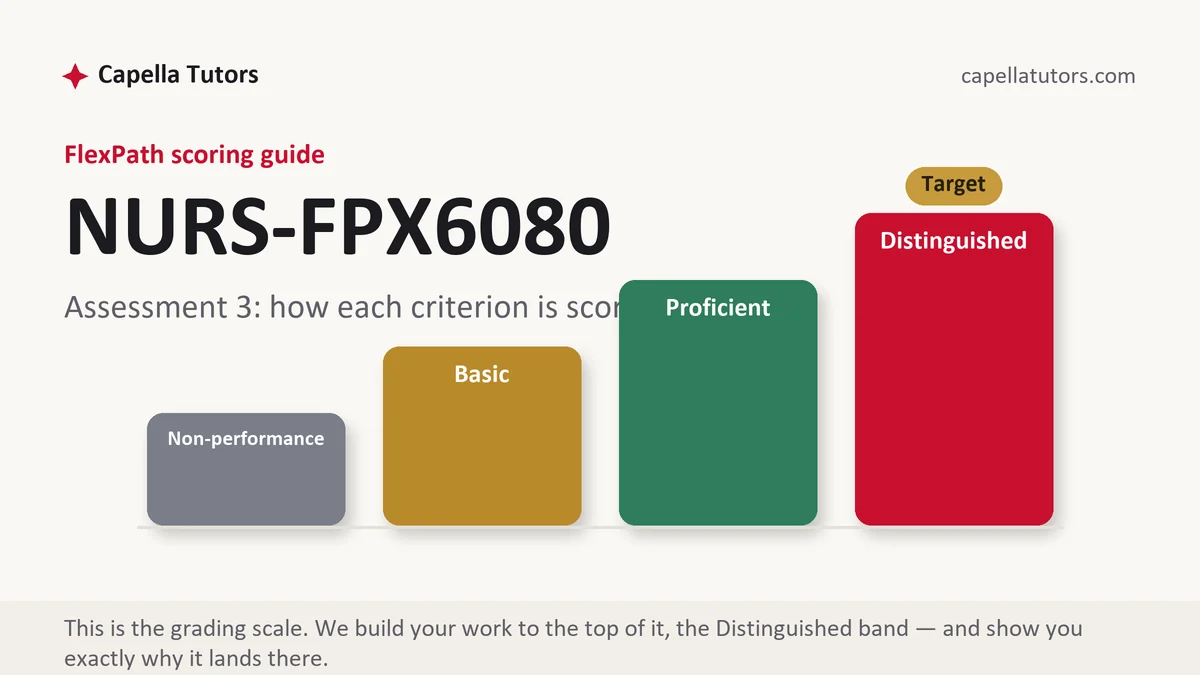
How NURS-FPX6080 Assessment 3 is scored
Criteria in FlexPath resolve to four levels rather than a grade, and the wording of the level is the specification for that section:
| Level | What it means on integrative practicum documentation |
|---|---|
| Distinguished | Each competency claim points to a specific artifact or a specific logged block of hours, the account includes something that went badly and what it changed, and the log and the narrative describe the same term without contradiction. |
| Proficient | The hours are accounted for and the competencies are addressed, but the claims rest on general assertion rather than on named evidence from the practicum itself. |
| Basic | A chronological story of the term with feelings attached. The most frequent landing place for closing practicum documents, and the easiest one to avoid. |
| Non-performance | Hours are unverified or incomplete, or a required competency goes unaddressed. This is the criterion that ends a session rather than lowering a score. |
The scholarly convention to import here comes from the appraisal literature rather than the essay tradition: a claim about your own capability is a claim requiring evidence, and the evidence available to you is your artifacts and your log. Practicum writing that keeps that rule reads like professional self-assessment. Practicum writing that abandons it reads like a diary, whatever vocabulary it uses.
The NURS-FPX6080 Assessment 3 method, step by step
-
Reconcile the log before you write a sentence
Total the hours, confirm each block has a date, a setting, an activity, and a verification, and settle every discrepancy while it can still be settled. Do this first because the narrative is built on the log, and a number that changes after the prose is written forces a rewrite of the sections that quoted it. Where entries are thin, expand them from memory only if you can do so truthfully, and flag anything you cannot reconstruct rather than inventing a plausible afternoon.
-
Build an evidence table out of your own entries
Make a private working table with one row per competency and columns for the log dates, the artifacts, and the observable results attached to it. Empty rows are the real finding. They tell you which competency you will have to argue from thinner material and where to be candid about partial achievement, which scores better than a confident claim an evaluator cannot trace.
-
Select the episodes that argue, including the failure
Choose four or five moments across the term, and make one of them something that went wrong. Reflective assessment in the nursing education literature consistently treats candid self-critique as the marker of the competency, while an unblemished account is read as low insight. Describe what you misjudged, what the consequence was, what you did next, and what standard or evidence reframed it for you.
-
Tie every claim to an artifact or a logged hour
This is the discipline the whole deliverable turns on. A sentence claiming you strengthened interprofessional communication should be followed by the thing that proves it: the revised competency checklist, the dated debrief you facilitated, the twenty hours in a specific setting. If nothing can follow the claim, either find the evidence or write the smaller claim your evidence supports.
-
Keep the two voices apart
Practicum documents hold a participant who was present and an analyst who assesses what happened, and most drafts fail at the seam. Write the participant sections concretely and in the past tense, write the analytic sections with citations and comparative judgment, and never let the analysis restate the observation in more impressive vocabulary. Carry forward the standards you cited in earlier deliverables so a source that framed your plan reappears doing different work here, which is exactly the continuity master's evaluators look for across a course.
-
Audit the document against itself, then submit
Read the finished draft with only the log open beside it and check every date, every hour total, and every quantitative claim. Then check that each competency named in the guide has a section, that the reference list reconciles both directions, and that no citation appears which does no work. Self-score each criterion and submit early in the week, because a document waiting for evaluation is not a document you can still fix.
A structure that maps to the criteria
Word targets our tutors plan against for a typical closing practicum document, not Capella requirements; redistribute toward the criteria your guide weights most.
| Section | What it must do | Guide |
|---|---|---|
| Summary of the practicum | Setting, role, hours completed, verification arrangement, and the objectives the term was organized around, stated as fact. | ~200 words |
| Account of the hours | How the hours were distributed across activities and settings, with the pattern explained rather than listed entry by entry. | ~250 words |
| Competency evidence | Each program competency addressed in turn, every claim followed by its artifact or its dated hours. | ~450 words |
| What went wrong | One misjudgment described honestly, the consequence, the correction, and the standard or evidence that reframed it. | ~250 words |
| Objectives met and unmet | The opening plan revisited, including the objective that did not survive contact with the site and why. | ~200 words |
| Forward statement and references | What the next course or role will require of you, stated specifically, then current APA references reconciled to the text. | ~150 words |
Annotated sample excerpt
An original model from our writers, showing how a competency claim carries its evidence. Study the pattern and write your own.
Between April 8 and May 2, twenty-six logged hours went to rebuilding how float-pool nurses are validated on unit-specific equipment, producing a two-page validation record that replaced the shared spreadsheet three departments had been annotating separately.1 The artifact is the evidence for the systems competency; the judgment it required was narrower than I expected, since the design problem turned out to be ownership of the record rather than the content of the checklist.2 One validation item was written from a policy I did not confirm was current, and my preceptor caught it in review on April 22, which is why the final version cites the revision date of every policy it draws on.3
- 1Dates, hours, and a named artifact in a single sentence. Every element of the claim is traceable to the log, which is what the evidence criterion is checking.
- 2Assigns the artifact to a specific competency and revises the writer's own initial framing. Analysis of the work, not a summary of it.
- 3The candid failure, with the date, the person who caught it, and the concrete change it produced. Self-critique with a consequence reads as the competency itself.
The full premium sample for your exact assessment, written fresh to your scoring guide and issue, is free to request. Study it, revise it into your own voice, and submit work you understand.
The five mistakes that cost Distinguished
- Chronology instead of appraisal. Week by week storytelling answers no criterion, however honest and however well written it is.
- Competency claims with nothing behind them. Growth asserted and never evidenced is the difference between Proficient and the top of the guide on this deliverable.
- A term with no mistakes in it. A flawless account signals thin self-assessment, and experienced evaluators read it that way immediately.
- Log and narrative that disagree. Contradictory hours or dates cast doubt on the whole file, and this is the one document where both are read side by side.
- The opening plan quietly abandoned. Objectives you set at the start and never mention again leave an obvious hole where the accountability criterion sits.
Pre-submission checklist
- Hours totaled, every block dated, verified, and reconciled before drafting
- Each program competency has its own section and its own named evidence
- One candid failure included, with the correction it produced
- Every date and number in the prose checked against the log line by line
- Sources from earlier deliverables carried forward and doing new work
- Every criterion self-scored at the top level, submitted early in the week
Closing out the practicum this session?
Send the scoring guide, your competency list, and your log in whatever shape it is in. Our writers turn documented hours into an argued evaluation, with scoring-guide QA and APA review before it reaches you, inside 24 to 48 hours. We write the deliverables and the documentation, and that is the whole of the boundary. Nobody here completes anyone's clinical hours, and any service claiming otherwise is not telling you the truth.