Whatever you are due in this course, we will draft it as a premium original sample with a walkthrough and hand it back inside 24 to 48 hours. The course on the transcript is NURS-FPX6426, Nursing Informatics Life Cycle Management, 2 points of Capella's 27-point FlexPath MSN and the closing course of the Nursing Informatics specialization. What it wants from you is project literacy: a system followed from the first business case to the day it is switched off, managed by people with names and authority rather than by narrative.
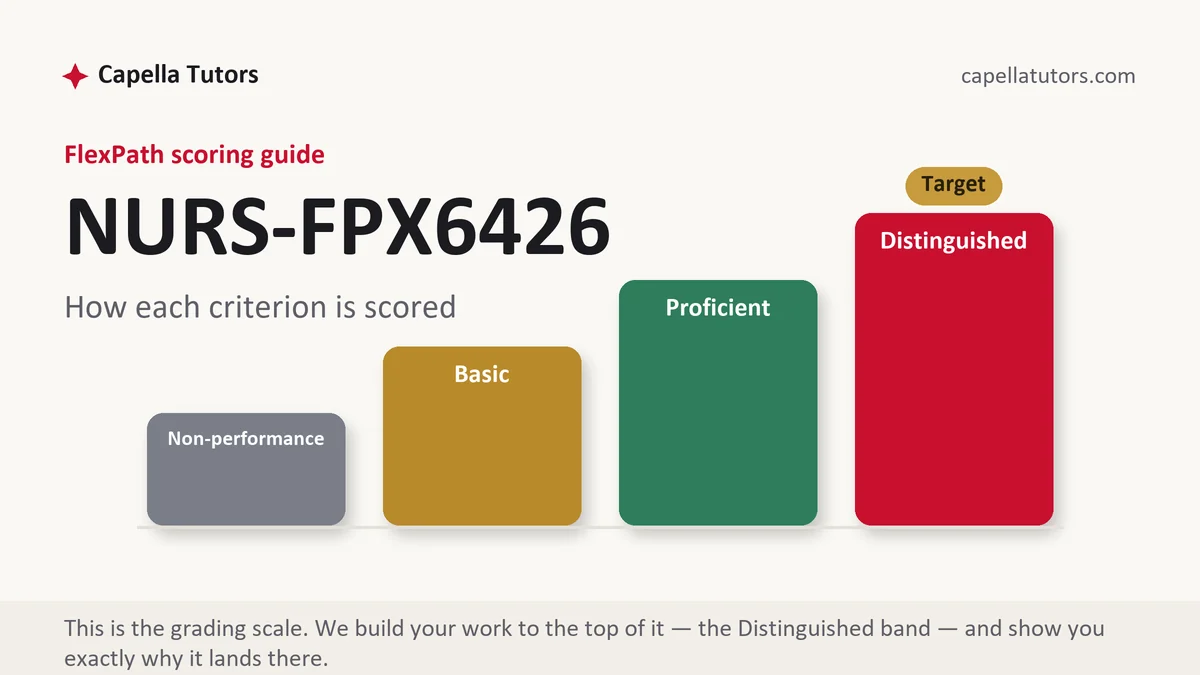
What NURS-FPX6426 actually grades
The criteria run along the whole arc, so the paper has to as well: planning and needs assessment, selection, build and testing, training and cutover, stabilization, optimization, and eventually retirement of the system. Each phase is graded on the work that genuinely happens inside it, not on its position in a diagram. Alongside that, the course grades governance, meaning who holds which decision, and change management, meaning what you do about the people who would rather keep the old way.
Two failure patterns dominate. The first is phase recitation, a paragraph per stage that could describe any project in any industry, which is textbook Basic. The second is the disappearing decision maker, where things get approved and implemented with no one accountable in the sentence. Distinguished work in this course reads like a project someone could staff on Monday, because every phase has an owner, an artifact, and a condition that has to be met before the next phase starts.
How we help in this course
Give us the scoring guide and the project you want to write about, real or realistic, and the draft comes back already scoped to something a committee could approve. Our writers on this course work in project language by habit: charters, requirements matrices, test scripts, risk registers, cutover plans, decommission checklists.
Order handling does not change here. The scoring guide gets decoded criterion by criterion before anyone writes, a subject-matched writer produces the draft, then it passes a criteria review and an APA and originality review before delivery. You get it inside 24 to 48 hours with free revisions until it meets target.
Governance with names on it
Write governance as a list of decision rights, never as a list of interested parties. The executive sponsor funds the project and breaks ties nobody else can break. The steering committee owns scope, schedule, and the authority to remove something from the release. A clinical or nursing informatics council owns clinical content: order sets, documentation templates, alert thresholds. A change advisory board approves what moves into the live environment and can order it reversed. Unit super users own local training, first-line support, and the feedback channel that reports what broke overnight. The project manager owns the schedule and the risk register. The vendor's team owns defect repair, which is a different conversation from an enhancement request.
The sentence that earns the credit is the one that says what each body does not decide. A steering committee that starts approving alert thresholds has taken a clinical decision it cannot defend, and an informatics council that starts moving dates has taken a schedule decision it cannot fund. Add a decision log with date, decision, owner, and rationale, and you have the artifact that keeps a go-live weekend from relitigating design choices made four months earlier. Stakeholders were engaged is a Basic sentence. The nursing informatics council approved the documentation template on a stated date, with the associate chief nursing officer as sponsor of record, is a Distinguished one.
Decision gates before the project moves
Projects are governed by gates rather than by dates, and this is the concept most students leave out. A gate is a written set of conditions, an owner authorized to say no, and a defined path when a condition fails. Five of them carry a life cycle paper. The business case gate asks whether the need is documented, the benefit measurable, and the funding identified. The selection gate asks whether requirements were scored rather than admired, references checked, and the contract reviewed for data ownership, interface costs, and exit terms. The build gate asks whether configuration is frozen, integration tested, and unresolved defects triaged by severity.
The readiness gate is the one with teeth: end-to-end and regression test scripts passed, training completion at a stated percentage by role, downtime forms printed and physically on the units, command center staffed by hour, interface monitoring live, and a rollback plan that has been rehearsed rather than written. Last comes the benefits gate, which compares performance to a baseline captured before cutover, and eventually the sunset gate covering retention schedules, a readable archive, legal holds, a read-only access period for clinicians, and the orderly shutdown of interfaces nobody remembers exist. Write one criterion that can genuinely fail, then say what happens when it does. That single move separates a plan from a wish.
The assessments, one by one
Assessment 1
Give us the scoring guide and this deliverable returns as a premium original sample within 24 to 48 hours, kept in revision at no cost until the guide is satisfied. Read the full Assessment 1 manual.
Assessment 2
Hand this one to us and a premium original sample lands inside 24 to 48 hours, revised free until it meets your guide. Read the full Assessment 2 manual.
Assessment 3
Our desk turns this deliverable into a premium original sample within 24 to 48 hours, with revisions running at no charge until your guide is met. Read the full Assessment 3 manual.
Assessment 4
Send the scoring guide and a premium original sample for this deliverable lands inside 24 to 48 hours, revised free until it meets the guide. Read the full Assessment 4 manual.
How to actually write NURS-FPX6426: where to begin
Convert the scoring guide into headings before writing a sentence, and paste the Distinguished language beneath each one so you are aiming at a target rather than at a topic. Then pick a project you can hold in your head: a barcode scanning rollout on two units, a sepsis alert build, a new documentation template, a telehealth platform replacement. Small and specific beats enterprise and vague, because the criteria reward detail that only exists at small scale.
Attach an artifact to every phase, since artifacts are what stop a life cycle paper from becoming a summary. A needs assessment with current-state data. A requirements matrix with must, should, and could weighting and a scoring column. A vendor evaluation sheet with the reference calls noted. A test script set that includes at least one end-to-end clinical scenario and one downtime scenario. A training plan differentiated by role, because a unit clerk and a charge nurse do not need the same ninety minutes. A cutover schedule, a risk register, a benefits measurement plan, and a decommission checklist. Name these and the paper reads as managed work.
Handle change management with a model applied to one real group. Lewin's unfreezing and refreezing, Kotter's staged approach, Rogers' diffusion of innovations with its early adopters and late holdouts, or ADKAR are all defensible; the choice matters less than the aim. Point the model at the night shift that has no super user, or the twenty-year veteran who has done this on paper since before the system existed, or the clinicians whose order set changed without consultation. Say what you do at each stage, what you measure to know whether it worked, and what your fallback is when adoption stalls anyway.
| Section | What goes in it | What Distinguished looks like |
|---|---|---|
| Planning and needs assessment | The problem, current-state data, scope, sponsor, and the benefit you expect. | The benefit is measurable and its baseline is already identified, not promised later. |
| Selection and procurement | Requirements weighted and scored, vendors compared, contract risks named. | Data ownership, interface cost, and exit terms addressed before signature. |
| Design, build, and testing | Configuration decisions, who approved them, and the test types you ran. | Test coverage includes end-to-end clinical scenarios and a downtime rehearsal. |
| Training and go-live | Role-based training, cutover model, support coverage, escalation path. | Rollback conditions written, with the person authorized to invoke them named. |
| Stabilization and optimization | Issue triage, exit criteria for stabilization, and the optimization backlog. | Optimization requests are prioritized by risk and measured against baseline. |
| Sunset and decommission | Retention schedule, archive access, interface shutdown, legal considerations. | Clinicians keep read-only access for a stated period, with the archive verified readable. |
Developing the analysis
Graduate credit in this course comes from choosing between options in public. The cutover decision is the clearest place to do it. A single-event conversion shortens the miserable period of running two processes and concentrates all risk into one weekend, while a phased rollout by unit or module lowers the risk of any single failure and buys months of dual documentation plus temporary bridges between old and new. Pick one, then justify it against your organization's size, its staffing depth on nights and weekends, and how much downtime the clinical service can absorb. Then protect the benefits claim: if no baseline exists for the measure you promised to improve, capturing it is the first task in the plan. Close with a risk register entry you have not solved, because a project plan that admits its exposure reads as experienced rather than optimistic.
Citations that survive faculty review
Use three groups of sources and keep their jobs distinct. Peer-reviewed implementation research from the Capella library, CINAHL, and PubMed supports what happens to adoption, documentation time, and safety events after a system change, held to roughly the last five years. Professional and industry material carries the practice standards: HIMSS work on project and governance practice, AMIA publications on implementation and clinical decision support, and the American Nurses Association's informatics scope and standards for what the informatics nurse is accountable to do at each stage. Federal material on healthit.gov supplies certification expectations, the SAFER guides for organizational responsibilities, and the frame for records retention and continued access after a system retires. Cite change theory to a primary or scholarly source rather than a training slide, and support any claim about contracts, retention, or legal holds with policy rather than recollection. Format in current APA and assign each source to the criterion it serves.
The mistakes that land Basic instead of Distinguished
- Phase recitation. Seven stages described in order, none of them tied to a project, an owner, or a document.
- Governance as a guest list. Stakeholders named with no decision rights, no boundaries, and no decision log.
- Go-live without rollback. A cutover plan that has no failure condition and nobody authorized to stop it.
- Training measured in hours. A number of sessions with no differentiation by role and no competency check.
- Benefits without a baseline. Improvement promised against a measure nobody captured before the change.
- The immortal system. A life cycle paper that stops at optimization and never addresses retirement or data retention.
NURS-FPX6426 questions students actually ask
Which life cycle model should I use?
Any recognized system development life cycle framing is acceptable as long as you apply one consistently and cite it. The phase labels matter far less than what you attach to them. A four-phase model with a real gate, a named owner, and a produced artifact per phase outscores a seven-phase model recited from a diagram. Pick your model in the introduction, say why it fits the project's size, and keep the same phase names throughout.
How much detail does the go-live section need?
Enough that someone could staff the weekend from your paragraph. Name the cutover model and defend it, then cover the pieces that decide whether a go-live survives: who sits in the command center and for which hours, how at-the-elbow support covers nights, the escalation path from super user to analyst to vendor, the downtime procedure and where the paper forms physically are, and the rollback trigger with the person authorized to pull it. A go-live section without a rollback decision is the most common gap in this course.
Do I have to name a change management theory?
Usually yes, and the safer habit is to name one whether or not the criterion demands it. Lewin's three-stage model, Kotter's change stages, Rogers' diffusion of innovations, and ADKAR all work for informatics projects. The credit comes from application, not selection: aim the model at one specific group that will resist, such as a night shift with no super user or a group of clinicians whose order set changed without warning, and say what you do at each stage. Then add the sentence students skip, which is what you do when the approach fails and adoption stalls anyway.
In NURS-FPX6426 right now?
Send the deliverable, the scoring guide, and the project you want it built around. First one is free, and it is with you inside 24 to 48 hours.