This manual is for NURS-FPX6426 Assessment 4, start to submission. Send the scoring guide and a premium original sample for this deliverable lands inside 24 to 48 hours, revised free until it meets the guide. Assessment 4 of NURS-FPX6426 closes the life cycle. Your scoring guide decides the format, and the assessment usually asks you to evaluate what the change actually achieved, plan how it will be sustained without a project team, and write the retirement or handover of whatever it replaces: the records that must survive, the access that must persist, and the day the old system is switched off. Your courseroom may print this as NURS FPX 6426 Assessment 4 or NURS6426 Assessment 4; it is the same deliverable, and NURS-FPX6426 Assessment 4 is what this manual walks through.
One honesty note before the manual: Capella revises courses and scoring guides over time, so always write to the exact scoring guide attached to your assessment in the courseroom. The course identity above is verified on capella.edu; the method and structure below are our tutors' approach to it, not Capella's official rubric text.
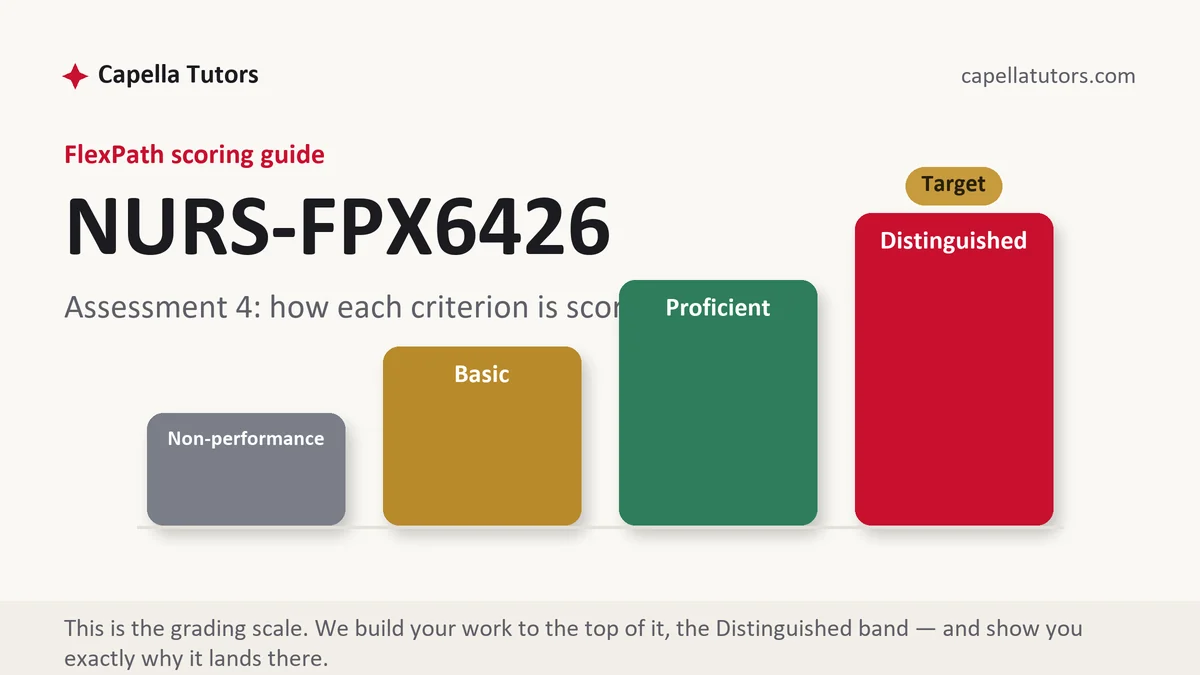
How NURS-FPX6426 Assessment 4 is scored
Four levels per criterion. On a closing deliverable the levels sort by whether the writer is willing to report a disappointing result:
| Level | What it means on a program evaluation and handover plan |
|---|---|
| Distinguished | The result is reported against the baseline and the target including where it fell short, sustainment is assigned to operational owners with a budget line, and the retirement plan names record retention, access after shutdown, and the shutdown date with its approver. |
| Proficient | A clear evaluation and a sensible transition plan. Complete, and one move short, because everything in it worked. |
| Basic | A summary of accomplishments with lessons learned appended. The most common closing submission, and the criterion caps it. |
| Non-performance | A required element is missing, most often the sustainability plan or the evaluation against the original measures. |
Decommissioning is the phase students skip and organizations regret. A system that is no longer used is still a legal record, still a support cost, still an access surface, and still a dependency for a report somebody runs quarterly. The criteria ask about retirement because the informatics nurse is usually the only person in the room who knows what still points at the old system.
The NURS-FPX6426 Assessment 4 method, step by step
-
Report against the measures you promised
Go back to the evaluation plan written earlier and answer it in its own terms: the metric, its denominator, the baseline, the target, and the actual result. Do not substitute a measure that performed better. If a target was missed, report the miss and analyze it, because an evaluation in which everything succeeded is an evaluation nobody believes at graduate level.
-
Keep the causal claim proportionate to the design
A before-and-after comparison in one organization supports associative language. Write improved from to alongside the confounders you can see, including anything else that changed in the same window, seasonal effects, and any change in how the outcome was documented. A plausible alternative explanation named by the author is worth more than a strong claim defended weakly.
-
Hand sustainment to operations with a name and a budget
The project team dissolves; the work does not. Assign each ongoing task to an operational owner with a backup, state the recurring cost in hours or dollars, and name the budget it comes from. Include the unglamorous items: code list maintenance, the annual review of the build, credential management for the interface, and the report someone will keep running.
-
Write the retirement plan for what you replaced
Name the shutdown date and its approver, then work backwards: which records are the legal record and where they will live, the retention period the record retention policy requires, whether historical data is migrated or archived, how a clinician retrieves an old document after shutdown, and how long read-only access persists. Every one of these has an owner.
-
Find what still points at the old system
Before shutdown, inventory the dependencies: interfaces, scheduled reports, quality submissions, research extracts, single-sign-on entries, and the local workflows that quietly rely on it. Publish the inventory with an owner per item and a date each one is retired or repointed. This inventory is the difference between a decommission and an outage.
-
Close with governance and honest lessons
State which standing committee inherits the system, what it reviews and how often, and what would trigger reopening the project. Then write two or three lessons specific enough to change a decision on the next project, not general enough to appear in any report. Support the design with recognized material, including AMIA and HIMSS work on system life cycle and governance, ONC resources on healthit.gov, and peer-reviewed evaluation literature, all in current APA.
A structure that maps to the criteria
The proportions below are our tutors' planning targets for a closing deliverable, not Capella requirements; your scoring guide decides the final format.
| Section | What it must do | Guide |
|---|---|---|
| Result against target | Each promised measure with its denominator, baseline, target, and actual, including the misses. | ~300 words |
| Interpretation and limits | What the design supports, the confounders, and the alternative explanations you cannot rule out. | ~250 words |
| Sustainment assignments | Ongoing tasks with operational owners, backups, recurring cost, and the budget carrying it. | ~250 words |
| Retirement of the replaced system | Shutdown date and approver, legal record location, retention, archival, and post-shutdown access. | ~300 words |
| Dependency inventory | Everything still pointing at the old system, with an owner and a retire or repoint date each. | ~200 words |
| Governance, lessons, references | The inheriting committee and its cadence, reopening trigger, specific lessons, and current APA sources. | ~250 words |
Annotated sample excerpt
An original model excerpt from our team, written the way a closing report reads when it is telling the truth. Learn the moves, then write your own around your own project.
Against the target set in the analysis phase, transcription turnaround improved from a median of 19 hours to 4 hours across 8,940 dictated documents in the six months after cutover, while the second promised measure was missed: documents returned for correction fell only from 11.2 percent to 9.8 percent of dictations, short of the 6 percent target, and the correction categories suggest the residual problem is template design rather than speech recognition.1 Turnaround also improved in the two clinics that never migrated, by a smaller amount, which points to a concurrent change in the transcription vendor's staffing and means the six-month comparison supports association rather than attribution.2 Retirement of the legacy dictation platform is set for March 31, approved by the chief medical information officer, with the transcribed documents already the legal record inside the electronic record, seven years of audio archived to cold storage under the record retention policy, read-only access to the legacy viewer retained for eighteen months, and a published inventory of the nine scheduled reports and two research extracts that still query it, each with an owner and a repoint date.3
- 1Reports both promised measures against their targets, names the miss without softening it, and points at the likely cause. Evaluators read a reported miss as evidence the rest of the numbers are honest.
- 2Uses a group that did not receive the change as an informal comparison, then names the concurrent vendor change and downgrades the claim accordingly. This is the most rigorous move available in a before-and-after design.
- 3Handles the retirement completely: date, approver, legal record, retention, archival medium, duration of read-only access, and a dependency inventory with owners. Nothing in this list is left for someone to discover after shutdown.
The full premium sample for your exact assessment, written fresh to your scoring guide and issue, is free to request. Study it, revise it into your own voice, and submit work you understand.
The five mistakes that cost Distinguished
- An evaluation with no shortfall. A closing report in which every target was met reads as advocacy, and the criterion for evaluation is asking what you learned rather than what you achieved.
- Measures swapped after the fact. Reporting the metric that performed well instead of the one you promised is the failure of integrity these criteria are most alert to.
- Causal attribution from a single-site before-and-after. The change happened in a world where other things also changed, and naming those things yourself is what keeps the claim defensible.
- Sustainment with no budget. Ongoing work assigned to an owner with no hours and no funding source is work that stops as soon as the owner gets busy.
- Shutdown without a dependency inventory. The scheduled report, the quality submission, and the single-sign-on entry that still point at the old system turn a planned retirement into an unplanned outage.
Pre-submission checklist
- Every promised measure reported with denominator, baseline, target, and actual result
- At least one shortfall reported and analyzed rather than omitted
- Causal language proportionate to the design, with concurrent changes named
- Sustainment tasks assigned to operational owners with backups, cost, and a budget line
- Retirement plan covering shutdown date, approver, legal record, retention, and post-shutdown access
- Dependency inventory published with an owner and a repoint date for every item
Want the closing report handled?
Send the scoring guide, the measures you promised, and whatever results you have. Our writers report the evaluation honestly, build the sustainment and retirement plans the criteria ask for, and two quality reviewers grade the draft before it reaches you. Delivery inside 24 to 48 hours, with free revisions until it meets your guide.