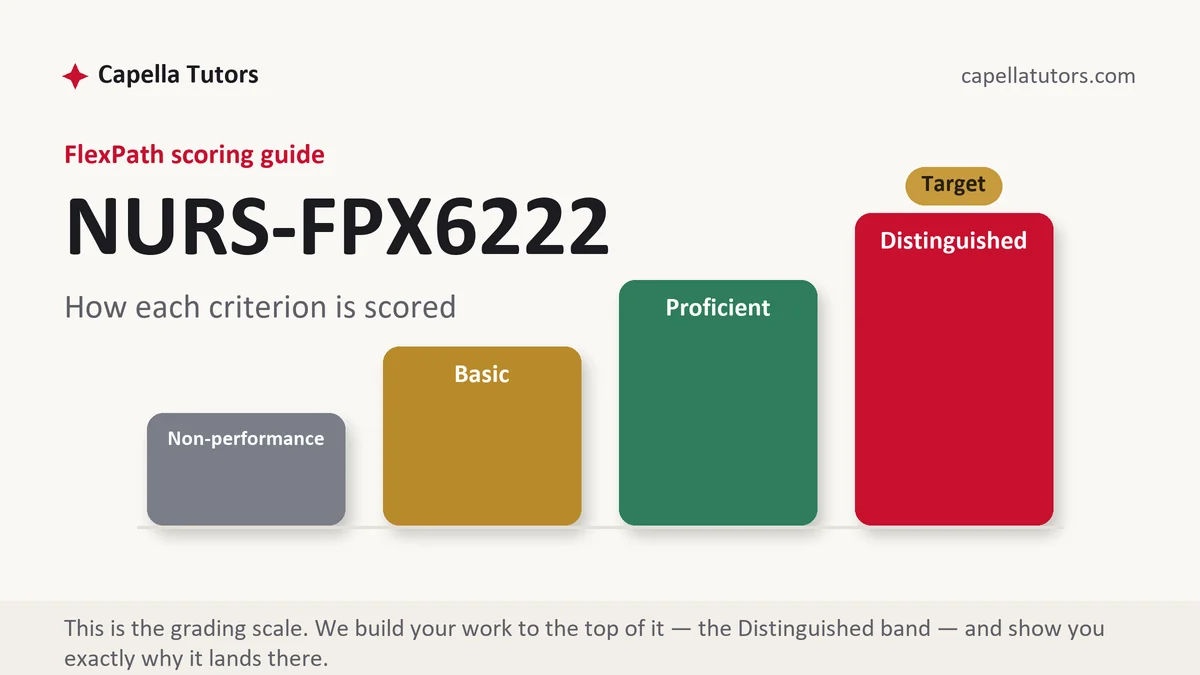
Bring us any deliverable in this course and it comes back inside 24 to 48 hours, written to the Distinguished descriptions in your own scoring guide, read twice by people who did not draft it, and revised free of charge until the score matches the target. The course on your transcript is NURS-FPX6222, Healthcare Safety and Quality Management, carrying 2 program points, one of four courses in the Nursing Leadership and Administration specialization, taught in FlexPath as part of the 27-point MSN.
What NURS-FPX6222 actually grades
The subject is not safety. The subject is the management of safety, and that distinction decides your score. Doing quality work means analyzing an event and proposing a fix. Managing quality means owning the apparatus that produces those analyses on a schedule: which policy triggers a review, who has authority to convene it, how many days the corrective actions get before someone chases them, which committee sees the summary, and what happens when a department misses its deadline twice in a row. Criteria in 6222 typically ask you to evaluate that apparatus in a real organization and then strengthen a piece of it, which means your paper needs owners, dates, and reporting routes, not only good intentions about harm.
Event analysis is graded as a governed process. A serious event review has a clock, a chartered team, a method, a written set of actions ranked by strength, and a follow-up audit that proves the actions were implemented rather than merely approved. That last part carries most of the weight, because the well-documented weakness of event review programs is that they generate education and reminders, the weakest controls available, and then close the file. When your deliverable proposes an action, place it on the hierarchy of controls out loud: a forcing function or an equipment standardization outranks a policy revision, and a policy revision outranks another mandatory module. Rank your own recommendations that way and the analysis criterion looks after itself.
The third graded strand is measurement and accountability. High reliability language sits underneath most of this course, and it is scored on application rather than recitation, so the five principles are only useful if you can point to the shift huddle, the escalation policy, or the debrief that either honors them or does not. Around them sit the measures: nurse-sensitive indicators, publicly reported rates, CMS program specifications, measure definitions with numerators, denominators, and exclusions, risk adjustment, and the reporting lag that means today's dashboard is describing last quarter. Write as though a board quality committee will read the summary, because the accountability criterion is asking whether anyone could be held responsible for what you proposed.
How we help in this course
Our 6222 drafts are built by writers who have sat in quality meetings, so the language arrives already governed: chartered review teams, corrective actions ranked by strength, audit dates, escalation thresholds, committee routes. Give us the shape of your organization, its size, its service lines, the event type or measure you want to work with, all de-identified, and the deliverable reasons about that place instead of a generic hospital. Where your scoring guide names a framework or a regulatory source, we write to that framework specifically rather than around it.
Delivery runs on the studio's usual clock: 24 to 48 hours per deliverable, a Distinguished target on every criterion, two independent quality reads before the file reaches you, and unlimited revision at no charge until you land the column you were aiming at. Evaluator feedback comes back into the same loop, which matters here because faculty in this course tend to push on exactly one thing, whether the accountability structure you described would actually hold.
The assessments, one by one
Assessment 1
The first deliverable in NURS-FPX6222 is a planning document rather than an argument. Read the full Assessment 1 manual.
Assessment 2
The gap analysis is where NURS-FPX6222 starts grading you as a manager of quality rather than a participant in it. Read the full Assessment 2 manual.
Assessment 3
This deliverable in NURS-FPX6222 is usually written for people who will not read past the first page. Read the full Assessment 3 manual.
Assessment 4
This deliverable in NURS-FPX6222 usually widens the frame from one process to the organization's use of its own data. Read the full Assessment 4 manual.
Assessment 5
The last graded deliverable in NURS-FPX6222 usually asks you to lead rather than to analyze. Read the full Assessment 5 manual.
How to actually write NURS-FPX6222: where to begin
Read the scoring guide as a job description rather than a checklist. Each criterion names a task a safety and quality manager performs, and your deliverable is the evidence that you can perform it. Copy those criteria into an empty document, put the Distinguished wording under each one, and treat any paragraph that answers none of them as a paragraph to delete. The clusters in 6222 usually run along these lines: appraise an organization's safety or quality performance, analyze an event or a gap using a defensible method, design controls and assign them, and build the measurement and reporting that proves the work happened.
Choose a subject that already has an owner. Something the organization tracks, reports, or gets penalized for is worth more to this course than something dramatic: a central line infection rate that has drifted for three quarters, a hand hygiene audit programme whose compliance figure nobody believes, a medication reconciliation step that gets skipped at every weekend admission, a rapid response system people call late. Those subjects come with existing data, an existing accountable role, and an existing committee, which means every criterion in the guide has something concrete to attach to.
Then write in the register of accountability. Safety science holds that systems produce most failures, and that principle does not abolish responsibility, it relocates it. A just culture approach separates simple human error, which asks for consolation and a system fix, from at-risk behavior, which asks for coaching about the shortcut, from reckless choices, which ask for a disciplinary route. Say which of the three your event involved and say who owns the response, because a paper that treats every failure as blameless is as unfinished as one that blames the nurse. Managers have to do both things at once, and the top column is written for people who can.
| Section | What goes in it | What Distinguished looks like |
|---|---|---|
| The organization and its performance | The setting, the service line, and the safety or quality performance you are appraising. | Performance stated as a rate against a named benchmark, with the reporting period given. |
| The event or gap | What happened or what is failing, de-identified, with the volume or frequency attached. | A specific process failure, dated and sized, not a category of harm in general. |
| Method and findings | The review method used, the contributing factors it surfaced, and how they interact. | Contributing factors ordered by leverage, with latent conditions separated from active errors. |
| Controls and assignments | The actions proposed, each with a named owner, a due date, and a strength rating. | At least one strong control proposed, with the weak ones acknowledged as supplements. |
| Measurement and reporting | The measure, its definition, its data source, its frequency, and who receives it. | A measure the organization can actually produce, with a threshold that triggers escalation. |
| Accountability and references | The committee route, the review cadence, and current APA citations both ways. | A named forum, a stated consequence for missed actions, sources matched to each claim. |
Developing the analysis
The safety management literature argues with itself, and that argument is where the higher scores live. Surgical safety checklists produced striking mortality reductions in their original multi-site work and then failed to reproduce that effect in large population-level replications, which tells you something useful about implementation quality rather than about checklists. Event review programs are near-universal and their published effectiveness is thin, largely because the actions they generate sit at the weak end of the control hierarchy. Culture survey scores predict some outcomes in some settings and not others. Take one of those disputes, state both sides with their study designs, then decide, and let the decision constrain your recommendation: if implementation fidelity is what separates the checklist successes from the failures, your control has to include a fidelity audit, not just an adoption date. Cataloguing agreement is Proficient work. Resolving a disagreement, then paying the cost of your resolution in the design section, is what the top column describes. Finish by naming the thing your evidence cannot establish and showing the plan survives it.
Citations that survive faculty review
Two layers again, and in this course the regulatory layer carries unusual weight. For clinical and behavioral claims, use peer-reviewed studies from roughly the last five years through the Capella library, CINAHL, and PubMed, and prefer the ones that report implementation detail over the ones that only report an effect size. For definitions, obligations, and thresholds, go to the primary sources: Joint Commission standards and sentinel event policy, AHRQ patient safety material and its common formats, Institute for Healthcare Improvement tools, CMS program specifications and measure documentation, and AONL competencies where the criterion touches the executive role. Do not paraphrase a measure definition from a journal article when the specification manual is available, because the numerator and denominator language in a quality paper needs to match what the organization actually reports. Write citations into your working sentences so they carry argument, and run the two-way check at the end, current APA, every citation in the list and every entry cited.
The mistakes that land Basic instead of Distinguished
- Education as the whole fix. Another module for staff who already knew the rule is the weakest control on the list and the most common recommendation in this course.
- Actions with no owner. An action assigned to "the unit" or "leadership" cannot be followed up, and the accountability criterion is looking for a role.
- Measures that do not exist. If nobody collects the number your plan depends on, your plan has a data project hidden inside it that you have not costed.
- The five principles as a recital. Listing high reliability principles without pointing at a practice that breaches one produces no application to score.
- A blameless universe. Removing all accountability is not just culture, it is the absence of a culture, and managers are graded on telling the categories apart.
- No route upward. Safety work that never reaches a committee, a chief nurse, or a board report stops at the unit door.
NURS-FPX6222 questions students actually ask
Is this just the undergraduate safety course again?
No, and writing it as though it were is the fastest route to Proficient. The undergraduate version asks you to analyze an event and propose an improvement. This one asks you to run the function that analyzes events: who convenes the review, on what deadline, under which policy, with what authority to change a process, and how the result reaches a committee that can hold someone to it. Same vocabulary, different chair. If your draft never mentions a policy, an owner, a due date, or a reporting route, you are still writing the undergraduate paper in graduate sentences.
What if my organization will not share its quality data?
Use the public layer, and say that is what you are doing. Hospital Compare data, state reporting sites, CMS program specifications, and Joint Commission and AHRQ published rates give you defensible national or state benchmarks and precise measure definitions. Then take the internal number down to something your manager can say out loud in a hallway, a monthly count or a rate the unit already posts on its board. One real local figure against a published benchmark is enough to size a problem. Inventing a dashboard is not, and evaluators who work in quality departments recognize invented numbers on sight.
Do I have to name a high reliability framework?
Only if your scoring guide asks for one, but naming one usually helps because it gives the appraisal criterion something to bite on. The five principles most safety-management writing uses are preoccupation with failure, reluctance to simplify, sensitivity to operations, commitment to resilience, and deference to expertise. Pick two or three that your event actually implicates and appraise the organization honestly against them, including where it falls short. A page that claims the organization satisfies all five reads as flattery. An appraisal that names one principle the organization only performs on paper reads as management.
Stuck on a 6222 deliverable?
Paste the prompt and its criteria, tell us the event type or the measure, and the first premium sample comes back free inside two days.