This manual is for NURS-FPX6222 Assessment 3, start to submission. This deliverable in NURS-FPX6222 is usually written for people who will not read past the first page. Your scoring guide decides the format, and the assessment typically asks for an executive summary that names the quality and safety outcomes at stake, explains what they are worth to the organization and the community it serves, specifies the measures that will carry them, and states what leadership has to do for the change to hold. Compression is the graded skill. An executive summary is not a shortened paper, it is a document written so that a chief nursing officer can decide from it. The method, a structure keyed to the criteria, and an annotated excerpt are below. Want it built for you? A premium original sample returns in 24 to 48 hours with revisions free until the guide is met. Your courseroom may print this as NURS FPX 6222 Assessment 3 or NURS6222 Assessment 3; it is the same deliverable, and NURS-FPX6222 Assessment 3 is what this manual walks through.
One honesty note before the manual: Capella revises courses and scoring guides over time, so always write to the exact scoring guide attached to your assessment in the courseroom. The course identity above is verified on capella.edu; the method and structure below are our tutors' approach to it, not Capella's official rubric text.
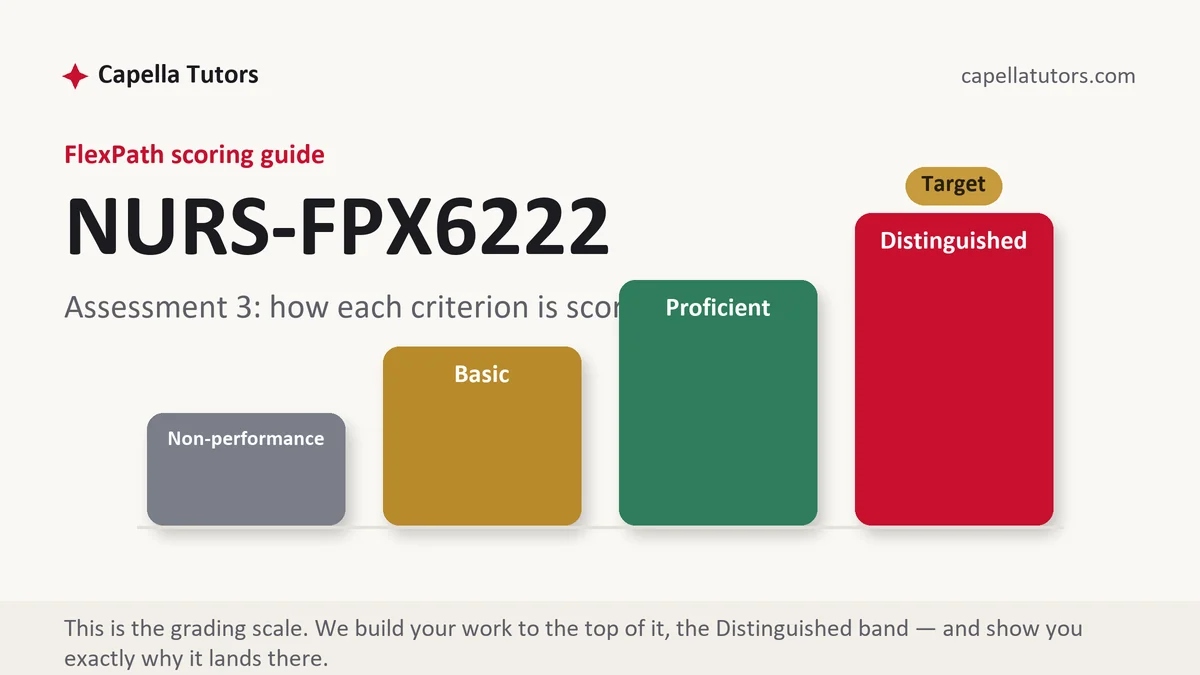
How NURS-FPX6222 Assessment 3 is scored
Criteria are scored one at a time against four levels, with no averaging, and on an executive summary the levels turn on whether the document supports a decision:
| Level | What it means on an executive summary |
|---|---|
| Distinguished | Outcomes are specified as measures with definitions, baselines, and sources; the value to the organization is stated in both money and obligation; and the leadership actions required are named down to the role. A reader could approve it without asking a question. |
| Proficient | Accurate, well-organized, and complete, with measures that exist and value that is argued. What holds it below the top is compression: the reader still has to work out what is being asked of them. |
| Basic | A summary of a topic. The subject is important, the outcomes are described in general terms, and no measure in the document has a definition or a baseline. |
| Non-performance | A required element is missing, most often the specific outcome measures or the strategic value, and its criterion falls to the floor irrespective of the writing quality. |
Executive readers ask two questions of any quality proposal, and the summary should answer both before it is asked. What obligation does this discharge, and what does it cost or save. Obligation comes from primary sources, accreditation requirements and federal payment and reporting rules; the money comes from your own organization's figures, declared as such. A summary that argues only from patient benefit is easy to admire and easy to defer.
The NURS-FPX6222 Assessment 3 method, step by step
-
Write the first paragraph as the decision
Open with what you are asking leadership to endorse and what changes if they do. Everything else in the document is support. Summaries that open with background spend their most valuable paragraph on material the reader already knows, and the criterion asking for executive communication notices.
-
Specify measures, do not name topics
Every outcome needs a definition, a numerator and denominator, a data source, a baseline value with its period, and a target. Screening completion measured as documented assessments divided by eligible patient days is a measure. Improved recognition of delirium is a topic, and topics cannot be tracked on a dashboard.
-
Separate what the organization owes from what it wants
Some of your outcomes are obligations under accreditation or payment rules and some are ambitions. Say which is which, and cite the requirement for the first group from the primary document rather than from a review article. The distinction changes how quickly leadership has to act, which is exactly the judgment an executive summary exists to inform.
-
Price the change on both sides of the ledger
State the recurring cost of the new model, the cost it displaces, and the net, with each rate sourced. Then discount any benefit that depends on time released rather than money released, and say in writing that you discounted it. Executives have seen enough projections built on saved minutes to distrust the ones that are not adjusted.
-
Name the leadership actions by role
Resource allocation, policy authorization, competency requirements, and the committee route are decisions only leaders can make, and the criterion asking about leadership's role is asking you to identify them precisely. Where your guide expects the executive frame, the competency sets published by the American Organization for Nursing Leadership give you the vocabulary for it; use peer-reviewed research for anything you claim about effect.
-
Keep the document to a decision length
One to two pages of tight prose with a short measure table, headed sections, and a reference list. Cut every sentence that explains what the reader already accepts. Then read it once as the chief nursing officer would: if a question you could have answered remains, answer it in the draft rather than in the meeting.
A structure that maps to the criteria
Targets our tutors plan against for a summary of this kind, not Capella requirements; follow your own guide on length and headings.
| Section | What it must do | Guide |
|---|---|---|
| The decision requested | What leadership is being asked to endorse, and what changes as a result, in the opening paragraph. | ~150 words |
| The systemic problem | The failure described at system level with its measured baseline and the process that produces it. | ~250 words |
| Outcomes and measures | Each outcome as a defined measure with numerator, denominator, source, baseline, and target. | ~300 words |
| Strategic value | The obligation discharged, cited from a primary source, and the financial effect with its assumptions declared. | ~280 words |
| Leadership actions | Resources, policy authority, competency requirements, and the committee route, each attached to a role. | ~250 words |
| Adoption, equity, references | How the change reaches every shift and population it must, and current APA citations both ways. | ~200 words |
Annotated sample excerpt
An original model excerpt from our team, at the register the top of the guide describes. Learn the compression, then write your own.
Two divisions spent forty-one thousand six hundred hours on continuous observation last year, about one million eighty-two thousand dollars of aide time at the current twenty-six dollar rate, and the model produces no measurable clinical result because an observer's only recorded output is presence.1 Converting twenty-four rooms to continuous video observation with a one to twelve technician ratio is projected to reduce observation hours to about fourteen thousand nine hundred, roughly three hundred and eighty-seven thousand dollars, against four and two tenths monitor technician positions at fifty-eight thousand loaded, so the net recurring reduction is near four hundred and fifty thousand dollars on the stated ratio.2 The reason to do it is not the money. Documented delirium screening completion on these divisions is fifty-eight percent of eligible patient days, unplanned removal of drains and feeding tubes ran at thirty-one events last year, and both are measures a technician workstation can capture continuously where a rotating observer cannot, so the request to leadership is to fund the conversion and to require the screening measure in the divisions' monthly quality report.3
- 1The baseline is stated in hours and in dollars with the rate named, and the sentence identifies the real defect, which is that the current model produces no data. Executives fund replacements for models that cannot be measured.
- 2The arithmetic shows both sides and the assumption it rests on, the staffing ratio. Saying on the stated ratio is what invites a reviewer to test the projection instead of doubting it.
- 3The paragraph refuses to let money be the argument, then converts the clinical case into two measures with denominators and ends on a specific ask. That sequence, obligation and outcome first, savings second, is the executive register the guide is describing.
The full premium sample for your exact assessment, written fresh to your scoring guide and issue, is free to request. Study it, revise it into your own voice, and submit work you understand.
The five mistakes that cost Distinguished
- Outcomes with no definitions. A measure without a numerator, a denominator, and a source cannot appear on a report, and an unreportable measure cannot be endorsed.
- A summary that is a shortened paper. Background first, decision last, is the structure of an essay. Executive readers stop reading before the ask arrives.
- Benefit claimed entirely from released time. Time saved across a shift rarely converts into money. Discount it openly and the rest of your figures become believable.
- Obligation and ambition treated as one thing. What accreditation or payment rules require sets a different clock from what the organization would like. Separate them and cite the requirement.
- Leadership actions written as leadership support. Support is not an action. Releasing a position, authorizing a policy, and adding a measure to a report are actions with owners.
Pre-submission checklist
- The opening paragraph states the decision requested and what changes if it is granted
- Every outcome carries a definition, numerator, denominator, source, baseline, and target
- Obligations cited from primary accreditation or payment sources, separated from ambitions
- Costs and offsets shown with rates sourced, and any time-based benefit discounted openly
- Leadership actions attached to roles, with the committee route named
- One to two pages, headed sections, and current APA citations matched both ways
Executive summary due in 6222?
Send the prompt, the criteria, and the measure or program you want summarized. We write it to decision length: measures with definitions and baselines, the obligation cited from primary sources, the money shown on both sides with assumptions declared, and leadership actions attached to roles. Inside 24 to 48 hours, two independent reads, revisions free until your scoring guide is satisfied.