This manual is for NURS-FPX6222 Assessment 1, start to submission. The first deliverable in NURS-FPX6222 is a planning document rather than an argument. Your scoring guide sets the template, and the assessment usually asks you to bring the learner, the practicum preceptor, and the faculty member into one conversation and then record what was settled: the setting, the safety or quality problem the hours will address, the objectives, and how the work will be supervised. In a course about managing quality, this document is the first quality artifact you produce, and evaluators read it accordingly. Below is the method our tutors use, a structure mapped to the criteria, and an annotated excerpt. Prefer to hand it over? A premium original record comes back in 24 to 48 hours with revisions free until the guide is met. Your courseroom may print this as NURS FPX 6222 Assessment 1 or NURS6222 Assessment 1; it is the same deliverable, and NURS-FPX6222 Assessment 1 is what this manual walks through.
One honesty note before the manual: Capella revises courses and scoring guides over time, so always write to the exact scoring guide attached to your assessment in the courseroom. The course identity above is verified on capella.edu; the method and structure below are our tutors' approach to it, not Capella's official rubric text.
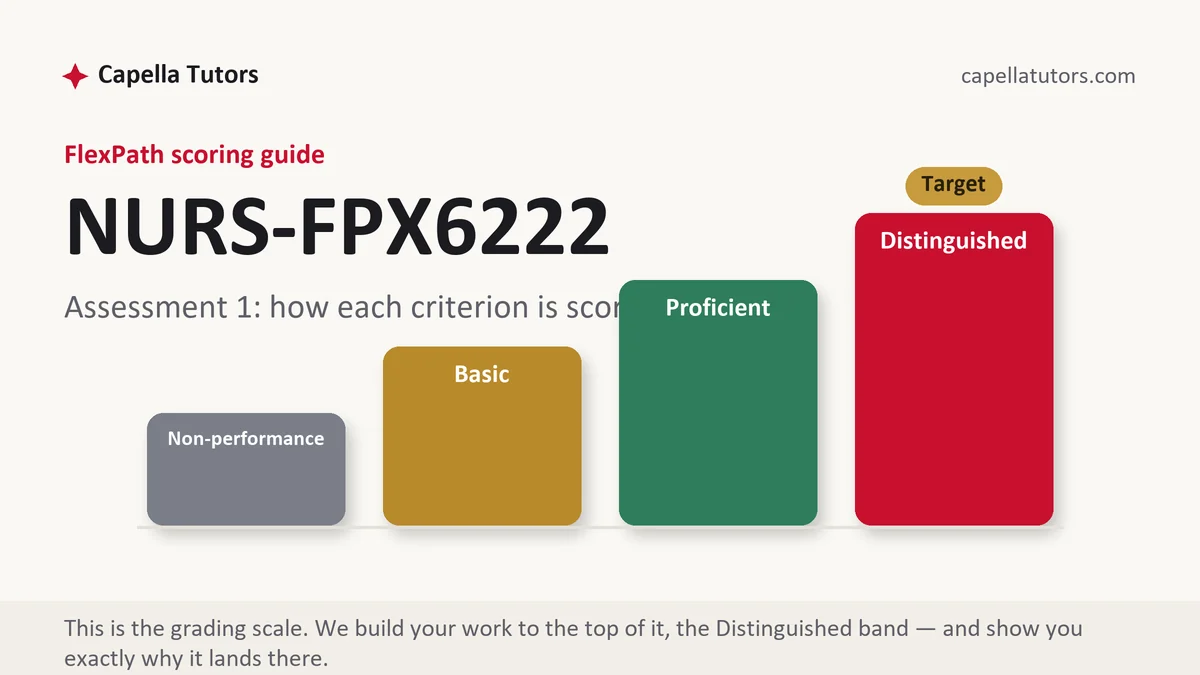
How NURS-FPX6222 Assessment 1 is scored
Nothing here is averaged. Each criterion is scored on its own against four levels, and on a planning record the levels reward what can be verified later:
| Level | What it means on a practicum planning record |
|---|---|
| Distinguished | The record reads like a charter. The safety or quality problem carries a measured baseline, the objectives name the artifacts they will produce, the supervision and data terms are explicit, and every commitment has a person attached to it. |
| Proficient | All required content is accurate and complete, and the objectives still describe activity rather than product. That is the usual distance between a solid record and the top of the guide. |
| Basic | A courteous summary of a call. Attendance, topics covered, and no commitment anybody could be held to in week eight. |
| Non-performance | A participant, a date, or a required field of the template is missing, and an incomplete planning record drops its criterion regardless of how well the rest is written. |
Choose the problem with the rest of the course in view. Later deliverables in this course are graded on your ability to appraise an organization's safety performance and strengthen part of the apparatus that produces it, which means the practicum problem should already have a measure, an accountable owner, and a committee that reviews it. A problem with all three gives every later criterion something concrete to hold. A problem you find interesting but nobody currently tracks leaves you building a data collection project you did not plan for.
The NURS-FPX6222 Assessment 1 method, step by step
-
Choose a problem the organization already measures
Something reported, audited, or reviewed by a committee is worth more to this course than something dramatic. If the setting already produces a rate, an audit result, or an event count, your baseline exists and your objectives can move it. If nothing is measured, the first half of your practicum becomes measurement design, and the hours run out before the analysis begins.
-
Match the preceptor to the data
The preceptor has to sit where the information lives. A quality director, a patient safety officer, an infection prevention lead, or a service line director can bring you measure definitions, audit files, and a committee seat. A preceptor one level removed from those will be generous with time and unable to give you a numerator.
-
Write objectives that produce artifacts
Each objective should end in a document: a gap analysis of one process against its policy, a control table with owners and due dates, a driver diagram, a summary presented to a named forum. Artifacts can be shown to a faculty member. Increasing familiarity with quality management cannot, and it is the phrasing that costs learners the objectives criterion most often.
-
Settle the reporting route while everyone is on the call
Ask which committee reviews the measure you have chosen, when it meets, who chairs it, and whether you may attend. Write the answers into the record. Quality work that never reaches a forum stops at the unit door, and arranging the seat in week one is easier than arranging it in week nine.
-
Put the confidentiality terms in writing
Agree what may appear in coursework and in what form: de-identified units, no patient identifiers, no named individuals, aggregate figures only where the counts are small. Record the agreement rather than relying on everyone's good intentions, because the first draft that names a unit and a date is the draft that generates a correction from faculty.
-
Reconcile the plan with the log before you submit
The hours you promise here are the hours you will report later, so check that the objectives, the weekly distribution, and the categories in your log all use the same language. Complete every field the template asks for, then submit at the start of a week rather than the end of one, since evaluation can take two business days.
A structure that maps to the criteria
Planning targets our tutors use for a record of this kind, not Capella requirements; expand whichever fields your own template asks you to expand.
| Section | What it must do | Guide |
|---|---|---|
| Call participants and logistics | Learner, preceptor, and faculty member with roles and credentials, plus date, format, and duration. | ~90 words |
| Setting and quality apparatus | The organization operationally described, and the committees, policies, and roles that govern quality in it. | ~180 words |
| The problem and its baseline | The safety or quality problem, its current measured value, the measure definition, and the reporting source. | ~220 words |
| Objectives and artifacts | Three to five objectives, each naming the document it will produce and who will receive it. | ~220 words |
| Hours, milestones, and access | The weekly distribution of hours, the meetings you will attend, and the data you have been granted. | ~160 words |
| Supervision, confidentiality, sign-off | Supervision arrangements, de-identification terms, escalation route, and the acknowledgements the template requires. | ~130 words |
Annotated sample excerpt
An original model excerpt from our team, at the register the top of the guide describes. Take the moves and write your own record.
Agreed focus for the practicum hours: the ambulatory infusion center runs twenty-two chairs and about sixty-one infusions a day, and its hypersensitivity reaction response has never been drilled since the center expanded in the spring, with emergency medication access and the escalation pathway both documented in a policy last reviewed twenty-two months ago.1 Objective one, audit ten consecutive days of practice against that policy and produce a gap table with each gap rated on the hierarchy of controls.2 Objective two, present the gap table and a proposed drill schedule to the ambulatory quality committee in week nine, which the preceptor chairs and which has agreed to a fifteen minute agenda item; the center's clinical manager will supply de-identified reaction logs for the preceding twelve months.3
- 1The problem is dated, sized, and tied to a specific document, so a reader can see exactly what is out of alignment. Naming the policy review date is what converts a concern into a finding.
- 2The objective names its artifact and the method that produces it. Rating gaps on the hierarchy of controls in the plan signals that the later analysis will not stop at recommending another education module.
- 3The forum, the week, the chair, the agenda time, and the data owner are all committed to paper. This is the sentence that makes the plan enforceable, and it is the one most learners leave out.
The full premium sample for your exact assessment, written fresh to your scoring guide and issue, is free to request. Study it, revise it into your own voice, and submit work you understand.
The five mistakes that cost Distinguished
- A problem nobody measures. Without a baseline you have a topic. The practicum then spends its hours designing a measure instead of improving a process.
- Objectives written as activities. Attending meetings and observing practice are inputs. The criterion is looking for what you will produce and who will receive it.
- A preceptor without access to the numerator. Measure definitions, audit files, and committee minutes are the raw material here, and a preceptor outside quality cannot supply them.
- No forum named. Improvement work that reports to nobody cannot be evaluated, and arranging a committee slot late in the term rarely succeeds.
- Confidentiality left to assumption. Write down what may be published and in what form. A record that anticipates naming units and dates invites a faculty correction immediately.
Pre-submission checklist
- All three participants named with roles and credentials, plus the date of the call
- The problem stated with a measured baseline, a measure definition, and its reporting source
- Objectives that each name an artifact and the person or forum receiving it
- The reviewing committee identified, with the meeting date and the access agreed
- De-identification and supervision terms written into the record
- Objectives, weekly hours, and log categories using the same language, submitted early in the week
Setting up a 6222 practicum?
Send us the template, the scoring guide, and whatever you know about the site and the preceptor. We return a premium original record inside 24 to 48 hours: a problem with a baseline, objectives that name their artifacts, a reporting route, and confidentiality terms written down. Two independent reads before delivery and revisions free until the guide is satisfied.