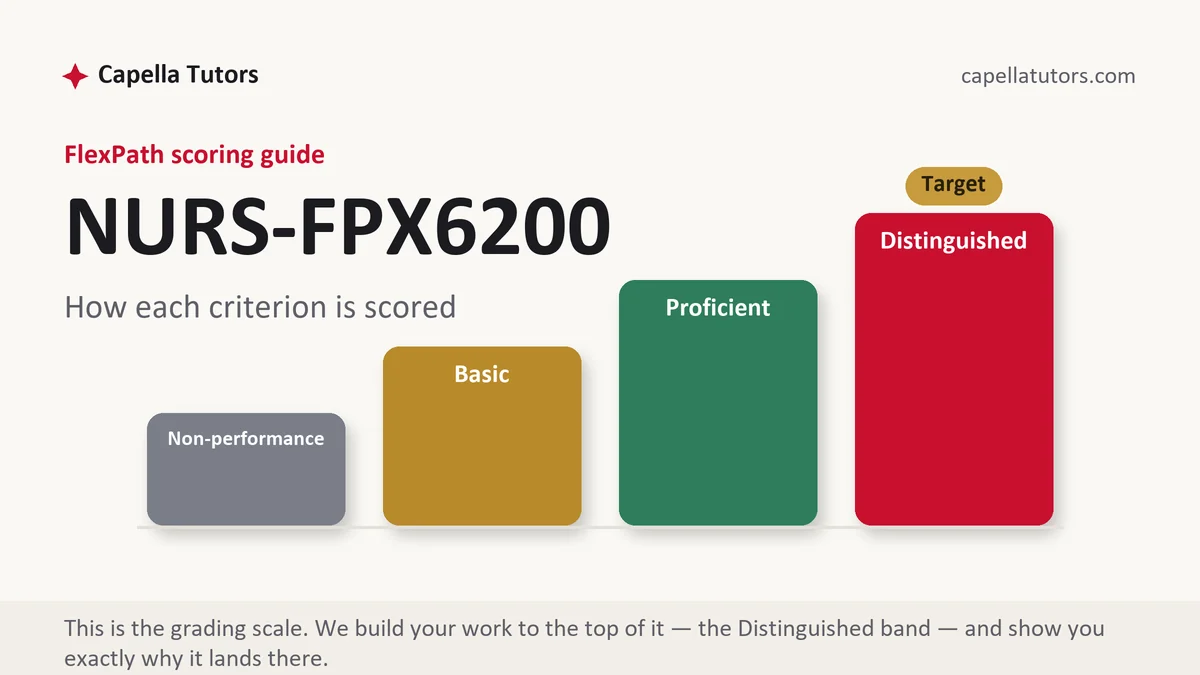
We write and tutor every deliverable in this course to the Distinguished column, back to you inside 24 to 48 hours, two independent QA reads before delivery, revisions free until the target column is the one you get. The course itself is NURS-FPX6200, Management and Leadership for Nurse Executives, worth 2 program points, one of the four courses in the Nursing Leadership and Administration specialization, delivered in FlexPath inside the 27-point MSN.
What NURS-FPX6200 actually grades
This course grades altitude. A charge nurse fixes the shift; an executive diagnoses the organization that keeps producing the shift, and the scoring guides are written to tell those two voices apart. Expect criteria that ask you to identify a management or leadership problem in a real unit or system, interpret it through a named leadership theory, and propose a response a director could fund, staff, and defend in a meeting. The theory is an instrument, not ornament. Transformational, servant, situational, and complexity leadership each predict different behavior under pressure, so choosing one commits you to its logic for the rest of the paper, and the top column rewards writers who honor that commitment instead of listing four theories and moving on.
Staffing and retention arrive as arithmetic. Vacancy rate, time to fill, first-year turnover, hours per patient day, agency premium: those are the terms executives argue in, and a paper that describes low morale without touching a single number reads like a staff complaint rather than a management analysis. When you write about retention, write about what losing one experienced nurse costs, the orientation hours a replacement consumes, and the overtime the vacancy generates while the position sits open. The criteria do not demand an accountant's precision. They demand that your recommendation be sized.
The third thing 6200 grades is influence you do not own. Nurse executives run change through people who never report to them: pharmacy, environmental services, the medical staff, a finance director who controls the position you want. Assessments in this course usually ask you to plan that persuasion out loud, naming the stakeholder, the interest that stakeholder holds, the evidence that would move them, and the concession you are prepared to make. Framing the whole thing as a business case, with a problem, options, a cost, an expected return, and the risk of doing nothing, is what separates an executive proposal from a wish list. Evaluators see the difference in the first page.
How we help in this course
We build 6200 deliverables the way a director builds a proposal. The problem gets defined at system level, the theory gets chosen and then genuinely used, the recommendation carries figures, and the stakeholder plan names real roles with real interests. Tell us your setting, unit type, bed count, shift pattern, anything you can say without identifying a person, and the draft argues from that rather than from a generic hospital that exists nowhere.
Terms are the studio's standard ones. Each deliverable comes back inside 24 to 48 hours, written at the Distinguished target for FlexPath criteria, checked by two people who did not write it, and revised at no cost until you reach the column you were aiming at. Faculty comments fold into the same cycle, also free, which matters in a course where a single unsupported recommendation can pull an otherwise strong submission down a level.
The assessments, one by one
Assessment 1
The opening deliverable in NURS-FPX6200 is administrative on its face and consequential underneath: your scoring guide decides the exact form, but the assessment usually asks you to convene the learner, the practicum preceptor, and the faculty member, then document what the three of you agreed. Read the full Assessment 1 manual.
Assessment 2
The second deliverable in NURS-FPX6200 usually asks for an analysis of a care setting before any plan is written: what the setting does well, what it is positioned to do, what it aspires to, and what results would prove the aspiration was met. Read the full Assessment 2 manual.
Assessment 3
By the third deliverable in NURS-FPX6200 the analysis is behind you and the criteria want a plan. Read the full Assessment 3 manual.
Assessment 4
The final graded deliverable in NURS-FPX6200 usually turns your plan outward: your scoring guide decides the medium, and the assessment typically asks you to carry the strategy to the people who have to fund it, staff it, or live with it, most often as a slide deck with speaker notes. Read the full Assessment 4 manual.
How to actually write NURS-FPX6200: where to begin
Start in the scoring guide, not the instructions. Paste each criterion into an empty document as a heading, drop the Distinguished wording underneath it, and leave it there while you write, because the criteria are the outline and anything that answers none of them is decoration you will cut later. In 6200 those criteria usually cluster around four jobs: define a problem with evidence, apply a leadership or management theory to it, recommend a course of action, and account for the people and the money that action consumes.
Then pick a problem you can see from where you stand. The strong 6200 topics are unglamorous and expensive: a night-shift vacancy pattern nobody has staffed around, a discharge process that holds beds until four in the afternoon, an onboarding program that loses a third of its new graduates before the year closes, a float pool that exists mainly on paper. Write the problem in one sentence with a number attached to it. If no number will attach, you have chosen a feeling, and feelings do not survive the analysis criterion.
Then hold the altitude for the whole paper. Executive writing attributes outcomes to structures: schedules, spans of control, incentive design, reporting lines, the way one policy collides with a union contract. When a draft starts describing individuals, a difficult charge nurse, an unhelpful hospitalist, it has fallen back to the unit floor and the analysis score falls with it. Ask instead what about this system makes that behavior rational, because the answer is usually the thing your recommendation should change.
| Section | What goes in it | What Distinguished looks like |
|---|---|---|
| Problem and setting | The management or leadership problem, sized with data, inside a described organization. | A named problem with a baseline figure and a stated cost of leaving it alone. |
| Leadership theory applied | One theory, its constructs, and how each construct maps onto the problem you defined. | The theory used to predict and explain behavior, with its limits admitted. |
| Evidence base | Peer-reviewed leadership and workforce research relevant to the action you will propose. | Studies weighed for design and setting fit rather than summarized in sequence. |
| Recommendation | The action proposed, with the positions, hours, and dollars it will consume. | Options compared, one chosen, the runner-up rejected in writing for a stated reason. |
| Stakeholders and influence | Who must agree, what each of them wants, and how you intend to earn the agreement. | Named roles with their interests, plus the objection you expect and your answer to it. |
| Evaluation and references | How success gets measured, by when, and by whom, in current APA both ways. | A metric the organization already collects, with a review date and a named owner. |
Developing the analysis
Leadership research is unsettled, which is a gift to this criterion. Transformational leadership correlates with lower turnover intention across a large cross-sectional literature, and cross-sectional is precisely the weakness: the same data cannot say whether good leaders retain nurses or whether well-resourced units produce leaders who look transformational on a survey. Magnet studies report better outcomes and struggle to separate the designation from the investment that earned it. Use that tension deliberately. Set two sources against each other, name the design difference that explains the disagreement, rule for one of them, and say what evidence would change your mind. Three studies that agree, summarized in a row, is Proficient work at best. Adjudicating between two that do not agree is what the top column is describing. Then say plainly what the literature cannot settle, usually the direction of causation, and show that your recommendation still holds if the answer runs the other way.
Citations that survive faculty review
Executive papers run on two evidence layers and faculty check both. The research layer, peer-reviewed work from roughly the last five years pulled through the Capella library, CINAHL, and PubMed, carries every causal claim you make about staffing, turnover, or leadership behavior. The standards layer, AONL nurse executive competencies alongside AHRQ, the Institute for Healthcare Improvement, Joint Commission requirements, and CMS payment and reporting rules, carries definitions, obligations, and the reason a finance committee is required to care. Neither layer does the other's job. AONL material can establish which executive competency your recommendation exercises; it cannot establish that a twelve-month residency lowers first-year turnover. Assign every source to a specific criterion and write the citation into the sentence that argues, since "Chen and Ortiz (2023) recorded a nine-point drop in first-year turnover after a twelve-month residency" argues, while the same claim with a parenthetical trailing behind it merely asserts. Close with the two-way check, every in-text citation present in the reference list and every reference actually cited, current APA throughout.
The mistakes that land Basic instead of Distinguished
- Theory as garnish. A theory named in the introduction and never used again leaves the application criterion with nothing to score.
- Analysis that stops at a person. If the cause you land on has a name and a badge number, keep going until it has a policy or a schedule instead.
- A recommendation with no price. Executives are graded on affordability; an unpriced proposal reads as an opinion.
- Stakeholders listed, not analyzed. Naming pharmacy and finance is a roster. Saying what each of them stands to lose is the criterion.
- No measure and no date. A change with no metric and no review point cannot be evaluated, and unevaluable plans score Basic every time.
NURS-FPX6200 questions students actually ask
Do I need a management title to write this course?
No, and most learners do not have one. What the criteria need is a system you can observe closely enough to describe honestly, which a bedside nurse on a 34-bed telemetry unit has in abundance. Write from what you watch: how the schedule gets built, who gets floated and why, what happens to an assignment when two people call out. Then add the layer you cannot see by asking for it, since a manager will usually share the unit's vacancy rate and target hours per patient day if you explain it is for a graduate paper. Position is not the qualification in this course, altitude is.
Which leadership theory should I pick?
The one that fits the failure, and then stay with it. Transformational leadership suits problems of engagement and change adoption. Situational leadership suits a team with uneven competence, a new graduate cohort working beside twenty-year veterans. Complexity leadership suits problems that keep reappearing in new forms because the system rather than the intervention is producing them. Servant leadership suits a culture problem where trust has already been spent. Choose before you write the analysis, not after, because the theory should shape what you notice, and a theory bolted on at the end always reads bolted on.
How much financial detail does an executive paper need?
Enough that a reader can tell whether the idea is affordable. You do not need a budget workbook, you need the shape of the money: what the change costs once, what it costs every year, what it saves or avoids, and roughly when those lines cross. Two or three defensible figures with their sources named will carry the criterion. A recommendation with no numbers gets read as a suggestion, and suggestions score Basic in a course whose premise is that nurse executives argue in the same units as everyone else at the table.
Working on 6200 this week?
Send the prompt, its scoring guide, and your unit type. The first premium sample costs nothing and lands within 48 hours.