This manual is for NURS-FPX6200 Assessment 4, start to submission. The final graded deliverable in NURS-FPX6200 usually turns your plan outward: your scoring guide decides the medium, and the assessment typically asks you to carry the strategy to the people who have to fund it, staff it, or live with it, most often as a slide deck with speaker notes. The graded skill is persuasion under scrutiny, not summary. Evaluators are reading for whether you know what each stakeholder loses, whether the ask is stated in one sentence, and whether the objection you would actually face appears on a slide with an answer under it. Below sit the method, the structure, and an annotated excerpt. Want it built for you? A premium original sample lands in 24 to 48 hours with free revisions until the guide is met. Your courseroom may print this as NURS FPX 6200 Assessment 4 or NURS6200 Assessment 4; it is the same deliverable, and NURS-FPX6200 Assessment 4 is what this manual walks through.
One honesty note before the manual: Capella revises courses and scoring guides over time, so always write to the exact scoring guide attached to your assessment in the courseroom. The course identity above is verified on capella.edu; the method and structure below are our tutors' approach to it, not Capella's official rubric text.
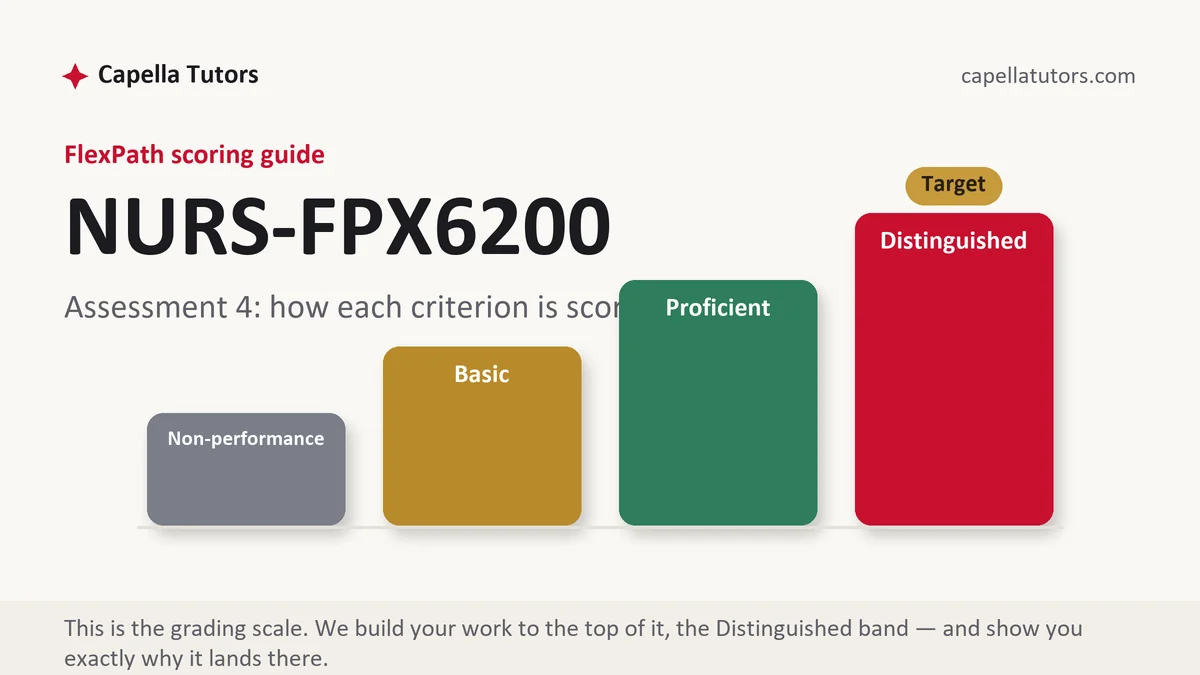
How NURS-FPX6200 Assessment 4 is scored
Each criterion in your guide is judged alone against four levels, and on a presentation the levels are mostly about audience discipline:
| Level | What it means on a stakeholder presentation |
|---|---|
| Distinguished | The deck is built for a named audience with a single ask, the speaker notes argue rather than narrate, the strongest objection is answered on the slide where it would be raised, and every figure on screen has a source under it. |
| Proficient | A clear, accurate, well-supported presentation of the strategy. What keeps it below the top is that it addresses everyone at once, so no stakeholder hears their own interest named. |
| Basic | The plan reformatted into slides. Bullet points lifted from the paper, notes that read the bullets aloud, and no request for a decision anywhere in the deck. |
| Non-performance | A required element is absent, commonly the speaker notes or any statement of the ask, and its criterion drops to the floor whatever the visual quality. |
Write for one room. A deck aimed at a perioperative governance committee sounds different from one aimed at the medical executive committee, and the criteria that ask you to communicate with stakeholders are asking you to demonstrate that you know the difference. Name the room in your first speaker note. It disciplines every choice after it, including which figures you show and which you leave in the appendix.
The NURS-FPX6200 Assessment 4 method, step by step
-
Name the room and the decision you want from it
Decide who is sitting there and what you want them to do before you open a slide. Approve a policy change, release capacity, fund a position, endorse a pilot. One decision per deck. A presentation that wants general support gets general support, which is another way of saying nothing changes on Monday.
-
Open on the cost of the current state, not on your idea
Stakeholders arrive attached to the way things are. The first substantive slide should price the status quo in units the room cares about, dollars for finance, delayed cases for surgeons, overtime for nursing, so that your proposal answers a question the audience is already holding. Leading with the solution invites a debate about the solution.
-
Give every stakeholder their own sentence
Work through the room and write what each participant stands to lose, in their language. A surgeon hears predictability and case order. Anesthesia hears staffing and end times. Finance hears contribution per hour. Nursing hears the schedule. A slide that names those interests separately is the difference between a presentation about your plan and a negotiation.
-
Put the objection on the slide where it will be raised
Anticipate the strongest challenge and answer it in place rather than in a closing section. If the proposal reallocates capacity, the objection is fairness, and the answer is a transparent rule applied to everyone with a review point at which it can be revisited. Answering early costs you nothing and buys the room's attention for the rest of the deck.
-
Write speaker notes that argue in full sentences
Notes are graded as prose. Each one should state the claim, carry the evidence with its citation, and end on the transition to the next slide. Keep the peer-reviewed research for causal claims and use primary sources for definitions and obligations, whether that is a professional body's executive competencies or a federal payment rule. Notes that restate the bullets forfeit the communication criterion outright.
-
Close by asking for the decision and naming the review date
The last slide is a request, not a thank you. State the ask in one sentence, name the owner of each action, give the date the room will see results, and state what you will bring back if the measures do not move. Then check the mechanics, since accessible contrast, readable type, cited figures, and a reference slide in current APA all sit inside the communication criterion.
A structure that maps to the criteria
Slide and note targets our tutors plan against for an executive presentation, not Capella rules; follow your guide where it specifies a count.
| Section | What it must do | Guide |
|---|---|---|
| Title and the room | Title, your role, the audience named, and the one decision you are asking for, stated on the opening slide. | 1 slide, ~120 words of notes |
| The cost of the current state | The problem priced in the units this audience uses, with the reporting period and source on the slide. | 2 slides, ~300 words of notes |
| The proposal | What changes, who does it, and when, with the rule or mechanism stated plainly enough to be applied. | 2 to 3 slides, ~320 words of notes |
| What it costs and what it returns | One-time and recurring cost, the return or recovered capacity, and the assumption the projection rests on. | 1 to 2 slides, ~250 words of notes |
| Interests and the objection | Each stakeholder group with its interest named, then the strongest objection with your answer under it. | 2 slides, ~280 words of notes |
| The ask, the measures, and references | The decision requested, the measures with owners and a review date, and a reference slide in current APA. | 2 slides, ~200 words of notes |
Annotated sample excerpt
An original model excerpt from our team, showing the register that scores at the top of the guide. These are speaker notes, which is where the argument lives.
This slide is for the perioperative governance committee, and the number on it is the one I want the room to hold for the next twenty minutes: prime time block utilization across the fourteen rooms ran at sixty-one percent last quarter against the seventy-five percent this committee adopted as its own target in March.1 The gap is not idle surgeons, it is release timing. Blocks returned inside twenty-four hours are almost never refilled, and the scheduling office reports that eighty-one percent of released time last quarter came back inside that window.2 At the finance office's contribution figure of two thousand three hundred and forty dollars per prime time hour, recovering six hours a week, which is under one percent of available block time, is worth about seven hundred and thirty thousand dollars a year, and I am asking this committee to approve a seventy-two hour release rule rather than to take anyone's block away.3
- 1The audience is named in the first clause and the figure is one the committee already owns, so the presenter is not introducing a standard, only reporting against it. Arguing from the room's own target removes the easiest objection before it forms.
- 2The diagnosis is specific and mechanical, and it carries its source. Naming release timing rather than surgeon behavior is also the politically survivable version of the same finding, which is a judgment the top of the guide rewards.
- 3The ask is stated in the same breath as the money and framed as a rule rather than a confiscation. Six hours a week is deliberately small, because a modest, sourced number is harder to argue with than an ambitious one.
The full premium sample for your exact assessment, written fresh to your scoring guide and issue, is free to request. Study it, revise it into your own voice, and submit work you understand.
The five mistakes that cost Distinguished
- A deck addressed to everybody. One audience, one ask. A presentation that speaks to finance, surgeons, and nursing in the same breath gives none of them a reason to move.
- Speaker notes that read the slide aloud. The notes carry the argument and the citations, and evaluators grade them as prose. Restating bullets forfeits the communication criterion.
- No ask. A deck that ends in thanks has not asked for a decision, and the criterion that rewards influence has nothing to score.
- Figures on screen with no source. An unsourced number invites the room to argue about the number instead of the proposal, and it reads as invention to an evaluator.
- The objection saved for the end. By the time you reach it, the audience has already raised it. Answering in place is what makes the rest of the deck audible.
Pre-submission checklist
- The audience and the single decision requested both stated on the opening slide
- The current state priced in the units this audience uses, with a period and a source
- Each stakeholder group given its own named interest rather than a shared bullet
- The strongest objection answered on the slide where it would be raised
- Speaker notes written as full-sentence argument with citations carried inside them
- Measures with owners, a review date, and a reference slide in current APA
Presenting a strategy for 6200?
Tell us the room, the ask, and the figures you can share. We build the deck and the speaker notes together, price the current state in the units your audience actually uses, put the real objection on the slide where it belongs, and end on a decision with owners and a review date. Back inside 24 to 48 hours, two independent reads, revisions free until your guide is satisfied.