This manual is for NURS-FPX6200 Assessment 3, start to submission. By the third deliverable in NURS-FPX6200 the analysis is behind you and the criteria want a plan. Your scoring guide sets the form, and the assessment usually asks for a strategic plan an executive committee could approve: a goal, the initiatives that reach it, the money and positions each one consumes, the people who have to agree, and the measures that will show whether it worked. The failure mode is well known to anyone who has read a stack of these. A plan that names a direction and never resources it. What follows is the method, the structure, and an annotated excerpt. Want the draft built for you? A premium original sample arrives in 24 to 48 hours, revised free until your guide is satisfied. Your courseroom may print this as NURS FPX 6200 Assessment 3 or NURS6200 Assessment 3; it is the same deliverable, and NURS-FPX6200 Assessment 3 is what this manual walks through.
One honesty note before the manual: Capella revises courses and scoring guides over time, so always write to the exact scoring guide attached to your assessment in the courseroom. The course identity above is verified on capella.edu; the method and structure below are our tutors' approach to it, not Capella's official rubric text.
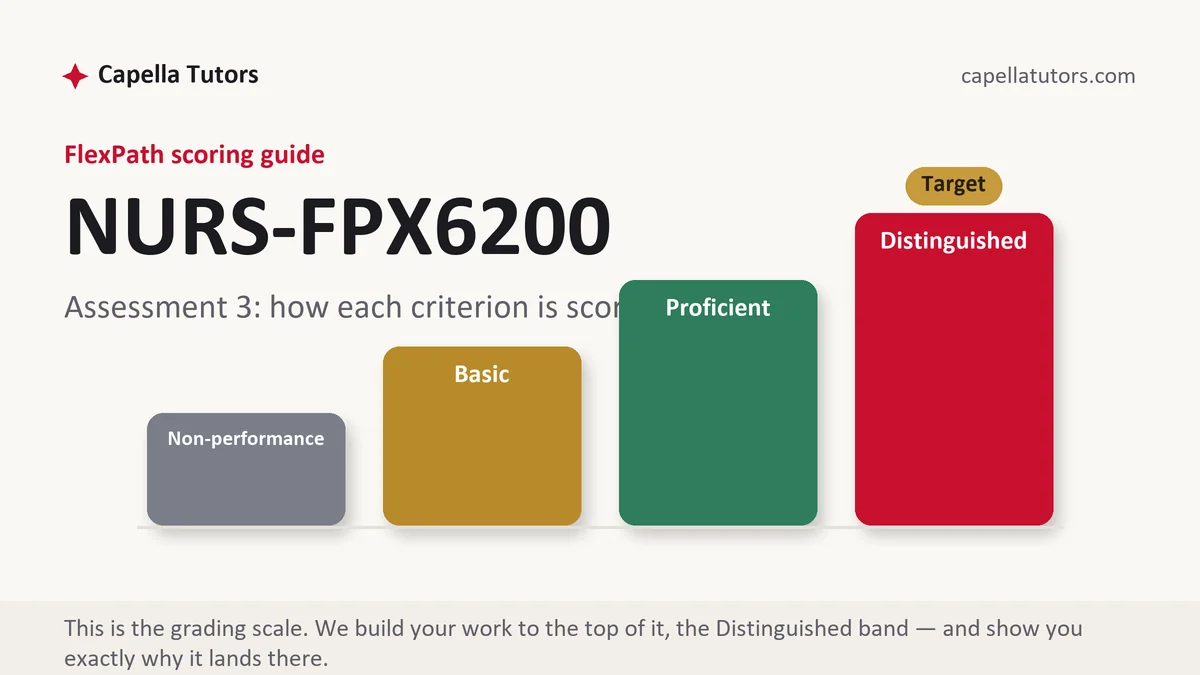
How NURS-FPX6200 Assessment 3 is scored
There is no averaging in FlexPath, so a plan is only as strong as its weakest criterion. Each one is placed on one of four levels, and on a strategic plan the levels turn on resourcing:
| Level | What it means on a strategic plan |
|---|---|
| Distinguished | The goal is measurable, the initiatives are costed with positions and hours, the sequence accounts for what has to happen first, and the plan is tested against the assumption most likely to be wrong. A committee could vote on it. |
| Proficient | A complete and coherent plan with figures attached. What holds it below the top is the absence of a stress test: nothing in the document says what happens if the central assumption moves. |
| Basic | A direction with initiatives listed beneath it and no resources named. This is the most common landing spot for a first submission, and it is a Basic that reads deceptively well. |
| Non-performance | A required component is missing, most often the evaluation plan or the financial implication, and a missing component takes its criterion to the floor regardless of the quality around it. |
Two conventions carry disproportionate weight in graduate work of this kind. State the assumptions under every projection, in the sentence that uses them, and give the reader the arithmetic rather than the conclusion. A plan asserting that converting agency labor will save well over a million dollars is a claim. The same plan showing the hours, the two rates, the difference, and the share of it you expect to capture in the first year is a finding, and it survives the one question a finance director always asks.
The NURS-FPX6200 Assessment 3 method, step by step
-
Write the goal as a number with a date on it
Reduce reliance on agency registered nurses in the medical division from thirty-one percent of worked hours to under ten percent within eighteen months. That sentence can be tracked in a payroll report every month. Improving workforce stability cannot be tracked at all, and a goal that cannot be tracked leaves the evaluation criterion nothing to attach to.
-
Choose two or three initiatives and reject the rest in writing
A plan is a set of choices, and the rejected option is part of the argument. Say why a twelve-month residency was chosen over a shift differential increase, or why an internal float pool was preferred to a second agency contract, and price the road not taken. Evaluators reward the refusal because it demonstrates that a comparison happened.
-
Cost each initiative in positions, hours, and dollars
Every initiative needs a one-time cost, an annual cost, and the benefit or avoided cost it produces, with each input sourced to a report, a published wage survey, or a declared assumption. Convert coverage into positions honestly, remembering that paid time off, orientation, and education hours mean a position covers considerably fewer productive hours than a calendar suggests.
-
Sequence the work against real dependencies
Recruitment precedes onboarding, onboarding precedes preceptor capacity, and preceptor capacity is the constraint nobody budgets for. Lay the initiatives on a timeline with the dependency named at each step, and state the capture rate you expect in year one rather than assuming the full annual benefit lands in month one. That single adjustment is what makes a savings figure credible.
-
Name the people who can stop this and what each of them wants
Finance controls the positions, human resources controls the requisition pace, the medical staff notices the coverage change, and the unit managers will carry the preceptor load. For each one, state the interest, the objection you expect, and the concession you are prepared to make. Reference the executive competencies published by the American Organization for Nursing Leadership where your guide asks you to locate the work in the role, and use peer-reviewed workforce research for anything causal.
-
Build the evaluation before the plan is finished
Pick measures the organization already produces, set the baseline value, state the review cadence and the forum, name the owner, and declare the threshold at which you would stop or reverse the initiative. A plan with a stopping rule reads as executive work; a plan that can only succeed reads as advocacy.
A structure that maps to the criteria
Word targets our tutors plan against for a strategic plan at this level, not Capella requirements; expand any section your guide weights more heavily.
| Section | What it must do | Guide |
|---|---|---|
| Purpose and goal | The problem restated in one sentence with its baseline, then the goal as a measurable result with a date. | ~200 words |
| Initiatives and alternatives | The two or three initiatives chosen, and the alternatives rejected with a stated reason and an approximate price. | ~320 words |
| Resources and financial implication | One-time and recurring costs, positions and hours, benefit or avoided cost, and the year one capture rate. | ~320 words |
| Sequence and dependencies | The timeline, what has to precede what, and the constraint most likely to move the dates. | ~200 words |
| Stakeholders and agreements | Who must approve, what each of them holds, the objection expected, and the concession available. | ~250 words |
| Evaluation, risk, and references | Measures with baselines and owners, the review forum and cadence, the stopping rule, and current APA both ways. | ~220 words |
Annotated sample excerpt
An original model excerpt from our team, written to the level the guide describes at the top. Take the moves, not the sentences.
The medical division currently covers the equivalent of eighteen and a half registered nurse positions with agency contracts. At the contracted one hundred and eighteen dollars an hour against a loaded core rate of sixty-eight, those thirty-eight thousand two hundred and seventy-two hours carry about four and a half million dollars, where core staff covering the same hours would carry about two and six tenths million, a gross annual difference near one million nine hundred thousand dollars.1 Conversion will not be instant, and the plan does not pretend otherwise: recruitment and onboarding of twenty-four nurses is sequenced across nine months, so year one is modeled at fifty-five percent capture, or roughly one million fifty thousand dollars, against one-time hiring and orientation costs of four hundred and ninety-seven thousand and a residency program running at one hundred and forty-five thousand a year.2 Year one therefore returns about four hundred and ten thousand dollars net and year two about one million seven hundred and sixty-nine thousand, and if the capture rate falls to forty percent the first year still clears its costs.3
- 1The arithmetic runs in the open, both rates are named, and the word gross signals that this is not yet the answer. Executives distrust a savings figure that arrives without its inputs, and evaluators grade the same instinct.
- 2The capture rate is the sentence that makes the whole projection credible. Naming the sequence that produces it, twenty-four hires across nine months, converts an assumption into a schedule anyone can question.
- 3The paragraph ends with a sensitivity test rather than a conclusion. Showing that the plan survives a worse assumption is the cheapest available demonstration of financial judgment, and it is rare in submitted work.
The full premium sample for your exact assessment, written fresh to your scoring guide and issue, is free to request. Study it, revise it into your own voice, and submit work you understand.
The five mistakes that cost Distinguished
- A goal that cannot be measured. Strengthening the workforce cannot be reported on. A percentage of worked hours with a date can be reported on every month.
- Initiatives with no price. An unresourced initiative is a preference. Positions, hours, and dollars are what turn a preference into a proposal a committee can vote on.
- Full annual benefit claimed in year one. Nothing lands in month one. A stated capture rate is the difference between a projection and a wish.
- No rejected alternative. If nothing was refused, no comparison happened, and the criterion asking you to evaluate options has nothing to grade.
- An evaluation plan with no owner and no stopping rule. Measures with no named owner are not monitored, and a plan that cannot fail cannot be evaluated.
Pre-submission checklist
- The goal written as a measurable result with a date and a baseline
- Two or three initiatives chosen, with the rejected alternative refused for a stated reason
- Every cost input sourced to a report, a published survey, or a declared assumption
- A year one capture rate stated, and a sensitivity test on the weakest assumption
- Stakeholders named with their interests, the expected objection, and your concession
- Measures with baselines, owners, a review forum, a cadence, and a stopping rule
Strategic plan due in 6200?
Send the prompt, the criteria, and whatever operational or financial figures you hold. We return a plan with the arithmetic on the page, a rejected alternative priced, a capture rate you can defend, and an evaluation section built from reports your organization already produces. Inside 24 to 48 hours, two independent reads including one devoted to the numbers, revisions free until the target column is yours.