This manual is for NURS-FPX6200 Assessment 2, start to submission. The second deliverable in NURS-FPX6200 usually asks for an analysis of a care setting before any plan is written: what the setting does well, what it is positioned to do, what it aspires to, and what results would prove the aspiration was met. Your scoring guide decides the framework and the format, and the graded skill sits underneath both. An executive analysis of a setting is an argument about where the organization stands, carried by figures the organization already reports and by an honest reading of what it cannot presently do. Below is the method our tutors use, a criterion-mapped structure, and an annotated excerpt. Prefer it handed off? A premium original sample lands in 24 to 48 hours with free revisions until your guide is satisfied. Your courseroom may print this as NURS FPX 6200 Assessment 2 or NURS6200 Assessment 2; it is the same deliverable, and NURS-FPX6200 Assessment 2 is what this manual walks through.
One honesty note before the manual: Capella revises courses and scoring guides over time, so always write to the exact scoring guide attached to your assessment in the courseroom. The course identity above is verified on capella.edu; the method and structure below are our tutors' approach to it, not Capella's official rubric text.
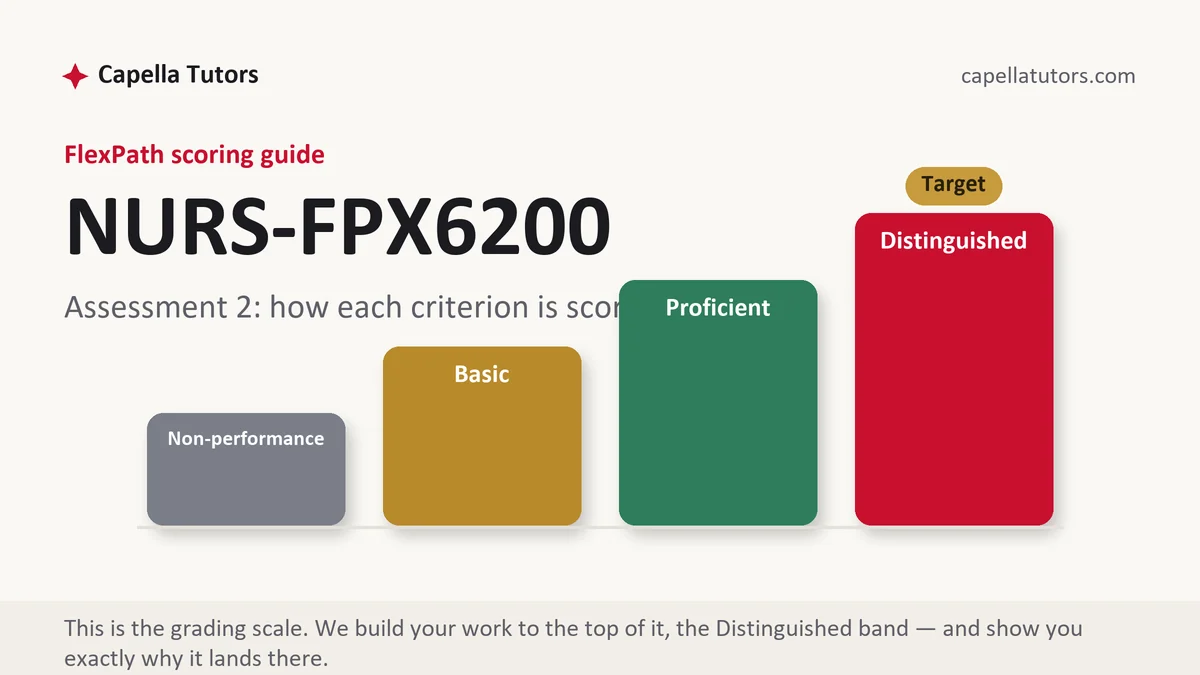
How NURS-FPX6200 Assessment 2 is scored
Nothing in FlexPath is averaged into a grade. Each criterion sits at one of four levels on its own, and on an analysis of a care setting the levels sort description from diagnosis:
| Level | What it means on a care setting analysis |
|---|---|
| Distinguished | The setting is characterized with reported data, the strengths are evidenced rather than claimed, and the aspiration is paired with a result that would confirm it. Strategic position is inferred from figures the reader can check. |
| Proficient | The analysis covers every required element accurately and reads as a competent internal summary. What is missing is the inference: the figures are present but they are not made to argue. |
| Basic | A tour of the department. Services listed, staff counted, culture praised, and no reader could say from the page whether the setting is gaining ground or losing it. |
| Non-performance | A required element of the framework is absent, or the analysis describes a setting with no data of any kind attached to it. |
One habit separates the top column here, and it is cheap to adopt: source the benchmark rather than asserting it. A sentence claiming a length of stay is high is an opinion. The same sentence carrying a reported peer group median, a state agency figure, or a published national average becomes a finding. Master's evaluators check the comparison point before they check the conclusion, because the comparison point is what makes an analysis auditable.
The NURS-FPX6200 Assessment 2 method, step by step
-
Fix the unit of analysis before the first paragraph
Decide whether you are analyzing a nursing unit, a service line, or an organization, and hold that boundary throughout. Analyses drift upward when the data gets thin, so a paper that opens on an orthopedic service line and ends discussing the health system has usually run out of figures. Name the boundary in your first section and state what sits outside it.
-
Assemble the numbers the setting already reports
Volume, case mix, payer mix, average length of stay, contribution margin if you can get it, vacancy rate, turnover, hours per patient day, and the quality measures the setting is publicly accountable for. Ask your preceptor for the monthly operations packet rather than for individual figures; the packet is a single request and it usually holds everything the analysis needs.
-
Evidence each strength instead of asserting it
A strength in an executive document is a capability the organization can demonstrate and a competitor would struggle to copy. Certification, surgeon retention, a nurse turnover figure below the regional median, a block schedule that runs at target: each of those can be shown. Culture, teamwork, and dedication cannot, and a strengths section built from them reads as staff morale writing rather than analysis.
-
Read the external environment as a set of constraints, not a background
Payer mix movement, referral patterns, competitor capacity, state licensure and scope rules, and the direction of payment policy are the conditions your later plan has to survive. Use primary sources for the payment side, since Centers for Medicare and Medicaid Services program rules and public reporting documentation define what the setting is actually paid and penalized on, and secondary summaries of those rules age badly.
-
State the aspiration as a result, then attach the measure
Aspirations are graded on testability. Becoming a regional leader in joint replacement is not a result; performing four hundred and eighty primary joint replacements a year at a contribution margin above five thousand dollars a case, with a readmission rate at or below the peer median, is. Write the aspiration, then the measure, then the reporting source that will carry the measure, and the criterion asking for results has been answered before it is asked.
-
Declare every assumption you had to make
You will estimate something. Say so in the sentence where you use it, with the basis: a per case contribution taken from the service line packet, a wage rate taken from a published survey, a volume projection built on the last eight quarters. Declared assumptions read as competence in master's work. Undeclared ones read as invention, and one of them can pull down the whole evidence criterion.
A structure that maps to the criteria
Planning targets from our tutors for an analysis of this kind, not Capella rules; follow your own guide where it asks for more or less.
| Section | What it must do | Guide |
|---|---|---|
| The setting and its boundary | The care setting described operationally, with volume, case mix, staffing model, and an explicit statement of what the analysis excludes. | ~250 words |
| Current performance | The figures the setting reports, each against a sourced comparison point, with the reporting period stated. | ~300 words |
| Demonstrable strengths | Capabilities the setting can evidence, each tied to a figure, a certification, or a documented result. | ~250 words |
| External conditions | Payer mix movement, payment policy direction, referral and competitor conditions, and regulatory constraints, from primary sources. | ~280 words |
| Aspiration and results | Where the setting intends to be, expressed as a result, with the measure and the report that will carry it. | ~250 words |
| Assumptions and references | Every estimate declared with its basis, and current APA citations matched in both directions. | ~120 words |
Annotated sample excerpt
An original model excerpt from our team, at the altitude the top of the guide is describing. Learn the moves and write your own version.
The orthopedic service line performed six hundred and twelve primary joint replacements in the twelve months to June, a volume that has moved less than two percent across eight quarters, while its payer mix has moved considerably: commercially insured cases fell from forty-six percent to thirty-four percent as Medicare Advantage enrollment in the two counties the line draws from rose.1 On the service line packet, a commercial primary replacement contributes about six thousand nine hundred dollars and the equivalent case under the dominant Medicare Advantage contract contributes about two thousand one hundred and fifty, so the seventy-three cases that changed payer carry roughly three hundred and forty-seven thousand dollars of annual contribution with them, on flat volume and unchanged clinical performance.2 The line is therefore not underperforming clinically; it is being repriced, and the strengths worth defending in the next section are the ones that hold value at the lower rate, principally a same-day discharge pathway that already covers fifty-eight percent of primary cases.3
- 1Volume and payer mix are reported for the same period, so the reader can see that one moved and the other did not. Naming the reporting window is what makes the comparison legitimate rather than convenient.
- 2The arithmetic is shown in the sentence, with the source of each rate named. Twelve points of six hundred and twelve cases is about seventy-three cases, and the difference between the two contribution figures prices them. A reader can audit every step, which is precisely what the analysis criterion asks for.
- 3The paragraph reaches a diagnosis and then points the rest of the paper at it. Repricing and underperformance call for different responses, and saying which one you are looking at is the move that separates the top level from a competent summary.
The full premium sample for your exact assessment, written fresh to your scoring guide and issue, is free to request. Study it, revise it into your own voice, and submit work you understand.
The five mistakes that cost Distinguished
- A benchmark with no source. Calling a figure high or low without a reported comparison point turns a finding back into an impression, and it is the single most common evidence failure in this deliverable.
- Strengths taken from the staff survey. Dedication and teamwork cannot be verified by a reader. A certification, a retention figure, or a pathway compliance rate can.
- Drift in the unit of analysis. A paper that starts on one service line and finishes on the health system has changed the subject, and every comparison in it stops meaning the same thing.
- The external section written as background. Payment policy and payer mix are constraints your later plan must survive, not scenery. If nothing in the analysis narrows the options, the section is decorative.
- Aspirations with no measure. Excellence and leadership cannot be confirmed or refused. A volume, a margin, and a reported quality result can all be checked next June.
Pre-submission checklist
- The unit of analysis stated once and held for the whole paper
- Every performance figure carries a reporting period and a sourced comparison point
- Each claimed strength tied to evidence a reader outside the organization could verify
- Payment and regulatory conditions taken from primary sources rather than summaries
- The aspiration expressed as a result, with the measure and the report that will carry it
- Every estimate declared with its basis, and citations matched both ways in current APA
Analyzing a care setting this week?
Send the prompt, the scoring guide, and whatever operational figures you can share without identifying anyone. We build the analysis around your setting, source every comparison point, show the arithmetic in the prose, and declare each assumption where it is used. Back inside 24 to 48 hours, two independent reads, revisions free until the column you wanted is the column you got.