We write premium samples for the assessments in NURS-FPX6100, decode your scoring guide criterion by criterion, and hand the work back in 24 to 48 hours with revisions until you hit your target. The course is NURS-FPX6100, The Role of Nurse Educators, worth 2 program points inside the Nursing Education specialization of Capella's FlexPath MSN. That program totals 27 points and runs on submit-on-grade timing, so a course closes the moment its last criterion lands, not when a term ends. Nursing Education is a four-course specialization, and 6100 is the one that argues who you are becoming rather than what you will build.
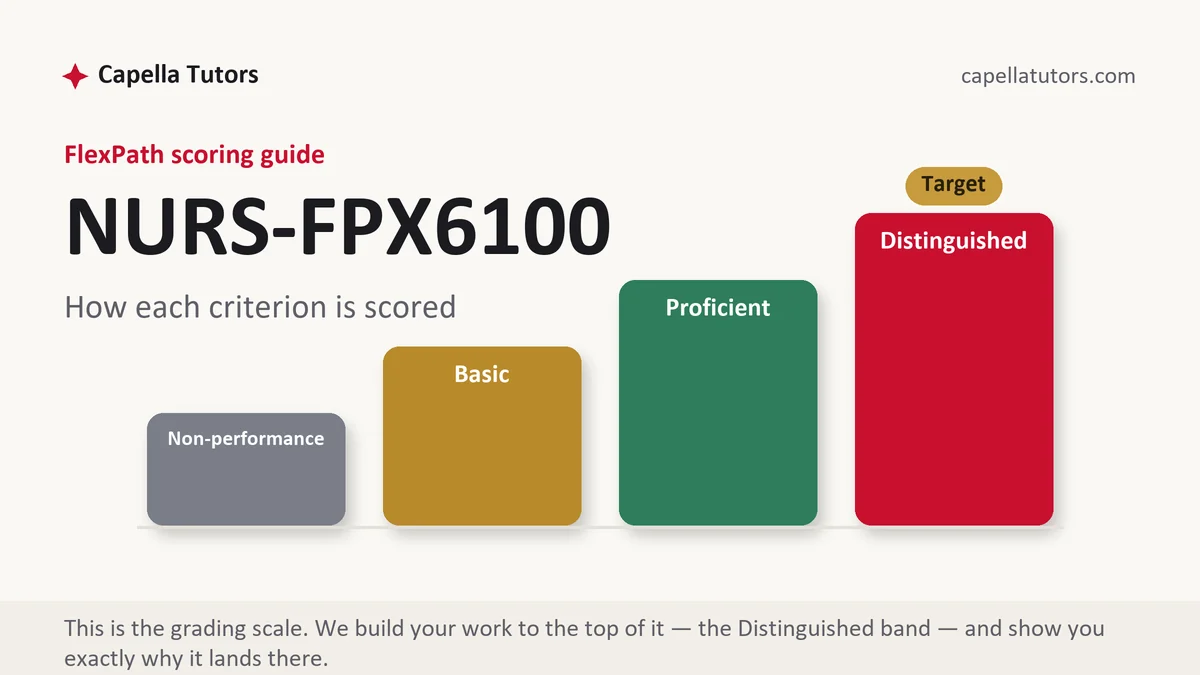
What NURS-FPX6100 actually grades
This course grades a role, not a subject. The writing asks you to describe what a nurse educator does, in a setting you can name, with the competencies of that role treated as a checklist you argue against rather than a list you recite. Two settings dominate the assessments in 6100: academic teaching, meaning prelicensure or graduate faculty work inside a school of nursing, and staff development, meaning the clinical educator, nurse residency coordinator, or professional practice development role that lives inside a hospital. The criteria almost always reward picking one and staying there. A paper that drifts between a community college classroom and a med-surg unit loses the specificity that separates the top two columns.
Three obligations show up again and again in the criterion language. Teaching, which the scoring guides read as more than lecturing, since it covers course design, clinical instruction, and evaluation of learners. Scholarship, which at master's level usually means using and disseminating evidence rather than generating it, and which learners routinely undersell. Service, which means committee work, curriculum groups, professional organization involvement, and the institutional citizenship that faculty appointments carry. Writing that names all three and shows how they compete for the same forty hours reads as informed. Writing that mentions teaching only reads as a student guessing.
The fourth thread is socialization, and it is the one that most often decides your score. The assessments in 6100 tend to ask how learners are brought into the profession: how a novice becomes competent, what a preceptor transmits that no syllabus contains, how incivility or exclusion damages a cohort. Distinguished work treats socialization as something the educator engineers deliberately. Basic work describes it as something that happens.
How we help in this course
Our nursing writers on this desk have held both sides of the role, bedside preceptor and classroom instructor, which matters here because 6100 punishes abstraction faster than any other course in the specialization. A draft from us names the setting in the first paragraph, anchors the role analysis to a competency framework, and keeps the self-assessment sections honest instead of promotional. Faculty in this course read a lot of writing about passion for teaching; they score writing about role components, evidence, and gaps.
The process is the same one behind every order here. Your scoring guide goes to a research analyst who maps each criterion to a section before anyone writes. A subject-matched writer drafts. The work passes scoring-guide QA, then APA and originality QA. Delivery lands inside 24 to 48 hours, and the revise-until-target guarantee covers whatever the evaluator sends back. Send the courseroom instructions and the scoring guide together, because in 6100 the two documents ask for noticeably different things and the criteria win.
Sitting in NURS-FPX6100 right now?
Send the assessment number with your scoring guide attached. The opening sample is on the house and turns around in 24 to 48 hours.
The assessments, one by one
Assessment 1
Send the scoring guide and we build the practicum planning document with you, the site, the mentor, the project, the objectives, and the call record, returned in 24 to 48 hours and revised free until your faculty signs it. Read the full Assessment 1 manual.
Assessment 2
Hand us the assessment and you get a premium original sample written to your scoring guide in 24 to 48 hours, revised free until the criteria clear. Read the full Assessment 2 manual.
Assessment 3
We build this one to your scoring guide and return it in 24 to 48 hours, revised free until every criterion clears. Read the full Assessment 3 manual.
Assessment 4
We build the slides and the speaker notes together, to your scoring guide, back in 24 to 48 hours with free revisions until the criteria clear. Read the full Assessment 4 manual.
Assessment 5
Send the scoring guide and we build the plan, the gap analysis, the goals, the timeline, and the evaluation, returned inside 24 to 48 hours and revised free until the criteria clear. Read the full Assessment 5 manual.
How to actually write NURS-FPX6100: where to begin
Open the scoring guide before the instructions. Copy every criterion into an empty document and make each one a heading, verb included. The instructions give you a scenario; the criteria are what gets marked. In 6100 the criteria usually cluster around four jobs: describe the educator role in a defined setting, analyze the competencies that role requires, explain how learners are socialized into nursing, and account for your own transition into teaching. If a criterion reads analyze the scholarship expectations of the nurse educator role, that sentence becomes a heading and nothing but scholarship goes underneath it.
Then choose your setting, on paper, in one sentence, before you draft. Write it as a place with numbers attached: a 24-bed telemetry unit that hires eight new graduates a year, or an associate degree program with two clinical sections of ten students. Specificity here does most of the work of the top column, because every later claim can be tested against it. Learners who skip this step end up writing about nurse educators in general, and general is exactly what the Basic descriptions describe.
Next, inventory your own teaching, which you have more of than you think. Precepting counts. Charge shift teaching counts. Annual competency validation, skills fairs, orientation classes, teaching a family how to manage a drain, all of it counts. Write down four encounters, the learner, the content, what you did, and what went wrong. Those four episodes become the evidence you attach to competency claims, and they are the reason a 6100 paper sounds like a nurse instead of a textbook. Keep the failures in. The transition criteria specifically reward recognizing that clinical expertise does not make you a competent teacher, and a paper with no admitted weakness reads as unexamined.
Anchor the competency sections in a published framework rather than your instincts. The NLN core competencies for nurse educators are the natural spine, since they are written as educator behaviors, facilitating learning, facilitating learner development and socialization, using assessment and evaluation strategies, participating in curriculum design, functioning as a change agent, pursuing continuous quality improvement in the role, engaging in scholarship, and functioning within the institution. Take three or four, not all eight, and argue each against your setting. Distinguished work says which competency you already hold, which you lack, and what closing the gap would take.
| Section | What goes in it | What Distinguished looks like |
|---|---|---|
| Setting and role definition | The specific school or clinical unit, the learners in it, and the educator role as it exists there. | The setting carries numbers and constraints, so every later claim can be checked against a real place. |
| Competencies of the role | Three or four named competencies from a published framework, each applied to your setting. | Each competency is judged, held or missing, with the development step named rather than promised. |
| Socialization of learners | How novices are brought into professional practice where you work, formally and informally. | Socialization is treated as designed, with the hidden curriculum and incivility risks named honestly. |
| Scholarship and service | What the role expects beyond teaching, and how those expectations conflict with the teaching load. | Master's level scholarship is defined accurately as evidence use and dissemination, not original research. |
| Role transition and development plan | Your move from clinician to educator, with specific preparation and mentoring. | The plan has a timeline, a mentor, and a measurable checkpoint, and it cites transition literature. |
Developing the synthesis
The verbs in this course are analyze and evaluate, and evaluators read them literally. Stacking source summaries is what earns Basic. The reliable move is to put two studies that disagree in the same paragraph and settle the argument yourself. Transition literature is full of useful disagreement: some studies find that expert clinicians who move into faculty roles report satisfaction and confidence within a year, others document reality shock, salary loss, and attrition inside the first two. Both can be true, and the interesting question is which one describes your setting. Adjudicate by design and population, a multi-site survey of faculty across program types is stronger evidence than a single-school qualitative study, but the qualitative work may match a small staff-development role far better. Then say what the evidence cannot settle, whether formal teaching preparation prevents the shock or merely delays it, and the top column is already yours. Naming your own limitation is not weakness in FlexPath scoring, it is the criterion.
Citations that survive faculty review
Evidence usually carries its own criterion here, so treat citation work as content rather than formatting. The working rules: peer-reviewed sources from roughly the last five years, an author and date on every factual claim, every in-text citation matched in the reference list and nothing in the list left uncited. Place the citation inside the sentence doing the analytical work, not stapled to the end of a paragraph. Give every source a job tied to a specific criterion, because a source with no job is padding an evaluator can see. Search through the Capella library, CINAHL, and PubMed for the peer-reviewed spine, and pull the standards layer from the NLN, the AACN Essentials, and QSEN competencies where the teaching content is safety or quality. Cite those as organizational reports in APA 7 form, with the organization as author. Standards documents support the role sections; they do not substitute for the research spine the analysis criteria want.
The mistakes that land Basic instead of Distinguished
- Writing about nurse educators in the abstract, with no named school, unit, or learner group anywhere in the paper.
- Treating the role as teaching only, then losing the scholarship and service criteria by omission.
- Describing socialization as something that happens to students instead of something the educator designs.
- Self-assessment that reports only strengths, which reads as unexamined and drops the transition criteria a full column.
- Listing NLN competencies without applying any of them, the single most common revision trigger in this course.
NURS-FPX6100 questions students actually ask
Do I need to already work as a nurse educator?
No, and most learners in the course do not. Precepting a new graduate, running competency day on your unit, or orienting travelers all supply the teaching encounters the criteria want described. What you cannot do is write from no setting at all. Pick one place where learning happens around you, name it, and let every section stay inside it.
Which competency framework should I anchor to?
The NLN core competencies for nurse educators carry the role sections cleanly, because they are written as educator behaviors rather than student outcomes. Add the AACN Essentials when your setting is prelicensure or graduate faculty work, and QSEN when the teaching in question is safety or quality content. Name the framework in the sentence that uses it, then apply the competency to something you did.
How much of this should be written in first person?
Use first person where a criterion asks you to assess your own readiness, and third person everywhere the criterion asks you to analyze the role. The role transition section is where I belongs, since the whole point is that expertise in one job does not transfer to the other. Self-assessment without evidence still scores Basic, so tie each admission to a competency and a source.