This manual is for NURS-FPX6100 Assessment 5, start to submission. Send the scoring guide and we build the plan, the gap analysis, the goals, the timeline, and the evaluation, returned inside 24 to 48 hours and revised free until the criteria clear. Assessment 5 of NURS-FPX6100 usually asks for a professional development plan for your own move into the nurse educator role, built from a competency self-assessment rather than from ambition. The criteria reward a plan someone else could hold you to: dated, resourced, and measurable. What follows is the method, a structure taken from the criterion language, and an annotated sample excerpt. Your courseroom may print this as NURS FPX 6100 Assessment 5 or NURS6100 Assessment 5; it is the same deliverable, and NURS-FPX6100 Assessment 5 is what this manual walks through.
One honesty note before the manual: Capella revises courses and scoring guides over time, so always write to the exact scoring guide attached to your assessment in the courseroom. The course identity above is verified on capella.edu; the method and structure below are our tutors' approach to it, not Capella's official rubric text.
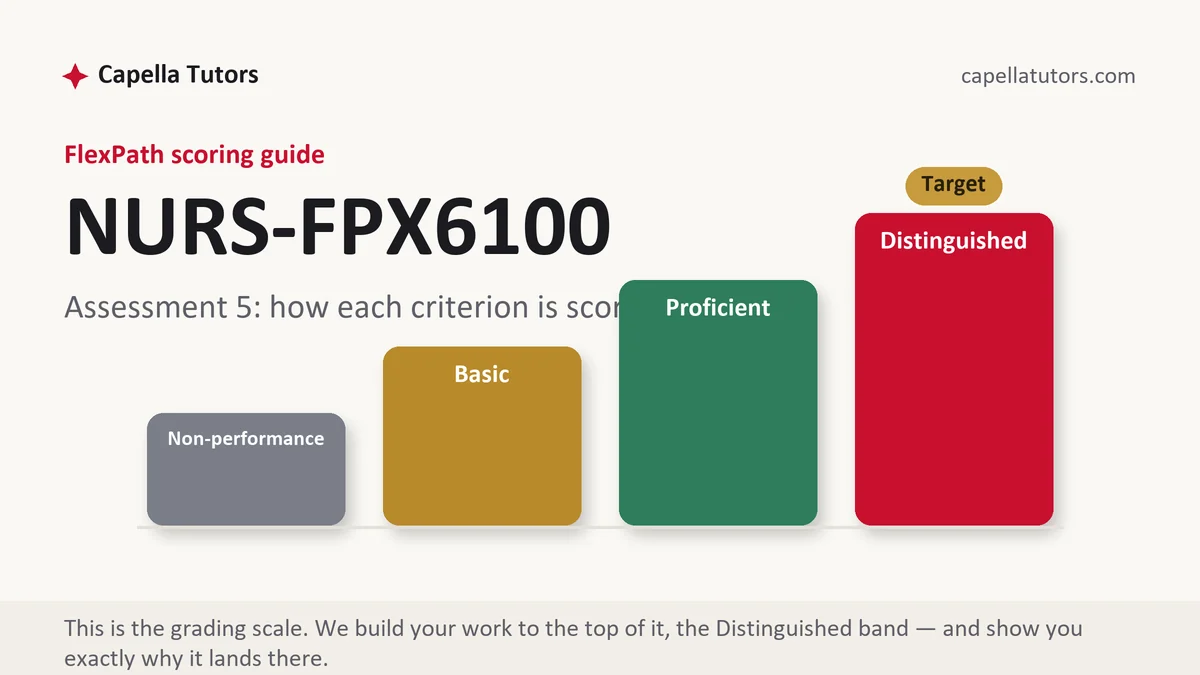
How NURS-FPX6100 Assessment 5 is scored
Each criterion in your guide lands on one of four levels, and the top level is always described in the criterion itself:
| Level | What it means on a professional development plan |
|---|---|
| Distinguished | The gap analysis scores every competency against a published framework with evidence for each rating, the goals are measurable and dated, the resources are named with real costs and hours, and the plan says how it will be revised when a goal slips. |
| Proficient | A credible plan with defensible goals and appropriate resources. The self-assessment reports ratings without the evidence behind them, which is the gap between the top two columns. |
| Basic | A statement of career intentions with a list of courses and conferences, no baseline, no measures, and no dates that anyone could check. |
| Non-performance | A required element is absent, most often the evaluation of the plan itself, or the self-assessment is not tied to any framework at all. |
The word doing the work in this assessment is measurable. A goal to become more confident teaching cannot be evaluated. A goal to sit the certified nurse educator examination by a stated date, having completed a specified number of documented teaching hours and a review course, can be evaluated by anyone holding the plan.
The NURS-FPX6100 Assessment 5 method, step by step
-
Turn the criteria into the plan's own sections
This deliverable has a natural shape, which is exactly why learners write it from habit and lose criteria. Build the section list from your guide instead. Where a criterion asks you to evaluate your development needs, the section reaches a judgment about which needs come first and why, not just a list of them.
-
Score yourself against a published framework, with evidence
Take the NLN core competencies for nurse educators, or the professional development scope and standards if your setting is a hospital, and rate each competency on a simple scale. Then attach evidence to each rating: the module you built, the evaluations you have never analyzed, the curriculum meeting where you had nothing to say. A rating with evidence behind it is a finding; a rating on its own is an opinion.
-
Rank the gaps by consequence, not by comfort
You cannot close eight competencies at once, so order them. The competency whose absence most damages learners comes first, which for most learners moving from bedside to teaching is assessment and evaluation rather than presentation skill. Say why you ordered them that way. Justified prioritization is frequently the criterion that separates Proficient from Distinguished here.
-
Write two or three goals that a stranger could verify
Each goal needs a verb, a measure, a date, and a source of verification. Complete a graduate level measurement course by December and submit a blueprinted 40 item examination reviewed by two content experts is verifiable. Improve my test writing is not. Two or three real goals beat six aspirational ones, and the criteria reward depth here rather than volume.
-
Resource the plan honestly, in money and hours
Name the resources: a certification review course and its fee, tuition reimbursement caps, a mentor with a title and an agreed meeting cadence, protected time you would have to negotiate and from whom. Cite the mentoring and role transition literature where it supports the structure. A plan with no costs reads as a wish, and evaluators price these things quickly.
-
Build in evaluation and a revision rule
Say how you will know each goal was met, when you will check, and what you will do when one slips. A quarterly review against the competency ratings, a mentor sign off, and a stated fallback if a course is cancelled turns a static document into a plan. This is the criterion most often left off entirely, and a missing element scores below a weak one.
A structure that maps to the criteria
Planning targets our tutors use for a development plan of this shape rather than Capella rules; weight the sections the way your scoring guide does.
| Section | What it must do | Guide |
|---|---|---|
| Introduction and role target | The educator role you are moving toward, the setting, and the timeframe the plan covers. | ~150 words |
| Competency self-assessment | Every competency in a named framework rated, with the evidence supporting each rating. | ~300 words |
| Prioritized gap analysis | The gaps ranked by consequence for learners, with the ordering justified from the literature. | ~250 words |
| Development goals | Two or three goals, each with a measure, a date, and a source of verification. | ~250 words |
| Resources, mentoring, and costs | Courses, fees, protected time, and a named mentor with an agreed cadence. | ~250 words |
| Evaluation and revision | Checkpoints, who reviews, the threshold for success, and the rule for a goal that slips. | ~200 words |
| References | Current APA, with the competency framework and transition literature cited properly. | as needed |
Annotated sample excerpt
This model paragraph comes from our writers and sits where the guide's top description points. Learn the pattern, then build the plan around your own gaps.
Rating myself against the educator competency set, the weakest domain is assessment and evaluation, and the evidence is specific: the pharmacology unit I revised for the college's evening cohort last term produced a 46 percent failure rate on one exam, and I had no blueprint to check whether the items matched what I taught.1 I am ranking that gap first, ahead of my thinner presentation skills, because a weak lecture costs learners time while an unmapped examination costs them a course and the program a defensible record.2 The goal therefore reads: by the end of the spring term, complete a graduate measurement course, blueprint the pharmacology examination against the revised objectives, and submit both the blueprint and the item analysis to my department chair for review.3
- 1Attaches a number and an artifact to the self-rating, so the gap is documented rather than confessed. Evidence behind each rating is what the analysis criterion is looking for.
- 2Justifies the ranking by consequence to learners and to the program, which answers the prioritization criterion instead of listing needs in the order they came to mind.
- 3Writes the goal with a verb, a deliverable, a date, and a named reviewer, which is what makes it verifiable by someone other than the writer.
The full premium sample for your exact assessment, written fresh to your scoring guide and issue, is free to request. Study it, revise it into your own voice, and submit work you understand.
The five mistakes that cost Distinguished
- A plan with no baseline. Goals that do not come from a scored self-assessment have nothing to be measured against and cannot satisfy the evaluation criterion.
- Ratings without evidence. Marking yourself competent in curriculum design with nothing attached reads as an opinion, and evaluators treat it as one.
- Six goals instead of two. Volume signals that none of them will be done, and the depth criteria reward the opposite.
- Free resources only. A plan with no fees, no tuition question, and no protected time to negotiate has not met the institution it lives inside.
- No revision rule. A plan that cannot absorb a cancelled course or a mentor's departure is a document rather than a plan, and the criterion notices.
Pre-submission checklist
- Target educator role and timeframe named in the opening
- Every competency in a published framework rated, each rating carrying its evidence
- Gaps ranked by consequence, with the ranking justified rather than asserted
- Two or three goals, each with a measure, a date, and a named verifier
- Resources costed in money and hours, mentor named with an agreed cadence
- Checkpoints, thresholds, and a written rule for what happens when a goal slips
Want a development plan your faculty cannot push back on?
Send the scoring guide and be honest with us about where you are weakest as a teacher. We score the competency set with you, rank the gaps by consequence, and build goals with dates, costs, and verifiers attached. Delivered inside 24 to 48 hours, revised until your target is met, and the opening sample costs nothing.