Hand us the technology assessment you are facing and you get a premium sample built to your scoring guide, back within 24 to 48 hours, revised free until the criteria clear. This is NURS-FPX6112, Technology Integration for Nursing Education, carrying 2 program points in the Nursing Education specialization of Capella's FlexPath MSN. The program totals 27 points and grades every criterion from Non-performance up to Distinguished, with no term deadline forcing your hand. Among the four specialization courses, 6112 is the one where a good idea about teaching has to survive contact with hardware, licenses, and learners on night shift.
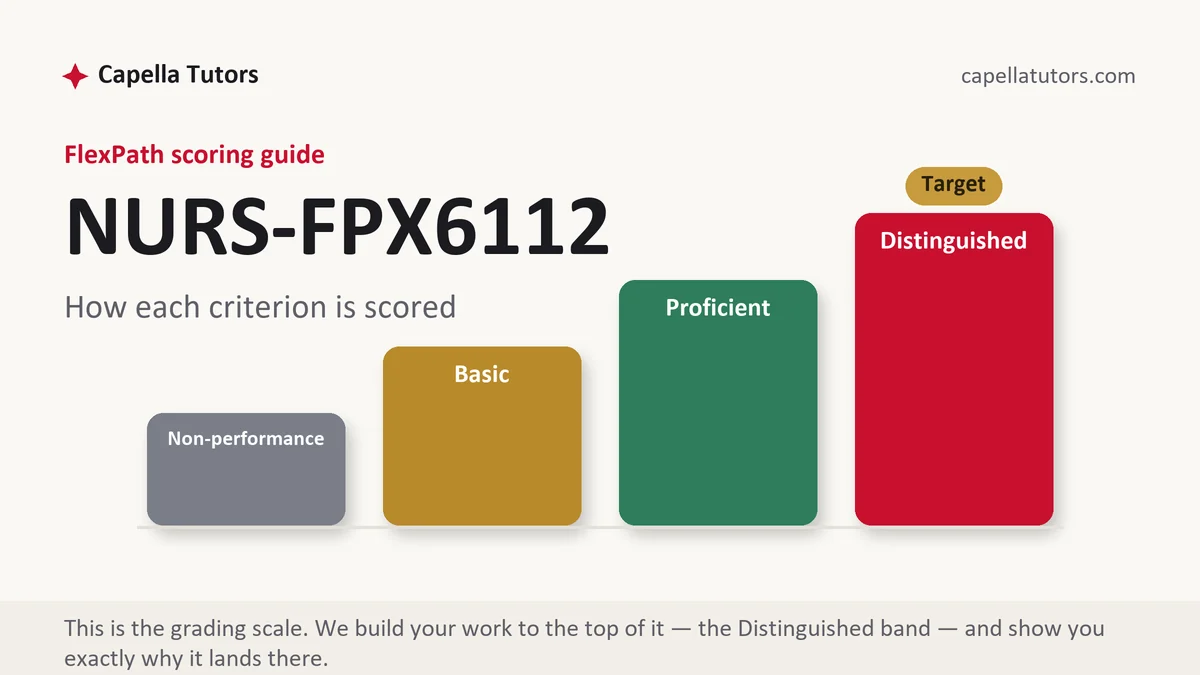
What NURS-FPX6112 actually grades
The subject is teaching technology, and the criteria are less interested in the tool than in your reasoning about it. Assessments in this course generally put a learning problem in front of you and ask what technology belongs there, why, how you would deploy it, and how you would know afterward whether learning improved. Candidates for the technology itself are ordinary: a mid or high fidelity manikin in a skills lab, a virtual patient or unfolding case platform, the learning management system your program or hospital already pays for, screen-recorded lectures, an audience response tool, a video-recorded return demonstration.
The scoring split is easy to describe and easy to fall into. Basic writing gives a feature tour, the manikin's capabilities, the modules the platform includes, the reports the system can generate. Distinguished writing starts with the learning problem and treats the tool as a means: this is the objective, this is where learners fail it, this is the affordance that addresses the failure, and here is what the evidence says about it. Pedagogy leads and technology follows, in that order, in every section.
Two criteria in this course get abandoned more than any others, and both are expensive. Accessibility is one, since captions, keyboard navigation, and contrast are treated by the scoring guides as a design obligation rather than a courtesy. Evaluation of learning impact is the other, because most learners reach for satisfaction data, and satisfaction is not learning. A skipped criterion scores Non-performance, which is a full level below the Basic you would get for writing something weak, so write something for every column.
How we help in this course
Our writers on this desk have run simulation days and built modules inside real learning systems, which shows up in the practical detail this course rewards: faculty preparation time, learner orientation, who fixes it at 0300, what happens to the scenario when the manikin's wireless drops. A draft from us keeps the learning problem in front, argues the tool against a specific objective, handles accessibility as its own section with concrete checks rather than a sentence of goodwill, and closes with an evaluation design that measures knowledge or performance rather than mood.
The machinery is the studio standard. A research analyst breaks your scoring guide into a section plan, a subject-matched writer drafts, and the work clears scoring-guide QA before APA and originality QA. You get it inside 24 to 48 hours and revisions run until you hit your target, with the first premium sample free. Tell us which technology you have real access to when you send the order, because the difference between a draft about a tool you use and one about a tool you read about is visible in the top column.
Stuck on a NURS-FPX6112 assessment?
Send the scoring guide and the technology you can actually get your hands on. First sample on us, returned inside 24 to 48 hours.
The assessments, one by one
Assessment 1
Send the scoring guide and we build the setup document with you, the site, the mentor, the technology you can actually reach, the objectives, and the minuted call, back inside 24 to 48 hours with revisions until it clears. Read the full Assessment 1 manual.
Assessment 2
Hand it over and you get a premium original sample written to your scoring guide in 24 to 48 hours, revised free until the criteria clear. Read the full Assessment 2 manual.
Assessment 3
Send the scoring guide and we build the comparison, the criteria, the evidence, the costs, and the recommendation, returned in 24 to 48 hours with revisions until every criterion clears. Read the full Assessment 3 manual.
Assessment 4
Send the scoring guide and we build the implementation plan, the timeline, the faculty development, the accessibility work, the budget, and the evaluation, back inside 24 to 48 hours with revisions until the criteria clear. Read the full Assessment 4 manual.
How to actually write NURS-FPX6112: where to begin
Read the scoring guide first and build your outline from its criteria, one heading each, verbs intact. The instructions supply the scenario, the criteria supply the grade, and in 6112 they diverge more than usual because the scenario tends to be about a tool while the criteria are about teaching. Expect the criteria to cover four or five jobs: define the learning need and setting, select and justify a technology, plan the integration, address accessibility and equity, and evaluate the effect on learning.
Write the learning problem before you name any product, in one sentence, with a number in it. Six of ten new graduates missed early sepsis recognition on their check-off. Third-semester students pass the pharmacology exam and still cannot titrate a drip at the bedside. Staff completed the restraint module and restraint documentation errors did not fall. A numbered problem gives every later paragraph something to be accountable to, and it is the difference between a technology plan and a technology wish.
Then argue fit, which is the intellectual core of the course. Match the tool's affordance to the cognitive or psychomotor level of the objective. Psychomotor skill needs repetition on equipment, so a manikin or task trainer earns its place. Clinical reasoning under uncertainty needs a case that unfolds and reacts, so a virtual patient or a live scenario beats any video. Straight recall of drug classes does not need a simulation suite at all, it needs spaced retrieval practice, and the learning system you already own can schedule that for free. The strongest move available to you is naming a mismatch out loud: a program that bought high fidelity manikins to teach content recall spent money on the wrong affordance, and saying so, with evidence, is the analysis the criteria are hunting for.
Plan the integration like someone who has to be in the room. Faculty development comes first, since a tool nobody was trained on gets used as a very expensive slide projector. Then learner orientation, so the first session is not spent on logins. Then the support path, named by role. Then the failure plan, because equipment dies and networks drop and the scenario still has to teach something. For simulation specifically, put prebriefing and structured debriefing in writing, since the debrief is where the learning is consolidated and skipping it turns an expensive scenario into an anecdote. Accessibility gets its own working checklist: captions and transcripts on anything with audio, alternative text on images, keyboard navigation and labeled controls for screen readers, contrast that survives a bright classroom, and no meaning carried by color alone. Anchor that section in Section 508 and the WCAG guidelines, then extend it into equity, bandwidth at home, shared devices, and whether a night shift nurse can complete the module at all.
| Section | What goes in it | What Distinguished looks like |
|---|---|---|
| Learning problem and setting | The objective learners are failing, the setting, and the numbers that show the gap. | The problem is quantified and traced to an objective, so the technology has something to be measured against. |
| Technology selected and fit | The tool, its relevant affordances, and why those match this objective's level. | An alternative is considered and rejected on pedagogical grounds, with evidence on both options. |
| Integration plan | Faculty preparation, learner orientation, support roles, timeline, and cost or licensing reality. | Prebriefing, debriefing, and a documented plan for the session where the equipment fails. |
| Accessibility and equity | Captions, transcripts, alt text, keyboard access, contrast, plus bandwidth and device assumptions. | Specific standards named and applied to this tool, with one honest barrier identified and remediated. |
| Evaluation of learning impact | What you will measure, with which instrument, when, and against what threshold. | Knowledge or performance data with a retention point, and satisfaction handled as weak secondary evidence. |
Developing the synthesis
The analysis criteria in this course want sources put in conflict, not lined up in agreement. Simulation research obliges. Some studies credit high fidelity manikins with better clinical judgment scores than lower fidelity equivalents, while others find the fidelity difference washes out once debriefing quality is controlled, which points at the debrief rather than the equipment as the active ingredient. Put those findings in the same paragraph and rule on them. Weigh design first, a multi-site randomized comparison carries more than a single-cohort pre and post study, then weigh setting, because a study of prelicensure students may not transfer to experienced staff in a hospital residency. Then state the limit of what is known, whether the gains survive six months without repeated exposure, and the top column is in reach. Learners lose this criterion by summarizing five simulation studies in a row and never deciding anything.
Citations that survive faculty review
Treat sourcing as part of the design argument, because evidence is usually scored separately here. Peer-reviewed work from roughly the last five years, tighter than that where a platform's capabilities are the point, since a study of a learning system from a decade ago describes software that no longer exists. Author and date on every factual claim, every citation matched in the reference list, nothing in the list uncited, and the citation placed inside the sentence carrying the reasoning. Run searches in the Capella library, CINAHL, and PubMed for the research spine. For the standards layer, use NLN resources on simulation and teaching practice, the AACN Essentials where competencies are in play, QSEN competencies for the informatics and safety angles, and Section 508 or WCAG documentation for accessibility. Vendor pages may confirm what a product does, but they never carry an effectiveness claim, and evaluators notice when they are asked to.
The mistakes that land Basic instead of Distinguished
- Opening with the technology instead of the learning problem, which flattens the whole paper into a product review.
- Choosing a tool whose affordance does not match the objective, then never noticing the mismatch.
- Leaving simulation planning at scenario level, with no prebriefing, no structured debrief, and no failure contingency.
- Reducing accessibility to one reassuring sentence, or skipping the criterion entirely and taking Non-performance.
- Measuring learner satisfaction and calling it evidence of learning, the single most common revision trigger here.
NURS-FPX6112 questions students actually ask
Which technology should I write about?
One you have touched, as a learner or as the person running it. The manikin in your skills lab, the module builder in your organization's learning system, the virtual patient platform your program licensed, the polling tool you used during an inservice. The integration criteria ask about faculty preparation, learner orientation, and failure modes, and those answers only sound real when you have watched the thing break.
How do I prove the technology improved learning?
Measure knowledge or performance, not enjoyment. A pre and post knowledge test scored against the same objectives, a simulation performance checklist scored by two raters, or a practice metric such as time to escalate a deteriorating patient all count as learning evidence. Satisfaction surveys measure reaction only, so use them as a secondary source and say what they cannot show. Add a retention point weeks later and the evaluation criterion is usually settled.
Does accessibility really carry its own criterion?
Often enough that skipping it is the most expensive gamble in the course, and a skipped criterion scores Non-performance rather than Basic. Cover the concrete checks: captions and transcripts for anything with audio, alternative text on images, keyboard navigation and screen reader labels, contrast that survives a projector, and no meaning carried by color alone. Anchor the section in Section 508 and the WCAG guidelines, then add the equity layer, bandwidth, shared devices, and night shift access.