This manual is for NURS-FPX6112 Assessment 4, start to submission. Send the scoring guide and we build the implementation plan, the timeline, the faculty development, the accessibility work, the budget, and the evaluation, back inside 24 to 48 hours with revisions until the criteria clear. Assessment 4 of NURS-FPX6112 usually asks for a plan to put a new educational technology into real use, which is a change management problem wearing a technology label. The criteria reward the parts nobody enjoys writing: training, support, failure, money, and how learning will be measured afterwards. Below you will find the method, the structure, and an annotated sample excerpt. Your courseroom may print this as NURS FPX 6112 Assessment 4 or NURS6112 Assessment 4; it is the same deliverable, and NURS-FPX6112 Assessment 4 is what this manual walks through.
One honesty note before the manual: Capella revises courses and scoring guides over time, so always write to the exact scoring guide attached to your assessment in the courseroom. The course identity above is verified on capella.edu; the method and structure below are our tutors' approach to it, not Capella's official rubric text.
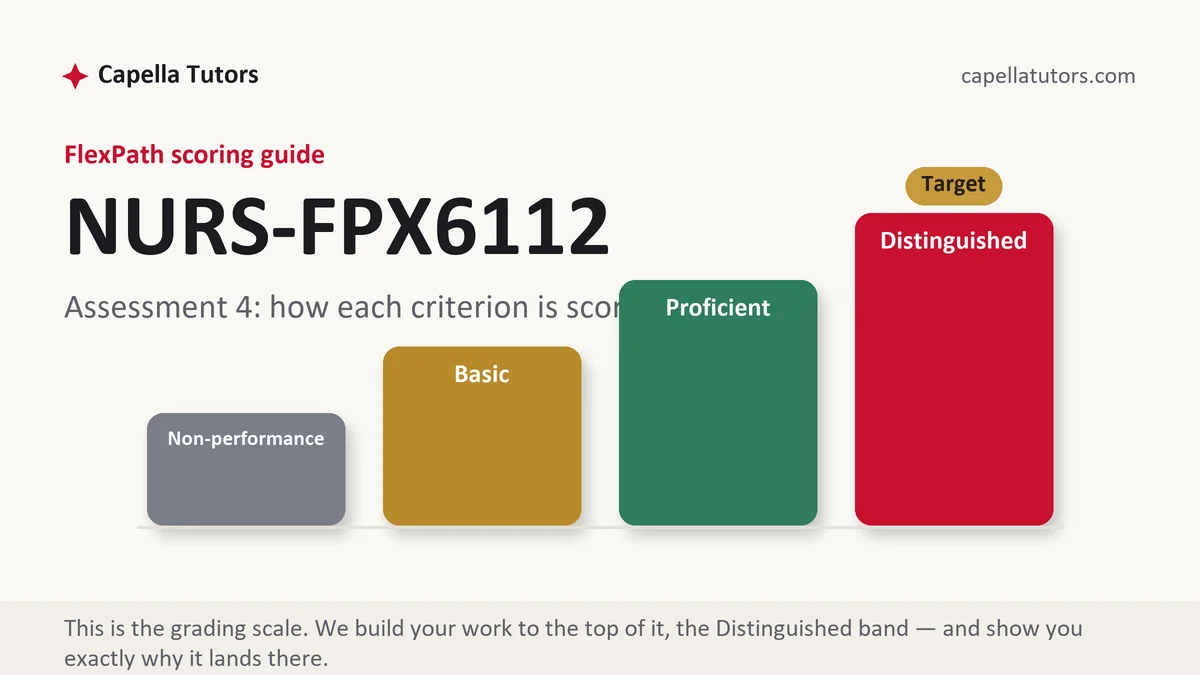
How NURS-FPX6112 Assessment 4 is scored
Each criterion resolves to one of four levels, and the level wording is the specification for the plan:
| Level | What it means on an implementation plan |
|---|---|
| Distinguished | The plan is dated, named, and costed, faculty development precedes learner contact, accessibility work is scheduled rather than promised, the failure contingency is written, and the evaluation measures learning against a threshold with a retention point. |
| Proficient | A complete and realistic plan with training, support, and evaluation all present. It assumes adoption rather than planning for the people who will resist it, which is the top column's move. |
| Basic | A rollout described in phases with no dates, no owners, no budget, and evaluation reduced to a satisfaction survey. |
| Non-performance | A required element is absent, most often accessibility or the evaluation of learning, and an absent element scores below a weak one. |
Adoption is the risk this plan exists to manage. Rogers's account of how innovations diffuse gives you the vocabulary the criteria reward, because it lets you plan for the early adopters who will pilot the product and the late majority who will need a colleague's demonstration before they touch it. A plan that treats faculty as a single group with one training session is the plan that gets a product used as an expensive slide projector.
The NURS-FPX6112 Assessment 4 method, step by step
-
Build the plan around the criteria and put dates on it
Turn each criterion into a section, then convert every intention in it into a dated line with an owner. Implementation criteria are graded on specificity, and a phase labeled preparation with no month and no name attached is the definition of Basic on this assessment.
-
Restate the learning problem the product is meant to solve
Open with the objective and the number: the proportion of learners failing a competency check, the errors a remediation pathway has not reduced, the escalation delay measured in a scenario. The plan's whole justification is that number, and the evaluation section at the end has to come back to it.
-
Sequence faculty development before learner contact
Name who trains, on what, for how long, and how competence is confirmed. Then plan the second wave: a peer champion per course, a short refresher before each term, and a written quick reference. Say what happens to a faculty member who does not attend, because that answer is the difference between a plan and a hope.
-
Write the support and failure paths by role
Who a learner contacts at 0300, who a faculty member contacts mid session, and what the session does when the platform is down or the equipment fails. Name the roles rather than the department. For simulation, put prebriefing and structured debriefing in the plan explicitly, and reference the healthcare simulation standards where you specify them, since a scenario without a debrief is an anecdote with a manikin in it.
-
Schedule accessibility as work, not as a promise
Give accessibility a line in the timeline with an owner and a completion date: caption every narrated segment, add text labels wherever color carries meaning, confirm keyboard operation and focus visibility, check contrast against the published ratio, and request the vendor's conformance report before signature. Then add the equity layer, bandwidth at home, shared devices, and whether a night shift nurse can finish the module in one sitting.
-
Budget it, then evaluate learning against a threshold
Total cost of ownership rather than sticker price: licensing, hardware, faculty development hours, technician time, and the annual renewal. Then the evaluation: a knowledge or performance measure tied to the opening number, a threshold, a retention point some weeks later, and the committee that receives the result. Satisfaction data may appear as secondary evidence, labeled as reaction and nothing more.
A structure that maps to the criteria
Planning figures our tutors use for an implementation plan of this shape rather than Capella rules; your scoring guide sets the real weighting.
| Section | What it must do | Guide |
|---|---|---|
| Learning problem and product | The objective, the measured gap, and the technology being implemented to close it. | ~200 words |
| Stakeholders and adoption strategy | Who is affected, who champions it, and how resistance is planned for rather than assumed away. | ~250 words |
| Timeline with owners | Dated phases from procurement to first learner contact, each line owned by a named role. | ~250 words |
| Faculty development and learner orientation | What training happens, how competence is confirmed, and what refreshers follow. | ~250 words |
| Support, failure, and simulation practice | Support paths by role, the contingency when it breaks, and prebriefing and debriefing where relevant. | ~250 words |
| Accessibility, equity, and budget | Scheduled accessibility work with an owner, equity assumptions, and total cost of ownership. | ~250 words |
| Evaluation and references | Learning measure, threshold, retention point, reporting body, plus current APA references. | ~200 words |
Annotated sample excerpt
An original model from our team, written to the level of specificity an implementation criterion expects. Match that specificity in your own plan.
The product is a virtual medication administration platform bought to support the dosage calculation remediation pathway that failed to lift second attempt pass rates above 71 percent last year, and it goes live with the January cohort.1 Faculty development runs before any learner touches it: two 90 minute build sessions in October for the four course leads, a recorded walkthrough for the eleven adjuncts who teach the lab sections, and a competence check in which each instructor builds and scores one practice case, signed off by the simulation coordinator by 15 November.2 Adoption is planned in two waves rather than one, because the two course leads who piloted the product in spring become the peer contacts for the adjunct group, and the plan assumes that at least three instructors will not attend the recorded session and schedules a repeat clinic in the first week of January for them.3
- 1Ties the product back to the measured failure it is meant to fix and states the go live date, so every later line in the plan has something to be scheduled against.
- 2Puts faculty development ahead of learner contact with dates, durations, a competence check, and a named signer. Specificity of this kind is what the implementation criterion pays for.
- 3Plans for non adoption explicitly, using peer champions and a repeat session. Anticipating the people who will not comply is the move most implementation plans never make.
The full premium sample for your exact assessment, written fresh to your scoring guide and issue, is free to request. Study it, revise it into your own voice, and submit work you understand.
The five mistakes that cost Distinguished
- Phases without dates or owners. A timeline that says preparation, implementation, and evaluation cannot be graded as a plan.
- Training as one session. A single all faculty inservice ignores everything known about how innovations spread and guarantees shallow use.
- No failure path. Equipment dies and platforms drop, and a session with no contingency stops teaching the moment it does.
- Accessibility promised, not scheduled. Without an owner and a date it is a sentence rather than work, and the criterion is often graded on the difference.
- Reaction data as the evaluation. Measuring whether faculty and learners liked the product leaves the learning criterion unanswered.
Pre-submission checklist
- Opening number stating the measured learning problem the product must fix
- Dated timeline with a named role owning every line
- Faculty development scheduled before learner contact, with a competence check
- Support and failure paths written by role, with prebriefing and debriefing where simulation is involved
- Accessibility work scheduled with an owner and a date, plus stated equity assumptions
- Total cost of ownership calculated, and a learning measure with threshold and retention point
Implementation plan with no timeline yet?
Send the scoring guide, the product, and the number it is supposed to move. We build the dated timeline, the faculty development sequence, the support and failure paths, the scheduled accessibility work, and the evaluation with a threshold. Back in 24 to 48 hours, revised until the criteria clear, and your first premium sample is free.