In Capella's RN-to-BSN sequence, NURS-FPX4045, nursing Informatics, carries 3 pts / 6 qcr and runs in both FlexPath and GuidedPath. Students search it as NURS4045 and NURS-FPX4045 interchangeably; either way, this is its help page.
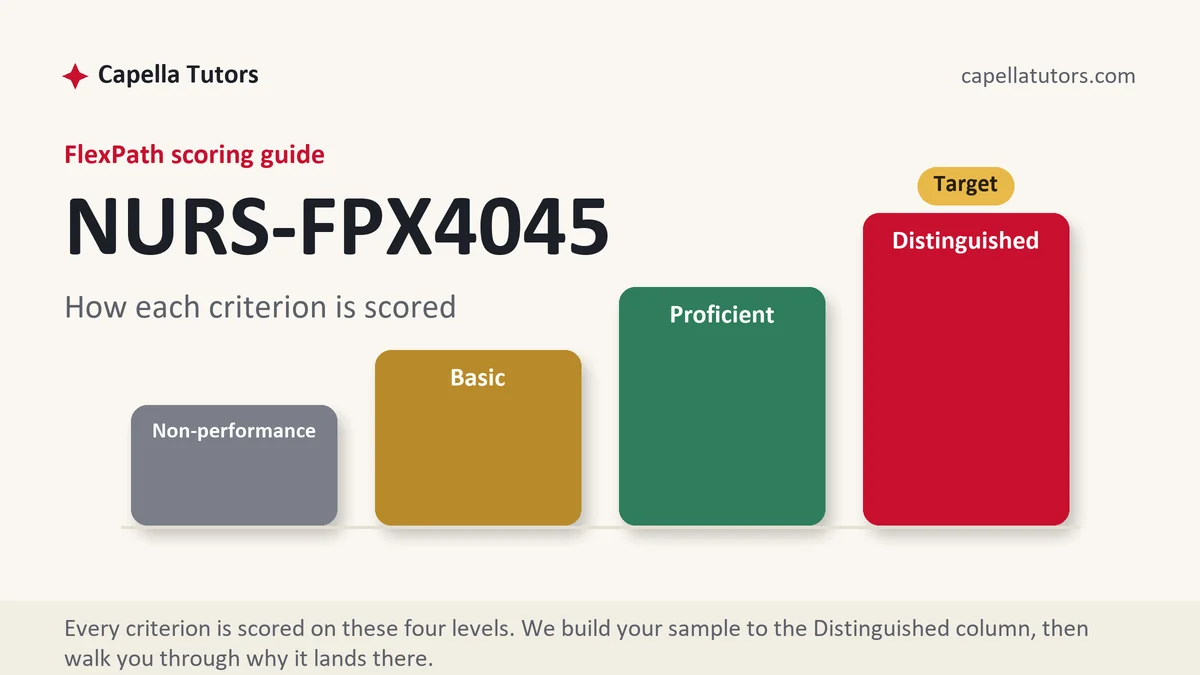
What NURS-FPX4045 actually grades
Informatics assessments sit at the awkward intersection of clinical practice and systems language: workflow analyses, technology evaluations, and data-privacy writing about the EHR you use every shift. The criteria reward treating technology as a patient-care instrument, impacts on outcomes, safety, and workflow, rather than an IT inventory, and they consistently ask for the regulatory layer to be named accurately.
How we help in this course
Our drafts translate shift-floor experience into informatics register: the workflow mapped step by step, the system evaluated against outcomes it should move, the privacy rules cited precisely instead of vaguely. If acronym-dense writing is where your grades dip, this is the course where a model changes everything.
Orders here get the standard machinery: your scoring guide decoded by the research analyst, a subject-matched writer, scoring-guide QA then APA and originality QA, delivery inside 24 to 48 hours, and the revise-until-target guarantee.
Assessment manuals for this course
Every assessment in NURS-FPX4045 has its own manual now: the walkthrough, the structure that maps to the criteria, an annotated sample excerpt, and the done-for-you door. Open Assessment 1, Assessment 2, Assessment 3, Assessment 4, or start from the list in the sidebar.
In NURS-FPX4045 right now?
Send the assessment number and the scoring guide from your courseroom. First premium sample free, back in 24 to 48 hours.
The criteria behind informatics assessments, decoded
What the 4045 scoring guides reward is a stance: technology treated as a patient-care instrument whose impacts on outcomes, safety, and workflow can be argued, with the regulatory layer named accurately rather than gestured at. The columns punish two habits in particular, inventory-style descriptions of systems, which read as Basic, and skipped privacy criteria, which score Non-performance outright. Drafts from this desk map the workflow step by step, evaluate the system against outcomes it should move, and cite the privacy rules precisely, because that is the exact shape of the Distinguished descriptions.
Both pathways, one set of drafts
The course runs in FlexPath and GuidedPath alike, and support adapts to the clock you chose. FlexPath students use the 24 to 48 hour turnaround to keep the submit-evaluate-next loop closing inside the billing session; GuidedPath students hand off early in the week so discussions clear before Thursday night Central and written work before Sunday. Same writers, same scoring-guide QA, same free-revision guarantee either way.
Five minutes of your EHR knowledge, well spent
Tell us which system your facility runs and one workflow that frustrates you, and the draft grounds its analysis there. You already hold the material this course grades; the desk's job is arguing it in informatics register, and the free first sample will show you that translation on a real assessment before you commit to anything. The sample also shows the privacy criteria handled correctly, which is where self-written informatics assessments most often surrender a column.
The assessments, one by one
Assessment 1
Informatics role and technology framing for a clinical setting. Read the full Assessment 1 manual.
Assessment 2
Protected health information: privacy and security argued exactly. Read the full Assessment 2 manual.
Assessment 3
Technology evaluated against outcomes, safety, and workflow. Read the full Assessment 3 manual.
Assessment 4
The informatics synthesis that closes the course. Read the full Assessment 4 manual.
How to actually write NURS-FPX4045: where to begin
Start with the scoring guide, not the instructions. Open it in your courseroom and give every criterion its own heading in an empty draft. The instructions supply a scenario; the criteria are the contract. In 4045 the criteria usually cluster around four jobs: describe a technology or an informatics role accurately, analyze what it does to patient care and workflow, handle protected health information correctly, and support all of it with appraised evidence. If a criterion says explain how the technology affects patient safety, that phrase becomes a heading and its section answers it, nothing else.
Then gather material from your own practice, where the informatics assessments in this course keep pointing. They usually ask you to work with a technology you can describe from use: the EHR your facility runs, barcode medication administration, smart pumps, a telehealth platform, a nursing-sensitive quality dashboard. Before drafting, write down the system's name, the workflow it sits inside, one place it helps, and one place it creates friction. That inventory turns every abstract criterion concrete. The evidence work in 4045 often takes an annotated-bibliography shape, current peer-reviewed sources each summarized, appraised, and tied to the technology question, so collect sources knowing you will judge each one, not just quote it.
Name the regulatory layer precisely. Assessments that touch protected health information expect HIPAA treated as a specific rule with specific applications: what counts as PHI, what a social media post can violate, what an interdisciplinary team may share and with whom. Writing that nurses must protect patient privacy is Basic. Citing the rule and applying it to a named behavior on a named unit is Distinguished.
| Section | What goes in it | What Distinguished looks like |
|---|---|---|
| Introduction and the technology | Name the system, the setting, and the nursing care problem it touches. | The stakes are a measurable outcome, medication errors or documentation time, not a claim that technology matters. |
| Technology or role analysis | What the system does and where it sits in the nursing workflow, step by step. | The workflow reads like someone who has used the system on shift, friction points included, not vendor language. |
| Evidence review or annotated bibliography | Four to six current peer-reviewed sources, each summarized and appraised. | Every annotation names the study design, judges its strength, and states what the source adds to the argument. |
| Protected health information | What counts as PHI, the rules that govern it, and the behaviors that put it at risk. | HIPAA cited as a rule and applied to specific staff behaviors, with interdisciplinary sharing boundaries drawn accurately. |
| Impact on outcomes and safety | The technology's effect on quality, safety, and the care team, argued with evidence. | Benefit weighed against a documented drawback, alert fatigue or workarounds, with evidence on both sides. |
Developing the synthesis
The criterion verbs in 4045 are analyze and evaluate, and evaluators apply them literally. Summary in a row is the trap: listing what five studies said about barcode scanning is Basic, weighing them against each other is Distinguished. The reliable move is to pair sources that disagree. One study credits barcode medication administration with a sharp drop in administration errors; another documents nurses scanning badge copies taped to the med room wall and the error rate creeping back. Put both in the same paragraph, then adjudicate: which design is stronger, a multi-site review or a single-unit observational study, and which setting looks more like yours. Tie the verdict back to the criterion, then name what the evidence cannot settle, whether the gains survive the novelty period, what implementation costs a small facility; the Distinguished column rewards exactly that named limitation.
Citations that survive faculty review
4045 grades evidence as its own criterion, so treat citation mechanics as content. The working rules: peer-reviewed sources from roughly the last five years, every claim of fact carrying an author-date citation, every citation matched in the reference list and nothing there uncited. Put the citation inside the sentence doing the analytical work rather than tacking a parenthetical onto a finished thought. Give each source a named job for a named criterion; a source without one is padding. Find them through the Capella library, CINAHL, and PubMed, and for the standards layer use HIMSS resources and ONC material on healthit.gov, cited as reports in APA 7 form. Government and standards sources carry the regulatory sections; the analysis criteria still want a peer-reviewed spine.
The mistakes that land Basic instead of Distinguished
- Writing an IT inventory instead of a care argument, features listed with no patient outcome attached.
- Handling the PHI criterion with one vague sentence about privacy; it is usually its own criterion and it scores alone.
- Annotations that summarize without appraising, no design named, no strength judged.
- Citation and reference lists that do not match, the most common revision trigger in evidence-graded courses.
NURS-FPX4045 questions students actually ask
Which technology should I choose for my 4045 assessments?
The one you can describe from use, almost always your facility's EHR or a system bolted to it: barcode scanning, smart pumps, a telehealth platform. The criteria reward workflow detail and honest friction points, and you cannot fake either about a system you have never touched.
How many sources do I need, and how recent?
Plan on four to six peer-reviewed sources published within the last five years, then add standards or government material, ONC, HIMSS, HHS guidance, for the regulatory sections. Treat any stated minimum in your scoring guide as a floor. Currency matters more in informatics than anywhere else, because five-year-old adoption data describes systems that have since been replaced.
What is the annotated bibliography actually asking for?
Three moves per source: what the study did, how strong its design is, and what it contributes to your technology question. A paragraph that restates the abstract is Basic coverage. Appraise the design by name, systematic review, cohort, single-site pilot, and end each annotation by stating the work that source does in your argument. Four sources handled that way outscore eight summarized ones.