Patient-Centered Care Coordination runs as NURS-FPX4065 at Capella, 3 pts / 6 qcr, available in both FlexPath and GuidedPath in the RN-to-BSN path. Whether your courseroom shows NURS4065 or NURS-FPX4065, it is the same course and the same support applies.
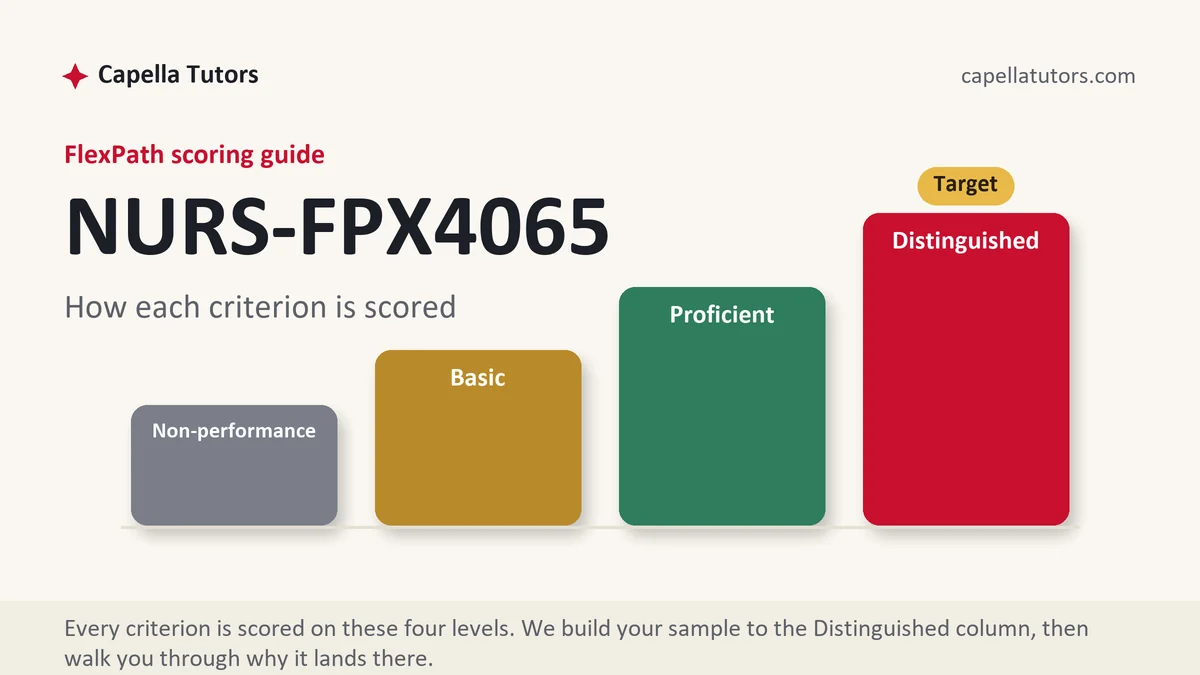
What NURS-FPX4065 actually grades
Care coordination writing asks you to choreograph a patient's journey across settings and disciplines: coordination plans, transition analyses, and ethics-inflected case work. The criteria reward showing the seams, where handoffs fail, where payers and providers pull differently, and how a coordinating nurse manages them, with the patient's voice kept structurally central rather than mentioned once.
How we help in this course
Our 4065 drafts are built as journey documents: each transition mapped with its risk and its owner, community resources named like someone who has actually made the referral calls, and the ethical dimension argued rather than gestured at. Clients repeatedly tell us the sample taught them what the course was actually about.
The service terms are the same ones the whole site runs on: 24 to 48 hour delivery per deliverable, Distinguished or A targets matched to your format, two independent QA passes before anything reaches you, and free revisions until the target is met.
Assessment manuals for this course
Every assessment in NURS-FPX4065 has its own manual now: the walkthrough, the structure that maps to the criteria, an annotated sample excerpt, and the done-for-you door. Open Assessment 1, Assessment 2, Assessment 3, Assessment 4, or start from the list in the sidebar.
In NURS-FPX4065 right now?
Send the assessment number and the scoring guide from your courseroom. First premium sample free, back in 24 to 48 hours.
Grading the seams: what the coordination criteria examine
Care-coordination scoring guides read for structural honesty about where journeys break: handoffs that fail, payers and providers pulling in different directions, and the coordinating nurse's management of both, with the patient's voice kept central throughout rather than mentioned once and abandoned. Meeting Proficient means mapping the journey completely; reaching Distinguished means adding the named extras, usually the ethical dimension argued or a transition's risk weighed. Our drafts are organized as journey documents for exactly this reason, each transition carrying its risk and its owner.
A two-question check before you order
Will the draft name real community resources?
Yes, written like someone who has made the referral calls, because resource specificity is one of the criteria evaluators apply most literally in this course.
What if my evaluation asks for revisions?
Feedback folds into a free revision pass until the target column is met; send the evaluator's comments as they arrive and the turnaround holds at desk speed. Most rounds clear within a day.
The hand-off that starts it
Assessment number, scoring guide, and any case scenario the courseroom supplies: that is a complete scope request, answered same day with the criterion breakdown and a 24 to 48 hour delivery window. Clients repeatedly tell us the first sample taught them what the course was about; it is free, so let it do that for you before a single dollar moves. Coordination writing rewards the desk's map-everything habit more than any other assessment type in the program.
The assessments, one by one
Assessment 1
The preliminary coordination plan for a real patient scenario. Read the full Assessment 1 manual.
Assessment 2
Ethical and policy factors argued into the coordination work. Read the full Assessment 2 manual.
Assessment 3
The coordination case presented to colleagues. Read the full Assessment 3 manual.
Assessment 4
The final coordination plan that closes the course. Read the full Assessment 4 manual.
How to actually write NURS-FPX4065: where to begin
Start with the scoring guide, not the instructions. Build the outline straight from the criteria, one heading each with its Distinguished description beneath it, and outline from that skeleton. The assessments in this course usually build in layers: an initial care coordination plan for a patient or condition, a fuller plan deepened with evidence, and somewhere in the sequence an ethical and policy analysis delivered to colleagues, often as a presentation with speaker notes. Whatever the deliverable, the criteria read for the same thing: a patient journey mapped across settings with the seams shown, not smoothed over.
Gather your raw material from practice before drafting. Pick a patient journey you have actually watched, heart failure discharge, stroke rehabilitation, and build a composite: the condition, the settings crossed, the handoffs, the community services involved. List the community resources you know by name, the home health agency, the transportation program, because a plan that says refer to community resources without naming any reads as Basic on the spot.
Keep the patient's voice structurally central. Mentioning patient-centered care in the introduction and never again is the most common shape of a Basic score in this course. Distinguished work shows the patient's preferences shaping actual decisions: the discharge timed to the daughter's work schedule, the teach-back done in the patient's first language.
| Section | What goes in it | What Distinguished looks like |
|---|---|---|
| Patient scenario and priorities | The condition, the settings the patient will cross, and the care priorities in order. | A composite patient specific enough to have preferences, with priorities justified by evidence rather than habit. |
| The coordination plan | Each transition mapped: who hands off, to whom, what travels with the patient, what can fail. | Every transition carries a named risk and a named owner, and the patient's goals shape the sequence. |
| Community resources | The services the plan relies on after discharge. | Real, findable resources with eligibility noted, written like someone who has made the referral call. |
| Ethical analysis | The ethical questions coordination raises: autonomy, equity, consent across settings. | Argued through named provisions of the nursing code of ethics, applied to decisions in this plan, not recited. |
| Policy analysis | The policies that shape what the plan can do: HIPAA, the Affordable Care Act, state nurse practice acts. | Specific provisions tied to specific plan decisions, including where policy constrains the ideal plan. |
Developing the synthesis
Coordination evidence disagrees with itself constantly, and that disagreement is your material. One trial shows nurse-led transitional care cutting thirty-day readmissions by a third; a later study shows the effect fading once the structured follow-up calls stop. Reporting both findings in sequence is Basic; putting them in one paragraph and adjudicating is Distinguished. Weigh design first, a randomized trial against a retrospective chart review, then durability, which study followed patients longer, and say which claim your plan should trust. Tie the verdict to the criterion it serves: the sentence naming your chosen strategy should also name the study that earned it the spot. Then name what the evidence cannot settle. Transitional care research rarely isolates which component does the work, and naming which one your plan bets on is the limitation move the top column rewards.
Citations that survive faculty review
The evidence criteria in 4065 expect peer-reviewed sources from roughly the last five years, hunted down through the Capella library's CINAHL and PubMed, and they expect each source doing named work for a named criterion: this trial supports the transition strategy, this study grounds the ethical tension. Two source types outside the journals matter here. The nursing code of ethics should be cited as its own document, by provision, whenever the ethical analysis leans on it. Policy sources, CMS pages, the text of the Affordable Care Act's relevant sections, state nurse practice acts, are cited as reports or legal references in APA 7 form. Integrate author-date citations into the sentences doing the arguing instead of appending them to finished thoughts. If the deliverable is a presentation, the citations live in the speaker notes, with a reference slide held to the same matching standard as any paper.
The mistakes that land Basic instead of Distinguished
- A generic plan that would fit any patient anywhere; the criteria reward specificity at every transition.
- The patient's voice mentioned in the introduction and never allowed to shape a single decision.
- Ethics gestured at with the word autonomy instead of argued through named code provisions.
- Slides submitted with thin speaker notes; the notes carry the grade, the slides only headline it.
- Policy sections that name laws without connecting any of them to a decision in the plan.
NURS-FPX4065 questions students actually ask
Do I need a real patient for the coordination plan?
No, and you should not use one. Build a composite from patients you have cared for: a realistic condition, a believable set of settings and handoffs, preferences specific enough to shape decisions. De-identify completely, no real names, dates, or facility details. A composite drawn from real practice gives you all the specificity the guide rewards with none of the privacy exposure.
What actually belongs in the ethical and policy section?
Application, not recitation. Take two or three provisions of the nursing code of ethics and show them working on decisions inside your plan: what autonomy requires when the patient refuses home health, what equity demands when the best rehab facility is out of network. Then do the same with policy: how HIPAA governs what the coordinating nurse may share at each handoff, how coverage rules constrain the plan you would otherwise write. Naming a law is Basic; showing where it bends your plan is Distinguished.
How do I handle the presentation-to-colleagues format?
Write the speaker notes first, as full prose paragraphs that satisfy the criteria on their own, then build slides that headline them. Evaluators read the notes; a beautiful deck with thin notes scores like a thin paper. Address colleagues directly, nurses who coordinate care, keep the citations in the notes, and hold the reference slide to the same APA standard as any paper.