Send the prompt and the scoring guide and a premium original sample returns inside 24 to 48 hours with the planning artifacts actually built, a charter with authority in it, a deliverable-based work breakdown, a network with the critical path identified, and a risk register whose entries have owners, plus free revisions until every criterion clears. Course identity: PM-FPX5018, Project Management Foundations, worth 2 program points, and one of the six electives from which Capella's FlexPath Master of Health Administration requires two, which is why a project management code turns up in a health administration transcript. The degree runs to at least 24 program points across twelve courses, 20 core and 4 elective, with no practicum attached. PM5018 searches arrive here too.
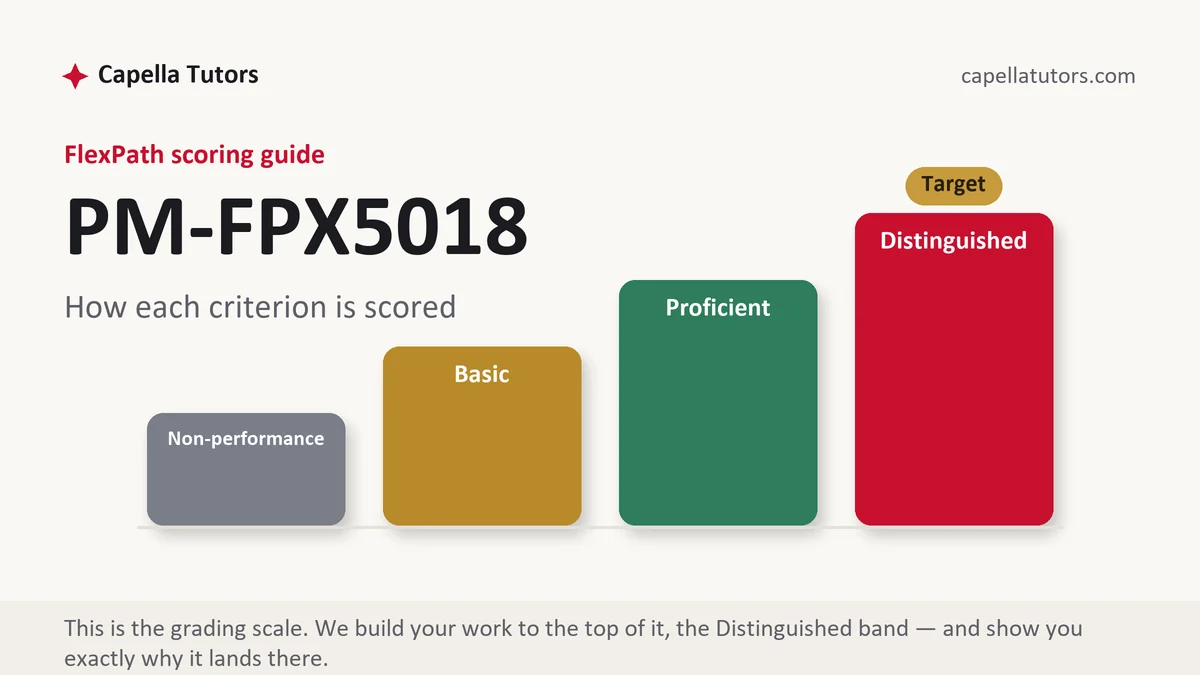
What PM-FPX5018 actually grades
The first thing graded is whether you know what a project is and can keep it separate from ordinary operations. A project is temporary, it produces a defined result, and it ends, which means running a clinic is not a project while opening one is. Expect criteria on the charter, and on whether yours contains authority rather than aspiration: a named sponsor, a stated business reason, objectives written so completion is checkable, success criteria, boundaries, funding limits, assumptions, constraints, and a line saying what is deliberately out of scope. Scope discipline is the single most graded habit in the course, because uncontrolled scope is how projects fail while everybody involved is working hard.
The second strand is planning arithmetic, and it rewards precision more than any other part of the course. The work breakdown decomposes deliverables rather than activities, and it stops where a package can be estimated and assigned to one owner. Estimating has to distinguish effort from duration, which is where health care projects come apart, since a nurse informaticist promised at fifty percent is rarely available at fifty percent. Schedules need real dependencies, and once dependencies exist the network gives you a longest path and everything else gets float.
The third strand is control and closure. Change runs through a documented process with an authority threshold, so a request becomes either an approved baseline revision or a declined item with a reason on file. Risk appears as a register whose entries carry a probability, an impact, a response type and an owner rather than as a paragraph of concerns, and progress is reported against the baseline in numbers a sponsor can act on.
How we help in this course
Tell us the project, an urgent care build out, a service line launch, an accreditation readiness effort, a records migration, and the draft comes back with the artifacts constructed rather than described: a charter with a sponsor and a funding limit, a breakdown decomposed to work packages, an activity list with dependencies you can defend, a critical path and float calculated, a cost baseline with contingency reasoning, and a register whose top risks each carry a response and a named owner.
Delivery terms match everything else in the studio. One premium original deliverable per assessment, back inside 24 to 48 hours, written to the top column of your uploaded scoring guide, taken through eight people from research to final proofread, with one reader doing nothing but recomputing every schedule and cost figure. Revisions are uncapped and free of charge, and faculty feedback is worked in without a new invoice until the criteria are satisfied.
How to actually write PM-FPX5018: where to begin
Read the scoring guide and identify which artifact each criterion is really asking you to produce, because this course grades documents rather than essays and a beautifully written paragraph earns nothing where a table was required. The assessments in this course usually ask you to plan a project of your own choosing or one given in a scenario, and your scoring guide decides whether that arrives as a charter, a scope and breakdown package, a schedule and budget, a risk and communication plan, or a presentation to a sponsor.
Then build the schedule from the network rather than from a calendar. Say activity A takes 4 weeks, B takes 9 and C takes 5 and both follow A, D takes 6 and cannot start until B and C are both complete, and E takes 3 and follows D. Path A, B, D, E totals 22 weeks. Path A, C, D, E totals 18. The project cannot finish sooner than 22 weeks, C carries 4 weeks of float, and if your sponsor asks for a faster date, spending money to accelerate C buys nothing at all. Say that in the paper. Naming the critical path, quoting the float on the paths that are not critical, and directing compression only at the path that controls the finish date is exactly what the scheduling criteria are written about.
Then estimate in a way that shows your reasoning. Take an activity a subject expert calls six days at best, ten days most likely and twenty six days at worst. The weighted three point estimate is six plus forty plus twenty six divided by six, which is 12 days, while the plain average of the three is 14, and the difference between those two numbers is worth a sentence. The more useful signal is the spread: a pessimistic case more than four times the optimistic one means nobody understands that activity yet, so it needs a risk entry, an owner and an early investigation rather than a padded number quietly buried in the estimate.
Then control the money with earned value, because it is the one technique that answers cost and schedule in the same breath. Say the budget at completion is 480,000 dollars, and at week 12 the plan called for 180,000 of work to be complete, the value of the work actually completed is 153,000, and 198,000 has been spent. Cost variance is 45,000 dollars unfavorable and schedule variance is 27,000 unfavorable, which sounds like two separate problems and is really one story. The cost performance index is 0.77, so you are receiving 77 cents of work per dollar spent, and the schedule performance index is 0.85. Project the finish by dividing the budget by that cost index and the estimate at completion is about 621,000 dollars, an overrun near 141,000 on current performance. A paper that produces that forecast, then names which of the two indices it intends to attack first and why, is doing graduate work.
Then write the risk register and the closure section, since these two carry the most marks per word in the whole course. Each risk gets a cause and effect statement rather than a label, a probability, an impact in dollars or weeks, a response chosen from avoid, mitigate, transfer or accept, a trigger that says when the response fires, and a single named owner. Then close the project properly: formal acceptance by the sponsor against the success criteria in the charter, handover to the operating department with a named date, release of contracts and staff, and lessons written as specific instructions rather than as reflections. Add the failure mode you consider most likely, and the sentence explaining what you would have planned differently, because a plan that anticipates its own weak point is what the top column describes.
| Section | What goes in it | What Distinguished looks like |
|---|---|---|
| Charter | Sponsor, business reason, objectives, success criteria, boundaries, funding limit, assumptions. | Authority stated explicitly, with an out of scope list and a named approver on a date. |
| Scope and work breakdown | Deliverables decomposed to work packages, with a definition of done for each. | Decomposition by deliverable, stopping where a package can be estimated and assigned to one owner. |
| Schedule | Activities, dependencies, durations, effort against availability, critical path, float. | The longest path identified and the float quoted, with compression aimed only at the critical path. |
| Cost and control | Cost baseline, contingency and its reasoning, the measurement method, the change process. | Variance and index figures computed with a forecast, and a change threshold that names the approver. |
| Risk and stakeholders | Cause and effect risk statements, probability, impact, response, trigger, owner, engagement plan. | Risks ranked by exposure with a response and one accountable person for each of the top items. |
| Communications, closure and references | Reports by audience and cadence, acceptance, handover, resource release, lessons, current APA both ways. | Acceptance tied back to the charter's success criteria, with lessons written as usable instructions. |
Developing the analysis
Be precise about what the professional literature in this field is. The widely taught bodies of knowledge are consensus practice standards published by professional associations and revised on their own schedule, describing what experienced practitioners agree on rather than what controlled studies established, so cite them by title, publisher and edition and treat them as authority for practice. Be equally careful with the failure statistics that decorate project papers. The famous percentages of projects delivered late or over budget come mostly from practitioner surveys with self selected respondents and definitions of failure that shift between editions, so quote the survey, the year, the sample and the definition, or leave the number out. The academic work is more interesting anyway, on systematic optimism in estimates and on forecasting duration from comparable past projects rather than from the plan in front of you. Use one of those findings to justify a decision in your own plan.
Citations that survive faculty review
Four kinds of source belong in this paper. Professional standards and practice guides are the primary reference for process and terminology, cited with the edition so a reader knows which vocabulary you are using. Peer-reviewed project management and operations journals through the Capella library carry the empirical claims, including the estimating and governance research behind any contrarian position you take. Because this course sits inside a health administration program the sector literature matters: published accounts of clinical system implementations, facility openings and service line launches give you dependency patterns a generic construction example cannot, and they take seriously the constraint that clinical contributors are borrowed from patient care. Your own documents belong in the evidence too, so a real charter, a change control policy or a completed lessons log should be named and dated. Practitioner blogs and certification study sites are not sources.
The mistakes that land Basic instead of Distinguished
- A work breakdown that lists activities in narrative order, so nothing in it is a deliverable anyone can accept.
- A schedule with no dependencies, which makes every activity critical and makes the float criterion unanswerable.
- Durations copied from effort hours, ignoring that the clinical contributors are available a few hours a week.
- A risk register of vague concerns, no probability, no impact, no response type and nobody's name against them.
- Scope changes absorbed without a baseline revision, after which every variance figure in the report is meaningless.
PM-FPX5018 questions students actually ask
What actually belongs in a project charter?
Authority and boundaries, on about two pages. The charter names the sponsor and states what decisions that person can make, gives the project manager authority over named resources, and records the business reason the project exists in terms somebody would defend at a budget meeting. Then the objectives, each written so completion is checkable, the success criteria the sponsor will judge it by, a high level scope statement, and an equally explicit list of what is out of scope, which is the sentence that prevents most arguments in month four. Then the milestone dates, the funding limit, the assumptions the plan rests on, the constraints it cannot move, and the known risks at the point of approval. Approval by a named person on a named date is what turns the document into a mandate.
How do I find the critical path without project software?
List the activities, write down what each one truly cannot start without, add every path from the first activity to the last, and take the longest one. That total is the shortest possible duration for the project, which is the whole point of the exercise, and any activity not on that longest path has float, meaning it can slip by that much without moving the finish date. Be honest about dependencies rather than recording the order you happen to have written the activities in, since a dependency that exists only in your head produces a schedule nobody can compress. Then compress only on the critical path, because shortening a task with four weeks of float buys you nothing and still costs money.
How do I report a project that is behind schedule and over budget?
In numbers, early, with a recovery option attached. Give the sponsor the two variances and the two indices, cost and schedule, then a forecast of the final cost calculated from the performance you have actually achieved rather than from the hope that the rest will go perfectly. Then present two or three recovery options with what each one costs and what it gives up, including the option of moving the date, and name the decision you need and the day you need it by. The reporting failure that damages careers is not the overrun, it is the overrun that appears in month seven having been visible in month three, so include the threshold that will trigger the next escalation before it trips.
Charter, schedule or risk register due?
Send us the scenario and the criteria. First premium sample free, back in 24 to 48 hours with the critical path and the numbers computed.