In Capella's MBA sequence, MBA-FPX5014, core Applied Managerial Finance, carries 2 pts / 4 qcr and runs in FlexPath. Students search it as MBA5014 and MBA-FPX5014 interchangeably; either way, this is its help page.
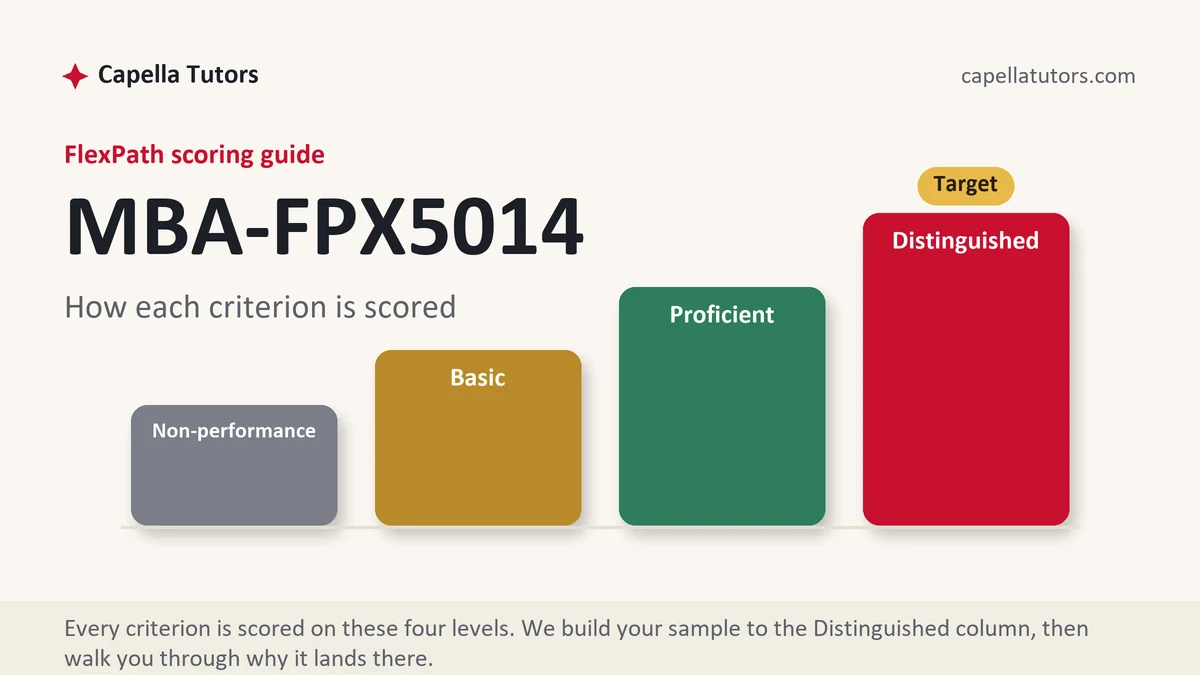
What MBA-FPX5014 actually grades
The finance core: time value, valuation, capital budgeting, and risk, applied to case decisions and written up for executives. Criteria reward the recommendation the analysis licenses, fund it, price it, walk away, with assumptions surfaced honestly. It is the course where non-finance managers most often order help, and the math must be flawless before the writing matters.
How we help in this course
Numbers first, narrative second: our finance drafts arrive with the model correct, the assumptions listed like a diligence memo, and the recommendation argued in plain executive English. The walkthrough explains each calculation so you can defend the work in your own voice.
Orders here get the standard machinery: your scoring guide decoded by the research analyst, a subject-matched writer, scoring-guide QA then APA and originality QA, delivery inside 24 to 48 hours, and the revise-until-target guarantee.
Assessment manuals for this course
Every assessment in MBA-FPX5014 has its own manual now: the walkthrough, the structure that maps to the criteria, an annotated sample excerpt, and the done-for-you door. Open Assessment 1, Assessment 2, Assessment 3, or start from the list in the sidebar.
In MBA-FPX5014 right now?
Send the assessment number and the scoring guide from your courseroom. First premium sample free, back in 24 to 48 hours.
The math must be flawless before the words matter
Finance assessments run a two-gate grading reality: a wrong model caps the grade no matter how elegant the memo, and a right model still scores Basic if the write-up cannot say what the numbers license. Our 5014 drafts clear both gates in order, valuation and capital-budgeting work verified first, then the executive narrative the criteria actually weigh, assumptions surfaced like a diligence memo and the recommendation argued in plain English: fund it, price it, or walk away. The Distinguished columns in this course almost always ask for exactly that commitment.
Defending the work in your own voice afterward
Because finance is where non-finance managers most often order help, the walkthrough carries extra duty here: each calculation explained step by step, so the reasoning is yours to defend in any follow-up. Clients tell us the walkthroughs read like the course's missing tutorial, which is the intended effect. Explained models compound as well: each one makes the next assessment's numbers less foreign, shortening every later week.
What materials does a finance scope need?
The assessment number, scoring guide, and case exhibits or dataset. The reply confirms the modeling scope and quotes the standard 24 to 48 hour delivery. Data-heavy weeks hold the same window; only the scope conversation gets longer.
Where does this course sit in the core?
It is one of the 2-point FlexPath core courses, graded on the same four-column ladder as the rest, and the free-revision guarantee runs until the Distinguished target is met.
The assessments, one by one
Assessment 1
The financial analysis with assumptions surfaced like a diligence memo. Read the full Assessment 1 manual.
Assessment 2
The capital or investment decision argued from the numbers. Read the full Assessment 2 manual.
Assessment 3
The finance synthesis that closes the course. Read the full Assessment 3 manual.
How to actually write MBA-FPX5014: where to begin
Begin with the scoring guide, not the case. Copy every criterion into a document as a heading with its Distinguished description underneath; that skeleton is the deliverable, and the case narrative only supplies the inputs. A typical 5014 assessment hands you a company or a case decision and asks for the finance: time value of money applied, an investment or project valued, capital budgeting run, risk weighed, all written up for an executive reader who wants the answer first and the proof behind it.
Then build the model before writing any prose. Pull the numbers from the case exhibits or the financial statements into a spreadsheet, compute what the criteria require, NPV, IRR, payback, a cost of capital, whatever your guide names, and check the arithmetic twice, because in this course a wrong model caps the grade no matter how well the memo reads. List every assumption as you make it: the discount rate and where it came from, the growth rate, the horizon, the tax treatment. That list becomes a section of the paper, and it is the section that separates finance writing from arithmetic homework.
Only then write, and write to an executive, not a professor. The recommendation goes in the first paragraph: fund it, price it, or walk away, with the single number that drives the call. The rest of the paper exists to let a skeptical reader trace that number.
| Section | What goes in it | What Distinguished looks like |
|---|---|---|
| Executive summary | The recommendation and the number that drives it, stated first. | One paragraph an executive could act on, including the condition that would reverse the call. |
| Financial analysis | The valuation and capital-budgeting work the guide names, with summary tables in the body. | Arithmetic correct and traceable, methods chosen for the decision at hand and the choice explained. |
| Assumptions | Every input listed with its source or justification. | Reads like a diligence memo: rate, growth, horizon, and tax treatment each defended in a sentence. |
| Risk and sensitivity | What could change the answer and by how much. | Sensitivity run on the two or three inputs that matter, with the break-even threshold stated plainly. |
| Recommendation and implications | The decision restated with its consequences for the firm. | Linked to shareholder value and strategy, with the next decision the firm faces if it proceeds. |
Developing the analysis
Basic finance writing reports outputs; Distinguished finance writing argues from them. The project's NPV is $2.4 million is a result, not an analysis. The analysis is the sentence after it: the NPV stays positive until revenue growth falls below 3 percent, growth has run above 6 percent for five years, so the margin of safety is wide and the recommendation is to fund. That is sensitivity argued rather than reported, and it is the move the Distinguished column keeps asking for under different names: implications, limitations, deeper analysis. Apply it everywhere. IRR against the hurdle rate, then what happens if the hurdle is wrong. Payback against the firm's actual liquidity position, not against a rule of thumb. Every number in the paper should be load-bearing for the recommendation, and every section should end by answering its criterion in the criterion's own verbs, because that is how the evaluator confirms it is covered.
Citations that survive faculty review
Finance papers cite two kinds of sources and both get checked. Data sources first: the case exhibits, the company's 10-K and investor materials for a real firm, published market rates for the cost of capital inputs. Cite them where the number appears, because an evaluator who cannot trace an input treats it as invented. Method sources second: current peer-reviewed or authoritative finance references for any technique beyond the course text, integrated into the argument in author-date form rather than listed at paragraph ends. The Capella library's ABI/INFORM database covers the scholarship, and SEC filings are free and citable for company data. Keep sources current, keep every in-text citation matched to the reference list in current APA, and never cite a source the paper does not actually use; padding is visible and it reads as exactly what it is.
The mistakes that land Basic instead of Distinguished
- An arithmetic error that propagates. One wrong cell flows into every later number; verify the model before writing.
- Outputs without interpretation. A table of NPVs with no argument attached is the definition of Basic in this course.
- Hidden assumptions. A discount rate that appears from nowhere invites the evaluator to distrust everything downstream.
- No sensitivity analysis. A single-point answer to an uncertain question ignores the part of finance the top column rewards.
- Writing to the professor. The audience is an executive; hedged academic prose fails the communication criterion the guide almost always carries.
MBA-FPX5014 questions students actually ask
Do the calculations go in the paper or in an appendix?
Both. Summary tables with the key results belong in the body where the argument uses them, and the full working model belongs in an appendix or an attached spreadsheet so the evaluator can trace any number to its inputs. What fails is the middle path: prose that mentions results the reader can nowhere verify.
What discount rate should I use?
The one you can defend. If the case supplies capital-structure data, compute a weighted average cost of capital and show the components. If it does not, build a rate from public inputs, a risk-free rate, a market premium, a beta from comparable firms, and cite each piece. The guide grades the justification, not the specific number; two students with different defensible rates can both score Distinguished.
My numbers do not match other students'. Is that a problem?
Not by itself. Different assumptions produce different outputs, and the scoring guide grades whether your assumptions are stated, sourced, and reasonable, and whether the arithmetic on them is right. It becomes a problem only when the divergence traces to a formula error, which is why the model gets verified before the memo gets written.