Bring us the guide, the organization and whatever you have already gathered, and each stage of the project comes back inside 24 to 48 hours built on one reconciled set of figures, with revisions free until every criterion clears. The course on your record: MHA-FPX5020, Health Administration Capstone, 2 program points, the culminating course of Capella's FlexPath Master of Health Administration and the last of its twelve courses toward at least 24 program points. It is a project and analysis course. The program requires no practicum, no field experience, no internship and no residency, so there are no placement hours to arrange and no preceptor to find. MHA5020 and MHA-FPX5020 both land here.
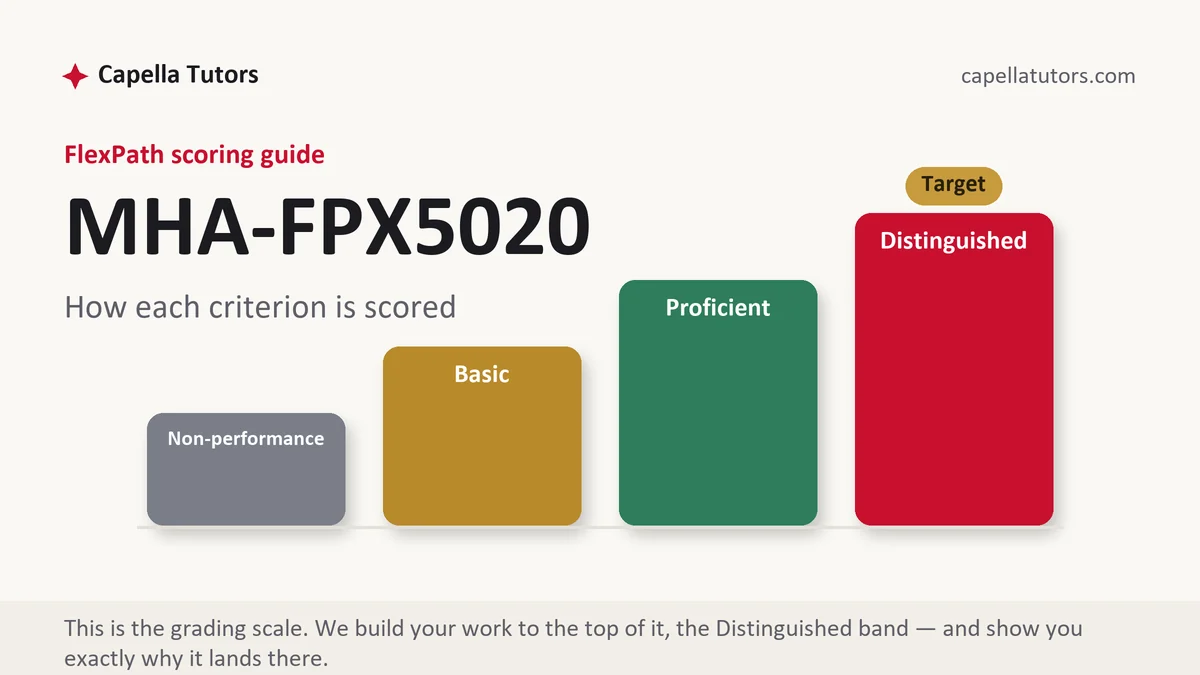
What MHA-FPX5020 actually grades
The capstone grades integration, and integration has a testable meaning rather than a rhetorical one: the money section, the operations section, the quality section and the strategy section have to describe the same organization doing the same thing at the same volume. Most capstone drafts are four competent papers fastened together, and an evaluator finds the seam immediately, because the volume in the forecast is not the volume in the staffing model and neither matches the denominator under the quality measure. Before you draft anything, fix one baseline period, one case volume, one set of rates and one source list, and make every section quote from that single fact base.
The second thing graded is whether the problem is worth an executive's attention. A capstone problem has a magnitude, a boundary and an owner. Improve patient experience is not a problem, it is a mood. A gap of a stated size, in a named population, over a defined period, against a comparison you can defend, is a problem, and the recommendation that answers it needs a number attached, a horizon, an approval path and a stated alternative. The criteria are written to reward a document a real committee could vote on, which is why the capstone punishes vagueness harder than the courses before it.
What the course does not grade is time spent in a placement. Nobody verifies a supervisor, logs hours or signs off on clinical experience, because the program requirements carry no such component. What takes the place of a placement is the burden of doing the analysis properly on an organization with real constraints, and the four lenses you already own do the work: reimbursement and margin from MHA-FPX5006, market position and objectives from MHA-FPX5010, measurement and regulatory exposure from MHA-FPX5014, and the governance question of who is allowed to approve any of it.
How we help in this course
Send the guide, the organization, and every figure and citation you have collected in earlier courses, and the first thing we build is the reconciliation: a single assumptions table holding the volume, the baseline rates, the unit costs, the period and the source or basis for each, which the whole document then draws from. Each stage is drafted against that table, so the finance model, the staffing plan, the measurement plan and the strategic argument cannot drift apart while you write them weeks apart.
The delivery terms are the studio's usual. Each stage as a premium original deliverable inside 24 to 48 hours, written to the Distinguished descriptors in your guide, through an eight person pipeline with a reviewer assigned to nothing except confirming that every number appearing in two sections appears identically in both. Revisions are free and unmetered, faculty comments included, until the criteria clear. Faculty have two business days to evaluate an attempt, which in a staged project is time to advance the next stage rather than time to wait.
How to actually write MHA-FPX5020: where to begin
Turn the scoring guide into the document's skeleton, then decide the project before writing a word of it, because a capstone that changes its subject in the third stage cannot be reconciled afterwards. The assessments in this course usually build the project in stages, each one graded on its own criteria while depending on the stage before it, and your scoring guide decides whether a given stage arrives as a proposal, an analysis, an implementation plan, an executive briefing or a presentation with speaker notes. Read the later criteria before drafting the early ones, since the last stage usually needs a figure the first stage was supposed to have produced.
Then build the case with every stream of benefit separated. Say a medicine service discharges 1,860 patients a year with 14.6 percent readmitted inside thirty days, which is 272 readmissions, and the program targets 12.2 percent, or 227, so 45 readmissions are avoided. Two transition nurses at $104,600 fully loaded plus $18,000 of software cost $227,200 a year. Now be careful, because this is where capstones inflate. Avoiding 45 stays avoids about $2,100 of variable cost each, or $94,500, but only if the bed then stays empty. If the bed is refilled, the saving is instead the contribution of the replacement case, 45 times $1,460, or $65,700. Those two cannot both be counted. Penalty exposure is the third stream: on $46.8 million of base inpatient payments a 0.68 percent adjustment is $318,240, and halving the excess would recover something in the region of $159,000, which is an estimate rather than a formula because the adjustment is computed on excess ratios across measured cohorts. Counting the backfill and the penalty gives $224,700 against $227,200 of cost. Every figure here is constructed to show the method, and the honest verdict is that the program roughly breaks even on money and earns its approval on measured performance, which is a far stronger paper than a fabricated three to one return.
Then run the reconciliation test, which is the single move that separates a capstone from a folder of assignments. Forty five avoided readmissions at an average stay of 4.1 days releases 185 patient days, which is about half a bed across the year. So if your strategy section also claims the program frees capacity for service line growth, it is spending the same 185 days twice, once as a cost saving and once as new volume. Walk every number through the document and check it appears identically wherever it appears: the volume in the pro forma matches the volume in the staffing plan, the baseline rate in the quality section matches the baseline in the financial model, and the period is the same period everywhere.
Then write the measurement and the approval path. The same 45 has to exist as a measure with a numerator, a denominator, a window and an exclusion rule, reported with the count beside the rate, because 227 against 272 is a year's difference and no single month will show it. Name the committee that approves each element, what the board sees rather than approves, and the review cadence. Then test the assumption most likely to be wrong, which is the borrowed effect size. At half the assumed improvement, 1.2 points instead of 2.4, only 22 readmissions are avoided, the counted benefit falls to roughly $111,600, and the program costs the organization about $115,600 a year, or $5,254 for each readmission prevented. That is the number a committee should be asked to approve or refuse, and printing it is what a Distinguished recommendation looks like.
| Section | What goes in it | What Distinguished looks like |
|---|---|---|
| Problem and baseline | The organization, the population, the gap, the baseline period and the comparison. | A gap with a magnitude and a boundary, measured on a period the whole document then reuses. |
| Evidence base | The literature and benchmarks behind the intervention you propose. | Effect sizes read with their designs, discounted for setting, with the discount explained. |
| Financial model | Cost of the program, benefit streams separated, break-even, and the payment consequence. | Streams that cannot coexist kept apart, with the weakest input tested and reported. |
| Operational plan | Staffing, workflow, sequence, dependencies, and who does the work on which shift. | An operating plan whose volumes and hours reconcile with the financial model line for line. |
| Measurement | The measures, their definitions, windows, exclusions, and the reporting cadence. | Measures a reader could recompute, with counts printed beside rates and a stated review cycle. |
| Governance and references | Approval path, risks, the refusal case, monitoring owners, current APA both ways. | Every element approved by a body with authority to approve it, and one assumptions table behind the paper. |
Developing the analysis
The capstone's evidence problem is transfer. Every effect size you borrow was measured somewhere else, in a different payer mix, with different staffing and a different patient population, and the transitional care and readmission literature in particular reports a wide spread of results with several well run trials finding nothing at all. A proposal quoting only the successful arms is doing procurement rather than analysis. Discount the borrowed effect, say by how much and why, and name the local condition that would have to hold for even the discounted figure to appear.
The second hazard is your own selection. The service line you chose is almost certainly the one performing worst, which means part of any improvement will be regression to the mean rather than your intervention, and the fairest treatment is to say so and to plan a comparison that could detect the difference. Close the analysis by stating plainly what the project cannot establish, then say which measure, over what period, would settle it after implementation.
Citations that survive faculty review
A capstone is graded partly on whether a stranger could audit it. Measure specifications and program rules come from the agency that publishes them, cited to the fiscal year or specification version in force, since a payment adjustment or a measure definition from two years ago will quietly misstate your central figure. Market, demographic and utilization figures come from the federal and state datasets that produce them, cited with the vintage year rather than through a news article repeating them.
Peer-reviewed health services, health management and health economics journals through the Capella library carry every effect estimate and every causal claim, with the design named beside the number. The organization's own documents are legitimate and useful, an annual report, a community health needs assessment, a public filing, a board minute, cited by title and year, and an internal report that cannot leave the building is cited to the organization with a line saying it is not retrievable. Label every constructed figure as constructed, keep the assumptions table as the single place any number is defined, and run the reference list both ways before the final submission.
The mistakes that land Basic instead of Distinguished
- Four sections carrying four different volumes, which tells an evaluator the project was assembled rather than integrated.
- Benefit streams double counted, with the same released capacity sold as a cost saving and as room for growth.
- A borrowed effect size applied at full strength, with no discount for setting and no reference to the trials that failed.
- A recommendation with no refusal case, so nobody learns what happens to the organization if the committee says no.
- Text lifted from your own earlier coursework, which is an integrity finding rather than a style problem.
MHA-FPX5020 questions students actually ask
Is the capstone a practicum, and do I need placement hours?
No. The catalog program requirements for this degree list no practicum, no field experience, no internship and no residency, and set no clinical hour count, so there is nothing to arrange with an employer and nobody to sign a log. The culminating experience is the project itself, which is why the criteria fall on analysis and documentation rather than on supervised performance. Two practical consequences follow. Your timeline is under your own control, since no external site has to schedule you, and the whole course fits the FlexPath rhythm of flat twelve week sessions and submit-on-grade. Separately, access to an organization is a research question rather than an enrollment requirement, so if your employer will not release figures you build the project on public data and say so, rather than treating the lack of access as a barrier to finishing.
Can I use my own employer as the capstone organization?
Usually yes, with two disciplines applied. First, permission and confidentiality: ask before you use anything that is not already public, keep patient level detail out of the document entirely, and where a figure is sensitive, either aggregate it until it is not or substitute a published benchmark and label the substitution in the text. Second, distance: writing about the department you work in tempts you into a paper that assumes context a reader does not have, so describe the organization structurally, name the payer environment and the ownership form, and support internal claims with an external source wherever one exists. If permission is refused or slow, build the project on a comparable public system, which is entirely legitimate and often produces a cleaner document because every number in it is citable.
How much of my earlier coursework can I reuse?
Reuse the subject freely and the sentences not at all. Choosing the same organization and the same problem you studied in the finance or planning course is sensible, and it is often why those students finish faster, because the fact base already exists. Copying paragraphs across from a submitted assignment is a different matter and is treated as an integrity issue rather than as efficiency, so if you want to build on your own prior work, ask your faculty first and cite the earlier paper as your own unpublished work if they permit it. What transfers cleanly without any of that difficulty is the raw material: the datasets, the citations, the assumption tables and the figures. Rebuild the prose around the capstone's criteria, which are written for an integrated project and will not be satisfied by text written for a single course anyway.
Capstone stage due?
Send the guide and the organization. First premium sample free, and the assumptions table comes back with it so the later stages reconcile.