Hand us the prompt and the scoring guide for anything this course sets and a premium original sample comes back inside 24 to 48 hours, written in the register a graduate health administration reader expects and revised free until the criteria clear. The identity of the course: MHA-FPX5001, Foundations of Master's Studies in Healthcare Administration, worth 2 program points, a core course in Capella's FlexPath Master of Health Administration, a degree that finishes at a minimum of 24 program points across twelve courses. Typed either way, MHA5001 or MHA-FPX5001, this is the page you were looking for.
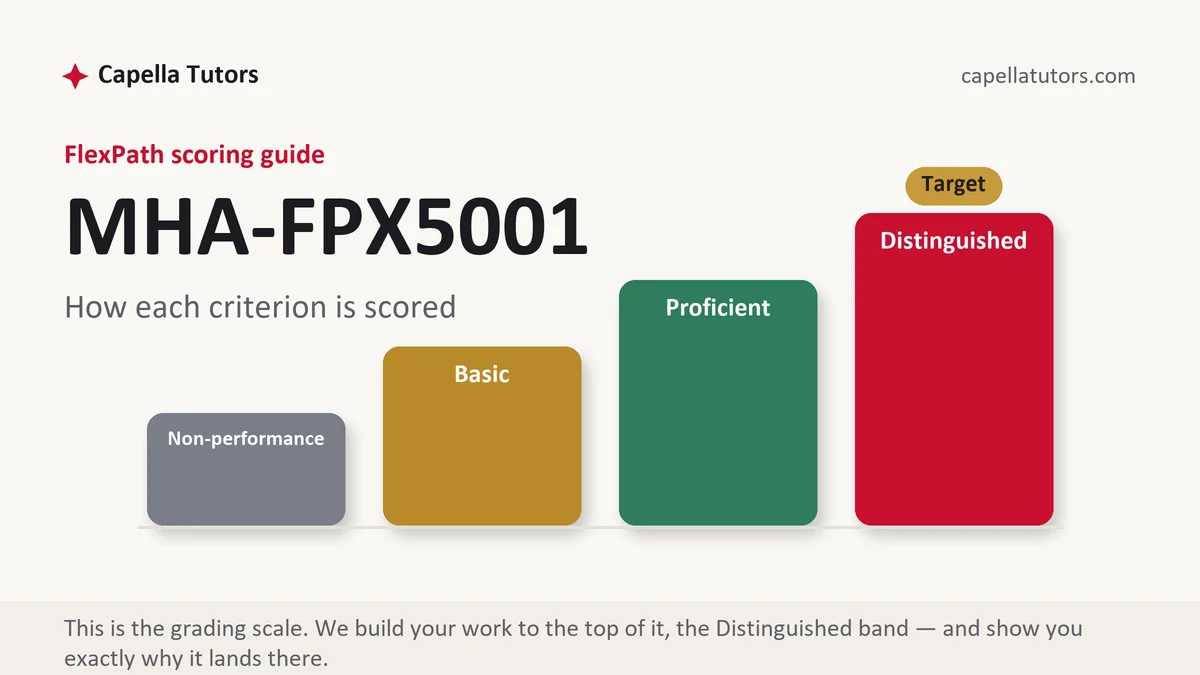
What MHA-FPX5001 actually grades
This is the course that installs the apparatus the rest of the MHA assumes you already own. The criteria are not asking for a reimbursement model or a service line strategy yet. They are asking whether you can locate peer-reviewed evidence through a library rather than a search engine, attach it to a claim, format the result in current APA, and write in the flat declarative register that health system executives read without translating. Administrators who have run a department for a decade lose criteria here for exactly that reason: the judgment is present and the paper still reads like a shift report.
The second graded strand is self-assessment against a published competency framework, and it is scored on precision rather than on modesty. The assessments in this course usually ask you to place yourself inside a competency directory and then plan the distance between where you sit and where the role you want requires you to be. Basic work rates itself in adjectives and sets a goal that reads improve communication skills. Distinguished work names the domain, states a current level and a target level, cites the evidence behind both ratings, and attaches one dated action per gap with a way to tell whether it happened.
The third strand is the health system as an object of study rather than as a workplace. Expect criteria that reward a learner who can already describe how money reaches a provider organization, who stands between the patient and the payment, and why a chief executive's decision has to travel through a medical staff, a board, a regulator and a bond covenant before it becomes real. None of that has to be mastered in 5001, and two of the courses that will demand it, the law and policy course and the economics course numbered NHS-FPX6008, sit in the same core. What is graded now is whether you can write about a health system without collapsing the difference between a clinic, a system and a payer.
How we help in this course
Send the guide, the prompt, and any competency inventory or reflection your faculty asked you to complete, and the sample arrives written to the top column rather than to the instructions. A health administration writer drafts the argument, a researcher pulls sources from the health services and management journals through library grade databases, and an APA editor owns the mechanics layer end to end, which is why formatting criteria rarely cost our clients a level in an intake course. Eight people touch a deliverable before it reaches you, and one of those passes exists only to confirm that every claim carries either a source or a labeled assumption.
Turnaround is 24 to 48 hours from the moment your materials land, and the revision policy has no meter on it: if faculty return the attempt, their comments come back into the same cycle at no charge until the criteria are met. Faculty have two business days to evaluate a submitted attempt, so the practical sequence in FlexPath is to submit early in a week, spend the wait moving your second course forward, and keep the revision window clear.
How to actually write MHA-FPX5001: where to begin
Start with the scoring guide, not the assignment description. Copy each criterion into an empty document as its own heading, paste the Distinguished wording underneath it, and treat everything that follows as an attempt to satisfy those sentences one at a time. Where the prompt and the guide seem to disagree, the guide wins. Your scoring guide also decides the shape of the deliverable, whether that is a paper, a memo, an annotated set of sources or a plan document, so read it before you commit to a structure.
Then do the arithmetic your self-assessment is supposed to rest on, because a rated inventory with no weighting behind it is a list rather than a plan. Score five domains from 1 to 5, set a target for each, and weight the domains by how much the role you are aiming at actually uses them. Say financial and analytical skill sits at 2 against a target of 4 at a weight of 0.30, knowledge of the health care environment at 3 against 4 at 0.25, leadership at 3 against 4 at 0.20, communication and relationship management already at 4 with a weight of 0.15, and professionalism at 4 with a weight of 0.10. The weighted gaps are 0.60, 0.25, 0.20, zero and zero, which totals 1.05, and the finance domain alone accounts for 0.60 of that, or 57 percent. That single fraction is the argument for a development plan that spends its first year on financial fluency instead of spreading effort evenly across five domains, and it is the kind of sentence that turns an inventory into a decision.
The other calculation worth running in your first week is the calendar, because 5001 is where pacing habits get set. FlexPath bills in flat twelve week sessions and caps you at two courses at a time, so 4 of your 24 points are in flight at any moment and the degree is six pairs of courses. Close a pair in six weeks and a session absorbs two pairs, which is 8 points, and three sessions carry the whole 24. Let a pair drift to nine weeks and the same degree needs five sessions and five flat charges instead of three. Cost per point moves with your submission rate rather than with anything printed in the catalog, which is the honest reason to treat this course as practice at finishing rather than practice at polishing. What your enrollment agreement permits in a given session is a question for your enrollment counselor rather than for a tutoring site.
Then fix the register, because it is the criterion most often lost by the most experienced students in the course. Claims carry citations, paragraphs open with a position rather than with a topic, and the passive voice goes, since an administrative document has to say who did what to whom. Contractions and hedges go with it. The first person is allowed exactly where a criterion invites reflection and nowhere else. Build the APA scaffolding before you draft, with heading levels that mirror your criterion outline and a reference list that grows while you read, because reconstructing citations at the end is how mechanics criteria get lost by people whose analysis was fine.
| Section | What goes in it | What Distinguished looks like |
|---|---|---|
| Purpose and framing | Why the document exists, stated in one sentence, with the audience named. | A purpose a reader could act on, scoped to what the deliverable can actually deliver. |
| Competency self-assessment | Domain by domain ratings, with the evidence that produced each rating. | Ratings weighted and defended, with evidence specific enough that a supervisor would recognize it. |
| Evidence and sources | The peer-reviewed and professional literature standing behind each claim. | Sources given jobs, current, library retrieved, and integrated inside the sentences making the claims. |
| Development actions | What you will do, by when, with what resource, and how you will know. | Every action tied to a named gap, with a date, an owner and an observable result. |
| Health system context | Where you work or intend to work, described structurally rather than anecdotally. | The organization placed inside its payment, regulatory and governance environment in a few precise lines. |
| APA mechanics and integrity | Title page, heading levels, in-text citations, reference list, original work. | A two-way citation check that reconciles, headings mirroring the criteria, no uncited paraphrase anywhere. |
Developing the analysis
Analysis in an intake course means putting sources against each other instead of stacking them up. Competency and leadership development research leans heavily on self-report, cross-sectional surveys and single organization samples, which is worth saying out loud when you use it, because a study in which managers rate both their own skill and their own performance cannot separate the two. Attribute frameworks to the body or the author that published them rather than to the textbook that summarized them, since a framework cited from a secondary source is the quickest way to tell an evaluator you have not read it. Close by naming what your evidence cannot establish, which in a self-assessment is almost always the accuracy of the self-rating, then say how supervisor input or a multi-rater instrument would test it.
Citations that survive faculty review
Three families of source do the work in this course. Peer-reviewed health services and health management journals, pulled through the Capella library rather than open search and kept inside roughly a five year window, support any claim about how administrators behave or about what develops competence. Professional bodies supply the frameworks themselves, and those are cited as the documents they are, with the publishing organization as author and the edition year printed on the instrument, because competency directories get revised and a reader needs to know which version you rated yourself against. Sector data sources, the national hospital association survey, employer coverage surveys and federal program data, carry any descriptive figure you use about the industry, cited as reports with the data year rather than the year you downloaded them.
Give every number a visible origin. Where a figure comes from your own workplace and the document cannot leave it, cite the organization and year in text and say in one sentence that the source is not retrievable. Then run the reference list both ways before submitting: every in-text citation present in the list, every list entry cited somewhere in the body.
The mistakes that land Basic instead of Distinguished
- Writing to the prompt instead of to the guide, so the document carries sections nobody is scoring and misses a section for a criterion that is.
- A self-assessment with no weighting, which produces five equal goals and therefore no plan.
- Development actions with no date, no resource and no observable result, which reads as intention rather than as planning.
- Frameworks cited from a textbook chapter rather than from the body that publishes them.
- APA left as a final cleanup pass, which costs the mechanics criterion and makes the analysis harder for an evaluator to follow.
MHA-FPX5001 questions students actually ask
My department has run fine for years. Why did my first submission come back Basic?
Because the criteria grade the document, not the experience standing behind it. Operational writing rewards brevity and shared context, and both habits read as unsupported assertion in a graduate paper. The repair is mechanical rather than intellectual: take each claim you made from experience, find a peer-reviewed source that establishes the general case, and put the citation inside the sentence making the claim. Then convert recommendations from instructions into arguments, since a memo can say do this while a graded analysis has to say do this, because of that, measured this way. Most experienced administrators clear the writing criteria on a second attempt once they stop treating sourcing as decoration.
Which competency framework should the self-assessment use?
Any published one your faculty accepts, chosen for fit and then used consistently through the whole document. Health administration has more than one competency directory in circulation, each revised on its own schedule, and they carve the same territory differently, so the risk is not picking the wrong one, it is switching vocabularies halfway through. Name the instrument and its edition year in the framing, rate every domain the instrument defines rather than the three you find flattering, and cite the publishing body directly. If your employer runs its own leadership model, use it as a second lens and say what it adds, because a document that reconciles a professional framework with the model your organization actually promotes people on is far more useful than either alone.
Can I run MHA-FPX5001 alongside a second course?
The concurrency cap in FlexPath is two courses, so yes, and this is one of the better ones to pair, because the labor here is reading, sourcing and writing rather than modeling. Put it beside a course whose criteria demand a different kind of work and the two rarely collide on the same evening. Sequencing matters more than volume. Submit an attempt here early in the week, and since faculty have two business days to evaluate it, spend that wait advancing the other course rather than refreshing the gradebook. Submit-on-grade means nothing moves while an attempt sits unevaluated, so the students who close sessions quickly are the ones who always have something in the queue.
Starting the MHA this session?
Send the prompt and the scoring guide. The first premium original sample is free, back inside 24 to 48 hours with the sourcing already done.